 NL·0365
Herbarium of the Nature Library
- Name
- Dispholidus typus
- Family
- Colubridae
- Native to
- Sub-Saharan Africa, from West Africa to Ethiopia and south to South Africa; absent from the central rainforest and the driest deserts
- Habitat
- Savanna, Open woodland, Fynbos, Karoo scrub
Boomslang
Dispholidus typus
Also calledBoomslang, 'tree snake' (Afrikaans) · Green tree snake
A slender, huge-eyed tree snake of sub-Saharan Africa. Its fangs sit at the back of the mouth, yet its venom is among the most dangerous of any snake. Bites are rare, but the venom works slowly and can cause fatal internal bleeding a day or more later.
The boomslang is a highly venomous snake in the family Colubridae. The species is native to Sub-Saharan Africa. Wikipedia
What it can do
- iHas excellent eyesight for a snake, with very large eyes that help it hunt chameleons by sight
- iiVenom stops blood from clotting, causing bleeding from gums, wounds and internal organs
- iiiInflates its throat to twice its size when threatened, showing the bright skin between its scales
In the field
Field marks
- aShort, egg-shaped head with enormous eyes, much larger than in most snakes
- bColour very variable: males often bright green, or green with black-edged scales; females usually olive or brown
- cStrongly keeled scales and a slender, whip-like body
- dThroat inflated into a balloon when alarmed
- Not to be confused with
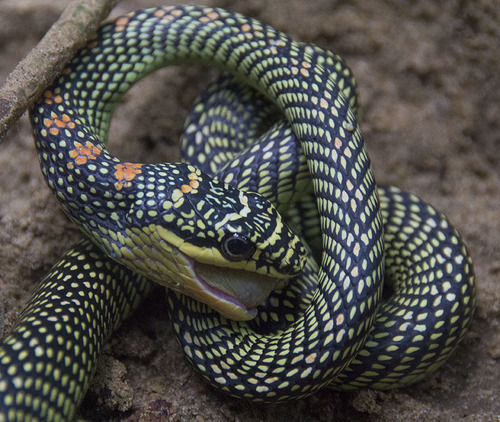
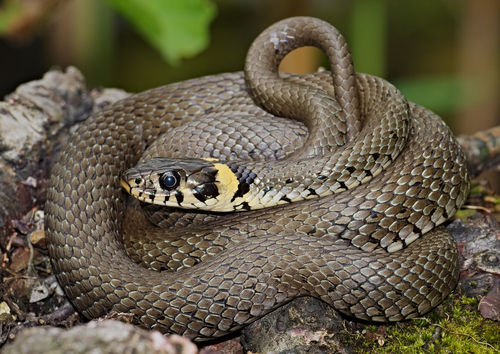
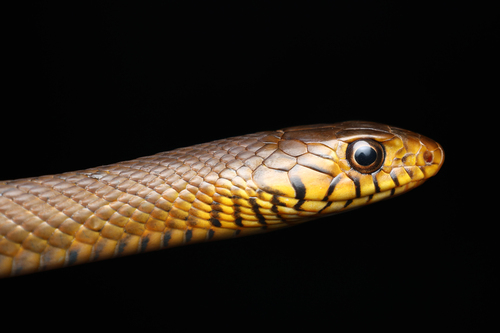
- Harmless green bush snakes (Philothamnus) look very similar but are smaller, with smaller eyes in proportion to the head. They can be hard to tell apart even for experts, so never approach or handle one to check; treat any large-eyed green or brown tree snake as a possible boomslang. Green mambas have a long, narrow head and smaller eyes.
- Where to see it
- Kruger National Park, KwaZulu-Natal, the Eastern and Western Cape, East African savannas; often in thorn trees near weaver nests
- When
- Resident; active by day, especially in warm months
Life & habits
- Diet
- Chameleons and other tree lizards, birds and their eggs and nestlings, frogs
- Habitat
- Trees and shrubs in savanna, woodland, fynbos and Karoo scrub
- Size
- Usually 1–1.6 m; up to ~2 m
Shy; it flees through the branches and bites only when handled or cornered. Because the symptoms can take hours to appear, anyone bitten must go to hospital at once and be observed for at least 24 hours. A specific monovalent boomslang antivenom is made in South Africa. Keep the limb still; never cut or suck the wound.
Where it lives
Recorded sightings
—
geo-referenced records in GBIF, from museums, herbaria and field observers.
Native range
Sub-Saharan Africa, from West Africa to Ethiopia and south to South Africa; absent from the central rainforest and the driest deserts
Drag the globe to turn it. Dots are where records exist, not a range map; darker means more records.
In the stacks
Searching the stacks…
Every page naming Dispholidus typus in the Biodiversity Heritage Library →
Marginalia
In 1957 the American herpetologist Karl P. Schmidt was bitten by a juvenile boomslang he was identifying. Thinking a rear-fanged snake could not kill him, he wrote notes on his symptoms as they progressed and died the next day.
Curiosity
The boomslang has some of the largest eyes relative to head size of any snake.
Kinship



Fact-checked: 1 correction made to this sheet. Photographs: iNaturalist contributors under the licences shown. Records: GBIF.org. Historical plates: Source Library (CC BY-SA 4.0; originals public domain). Summary text: Nature Library editors and Wikipedia (CC BY-SA). Medicinal and edibility notes are historical and educational, not advice. iNaturalist taxon 30358.