 NL·0719
Herbarium of the Nature Library
- Name
- Bubo virginianus
- Family
- Strigidae
- Native to
- Alaska and Canada through the US, Mexico and Central America to South America; in the far south replaced by the Magellanic Horned Owl
- Habitat
- Forest, Desert, Grassland edge, Cities, Swamp
On eBird ↗
Great Horned Owl
Live sightings near you, the range map, bar charts of when it is seen, and Macaulay Library photos and recordings.
Great horned owl
Bubo virginianus
Also calledBúho cornudo (Spanish) · Tecolote (Spanish, from Nahuatl tecolotl) · Ñacurutú (Guaraní / Spanish, South America) · Grand-duc d'Amérique (French)
The tufted, yellow-eyed owl of children's books, found from Arctic tree line to tropical forests. It takes prey up to the size of skunks and geese and nests in the dead of winter.
The great horned owl, also known as the tiger owl or the hoot owl, is a large owl native to the Americas. It is an extremely adaptable bird with a vast range and is the most widely distributed true owl in the Americas. Its diet consists primarily of rabbits and hares, rats and mice, and voles; it remains one of the few regular predators of skunk. Hunting also includes rodents, larger mid-sized mammals, birds, reptiles, amphibians, and invertebrates. Wikipedia
What it can do
- iHunts one of the widest prey ranges of any bird — from insects to skunks, ospreys and other owls
- iiRegularly kills skunks, possibly helped by a weak sense of smell
- iiiSilent flight from serrated, velvety flight feathers
- ivBegins nesting in January or February, often in old hawk or crow nests
In the field
Field marks
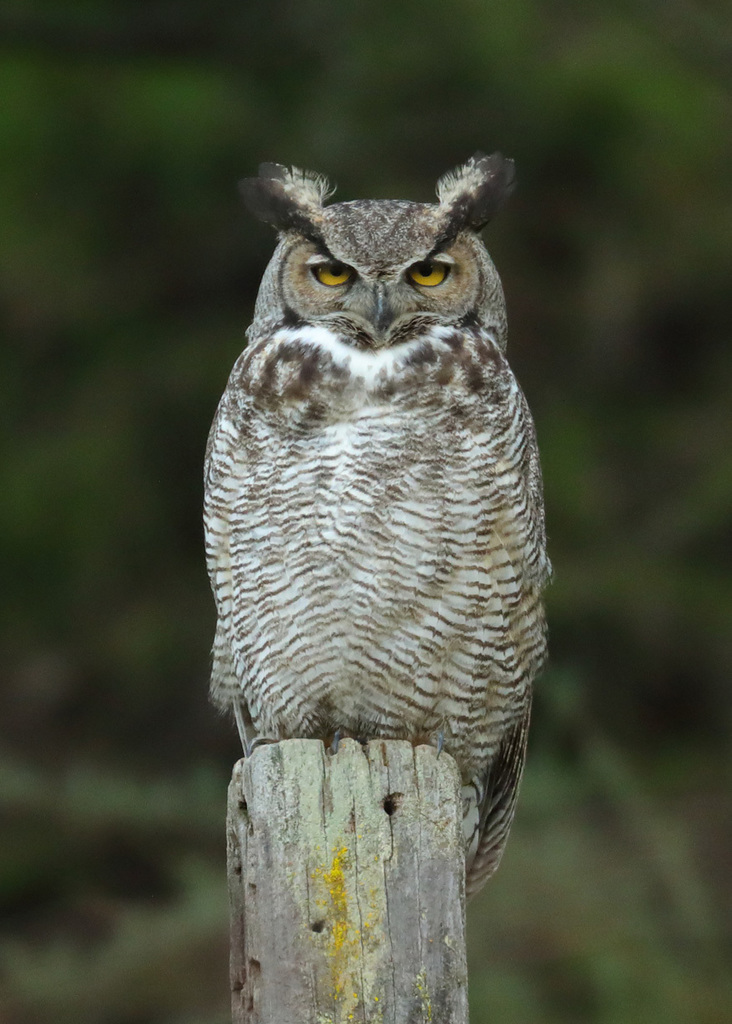
- aLarge, bulky owl with widely spaced ear tufts
- bYellow eyes in a rusty-orange facial disc rimmed with black
- cWhite throat bib
- dFine horizontal barring on the underparts
- Voice
- Deep, soft, stuttering hoots, e.g. 'hoo-h'HOO-hoo-hoo'; juveniles give a rasping hiss-scream.
- Not to be confused with
- Long-eared Owl is slim with close-set tufts and vertical streaks below. Barred Owl has no tufts and dark eyes. Eastern and Western Screech-Owls have tufts but are tiny.
- Where to see it
- Parks, woodlots and deserts throughout the Americas; often seen on winter evenings on nest platforms in cottonwoods or on saguaros.
- When
- Resident year-round
Listen
Looking for field recordings…
Life & habits
- Diet
- Rabbits, rodents, skunks, birds including waterfowl and other raptors, reptiles
- Habitat
- Almost any habitat with trees, cliffs or structures to roost and nest
- Size
- 46–63 cm; wingspan 100–145 cm; 0.9–2.5 kg
- Lifespan
- Banding record about 28 years
Mated pairs duet at dusk in winter, the female's hoots higher than the male's despite her larger size.
Where it lives
Recorded sightings
—
geo-referenced records in GBIF, from museums, herbaria and field observers.
Native range
Alaska and Canada through the US, Mexico and Central America to South America; in the far south replaced by the Magellanic Horned Owl
Drag the globe to turn it. Dots are where records exist, not a range map; darker means more records.
In the old herbals & bestiaries
Woodcuts and engravings matched from the Source Library’s scanned books by name. Plates marked “relative” show a close kin rather than this exact species. Click a plate to read the page it came from, with translation.

François Bouchard — Recueil de cent-trente-trois oiseaux des plus belles especes (1775)
François Bouchard · 1775 · p.115

Jan Jonston — Naeukeurige beschryving van de natuur der viervoetige dieren (1660)
Jan Jonston · 1660 · p.81

Ornithology: The History of Birds
Ulisse Aldrovandi · 1599 · p.542

François Bouchard — Recueil de cent-trente-trois oiseaux des plus belles especes (1775)
François Bouchard · 1775 · p.127

Ornithology: The History of Birds
Ulisse Aldrovandi · 1599 · p.541
In the stacks
Searching the stacks…
Every page naming Bubo virginianus in the Biodiversity Heritage Library →
Marginalia
In much of Mesoamerica the owl (Nahuatl tecolotl) was associated with Mictlantecuhtli, lord of the underworld, and its call with death — a belief still voiced in the Mexican saying 'cuando el tecolote canta, el indio muere'.
Curiosity
Like other owls it cannot move its eyes in their sockets, so it turns its whole head — up to about 270 degrees.
Kinship
Photographs: iNaturalist contributors under the licences shown. Records: GBIF.org. Historical plates: Source Library (CC BY-SA 4.0; originals public domain). Summary text: Nature Library editors and Wikipedia (CC BY-SA). Medicinal and edibility notes are historical and educational, not advice. iNaturalist taxon 20044.