 NL·0717
Herbarium of the Nature Library
- Name
- Bubo bubo
- Family
- Strigidae
- Native to
- Europe, Turkey, the Middle East, Central Asia and northern Asia to the Pacific; North African birds are now treated as the separate Pharaoh eagle-owl
- Habitat
- Mountains, Temperate forest, Steppe, Desert edge
On eBird ↗
Eurasian Eagle-Owl
Live sightings near you, the range map, bar charts of when it is seen, and Macaulay Library photos and recordings.
Eurasian eagle-owl
Bubo bubo
Also calledShah-buf (Persian) · Puhu (Turkish) · Uhu (German) · Grand-duc d'Europe (French) · Búho real (Spanish) · Filin (Russian)
One of the largest owls in the world, with blazing orange eyes and tall ear tufts. A top predator of cliffs and forests, it hunts everything from voles to foxes, herons and other birds of prey.
The Eurasian eagle-owl is a species of eagle-owl, a type of bird that resides much over Eurasia. It is often just called the eagle-owl in Europe and Asia. Wikipedia
What it can do
- iCan kill prey as large as young roe deer and foxes
- iiRegularly kills other raptors and owls, including buzzards and peregrines
- iiiIts deep hoot can carry several kilometres on still nights
- ivHas recolonised cities such as Helsinki and nests on buildings and quarries
In the field
Field marks
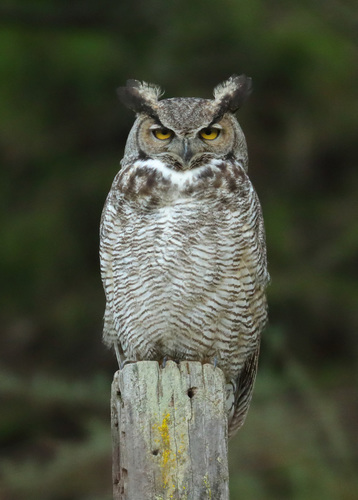
- aHuge, barrel-shaped tawny-brown owl
- bLarge orange eyes and long, often raised ear tufts
- cDark streaking on the breast; white throat shows when calling
- dThickly feathered legs and feet
- Voice
- A deep, resonant 'oo-hu' (hence German 'Uhu'), repeated every 8–10 seconds; females higher-pitched.
- Not to be confused with
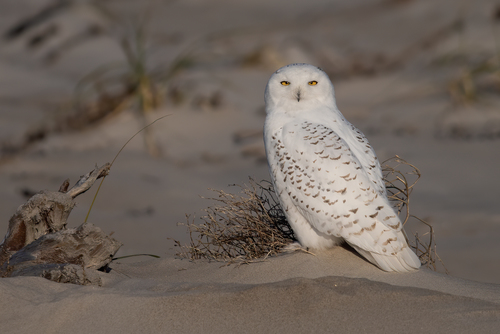
- Long-eared owl is far smaller and slimmer. Pharaoh eagle-owl (North Africa, Arabia) is smaller and paler sandy-buff. Snowy owl has no ear tufts.
- Where to see it
- Gorges and quarries of Spain, southern France, the Alps, Turkey and the Caucasus; the Sierra Morena and Monfragüe in Spain.
- When
- Resident; most vocal in late autumn and late winter
Listen
Looking for field recordings…
Life & habits
- Diet
- Mammals from voles to hares and hedgehogs, rats, birds up to heron and duck size, frogs
- Habitat
- Cliffs, rocky gorges, quarries, forests with crags, steppe ravines
- Size
- 56–75 cm; wingspan 131–188 cm; males 1.2–3.2 kg, females 1.75–4.6 kg
- Lifespan
- Up to about 20 years in the wild; longer in captivity
Hunts from a perch at dusk, gliding silently down onto prey, and often caches surplus kills at the nest.
Where it lives
Recorded sightings
—
geo-referenced records in GBIF, from museums, herbaria and field observers.
Native range
Europe, Turkey, the Middle East, Central Asia and northern Asia to the Pacific; North African birds are now treated as the separate Pharaoh eagle-owl
Drag the globe to turn it. Dots are where records exist, not a range map; darker means more records.
In the old herbals & bestiaries
Woodcuts and engravings matched from the Source Library’s scanned books by name. Plates marked “relative” show a close kin rather than this exact species. Click a plate to read the page it came from, with translation.

History of Animals, Book I: On Viviparous Quadrupeds
Conrad Gessner · 1554 · p.414

Garden of Health
Jacob Meydenbach · 1491 · p.612

François Bouchard — Recueil de cent-trente-trois oiseaux des plus belles especes (1775)
François Bouchard · 1775 · p.127

François Bouchard — Recueil de cent-trente-trois oiseaux des plus belles especes (1775)
François Bouchard · 1775 · p.115

The Secrets of Albertus Magnus on the Nature of Women and the Virtues of Herbs
Albertus, Magnus, Heiliger · 1604 · p.62
In the stacks
Searching the stacks…
Every page naming Bubo bubo in the Biodiversity Heritage Library →
Marginalia
Eagle-owls were used as live decoys in German 'Hüttenjagd' hunting, where crows and raptors were shot as they mobbed the tethered owl, and the Persian name 'shah-buf' means king of owls.
Curiosity
A wild eagle-owl nicknamed Bubi, living at Helsinki's Olympic Stadium, briefly stopped a Euro 2008 qualifying match when it flew onto the pitch.
Kinship
Fact-checked: 2 corrections made to this sheet. Photographs: iNaturalist contributors under the licences shown. Records: GBIF.org. Historical plates: Source Library (CC BY-SA 4.0; originals public domain). Summary text: Nature Library editors and Wikipedia (CC BY-SA). Medicinal and edibility notes are historical and educational, not advice. iNaturalist taxon 20059.