 NL·0533
Herbarium of the Nature Library
- Name
- Prosthemadera novaeseelandiae
- Family
- Meliphagidae
- Native to
- New Zealand
- Habitat
- Temperate rainforest, Gardens
On eBird ↗
Tui
Live sightings near you, the range map, bar charts of when it is seen, and Macaulay Library photos and recordings.
Tūī
Prosthemadera novaeseelandiae
Also calledTūī (Māori) · Kōkō (Māori) · Parson bird (English)
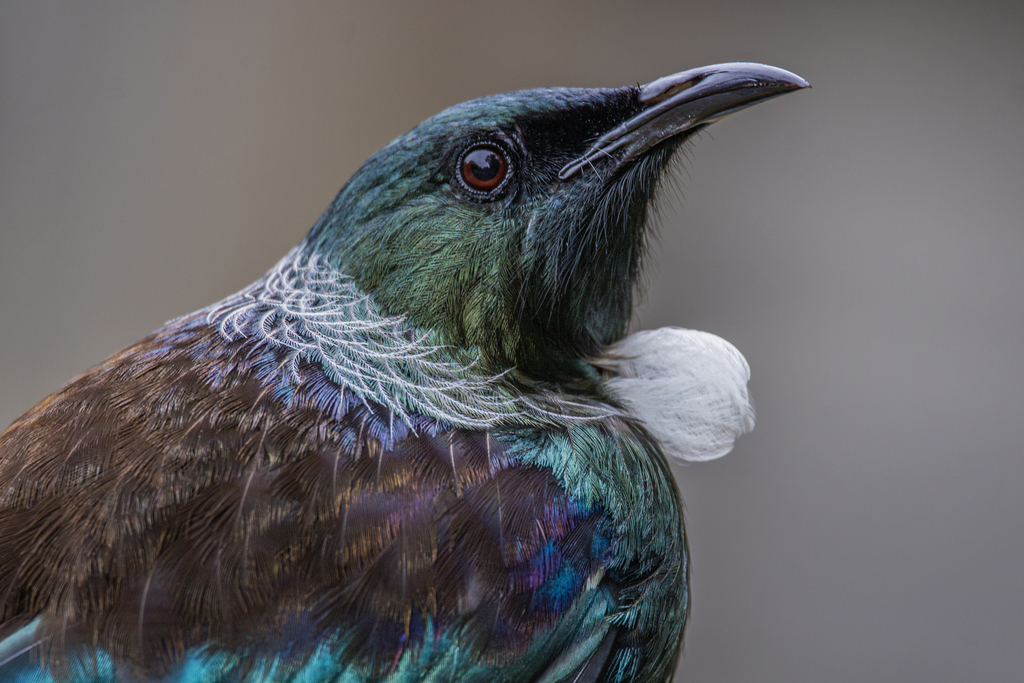
A New Zealand honeyeater with iridescent plumage and a white throat tuft. Its complex song, with clicks, chimes and wheezes, comes from two voice boxes.
The tūī is a medium-sized bird native to New Zealand. It is blue, green, and bronze coloured with a distinctive white throat tuft (poi). It is an endemic passerine bird of New Zealand, and the only species in the genus Prosthemadera. It is one of the largest species in the diverse Australasian honeyeater family Meliphagidae, and one of two living species of that family found in New Zealand, the other being the New Zealand bellbird. The tūī has a wide distribution in the archipelago, ranging from the subtropical Kermadec Islands to the sub-Antarctic Auckland Islands, as well as the main islands. Wikipedia
What it can do
- iTwo-sided syrinx lets it sing two notes at once
- iiSome song elements are reported to be too high-pitched for people to hear
- iiiPollinates flax, kōwhai and other native plants
- ivAccomplished mimic, including human speech
In the field
Field marks
- aDark iridescent plumage with blue, green and bronze sheen
- bTwo white throat tufts (poi)
- cLacy white collar of filamentous feathers
- dCurved black bill
- Voice
- A rich mix of bell-like notes, clicks, cackles and wheezes.
- Not to be confused with
- Korimako (New Zealand bellbird) is smaller, olive-green and lacks the white tufts.
- Where to see it
- Zealandia (Wellington), Tiritiri Matangi, Otari-Wilton's Bush, Auckland parks
- When
- Resident
Listen
Looking for field recordings…
Life & habits
- Diet
- Nectar, fruit, insects
- Habitat
- Native forest, regenerating scrub, parks and gardens
- Size
- About 30 cm; 90–150 g
Tūī are aggressive defenders of nectar trees, chasing off other birds with loud wing whirring.
Where it lives
Recorded sightings
—
geo-referenced records in GBIF, from museums, herbaria and field observers.
Native range
New Zealand
Drag the globe to turn it. Dots are where records exist, not a range map; darker means more records.
In the stacks
Marginalia
Māori trained captive tūī to recite karakia and greetings. 'Parson bird' refers to the white tufts resembling clerical bands.
Curiosity
Like other songbirds, the tūī has a two-sided voice box (syrinx), but it uses it with unusual virtuosity, producing two independent sounds at once.
Kinship



Fact-checked: 2 corrections made to this sheet. Photographs: iNaturalist contributors under the licences shown. Records: GBIF.org. Historical plates: Source Library (CC BY-SA 4.0; originals public domain). Summary text: Nature Library editors and Wikipedia (CC BY-SA). Medicinal and edibility notes are historical and educational, not advice. iNaturalist taxon 12580.