 NL·0249
Herbarium of the Nature Library
- Name
- Dacelo novaeguineae
- Family
- Alcedinidae
- Native to
- Eastern Australia; introduced to south-western Western Australia, Tasmania and New Zealand
- Habitat
- Eucalypt woodland, Open forest, Suburban parks
On eBird ↗
Laughing Kookaburra
Live sightings near you, the range map, bar charts of when it is seen, and Macaulay Library photos and recordings.
Laughing kookaburra
Dacelo novaeguineae
Also calledGuuguubarra (Wiradjuri) · Kookaburra (Australian English, from Wiradjuri) · Martin-chasseur géant (French)
The world's largest kingfisher, famous for its raucous family chorus of 'laughter' at dawn and dusk. It rarely fishes, instead dropping onto snakes, lizards and insects from a perch.
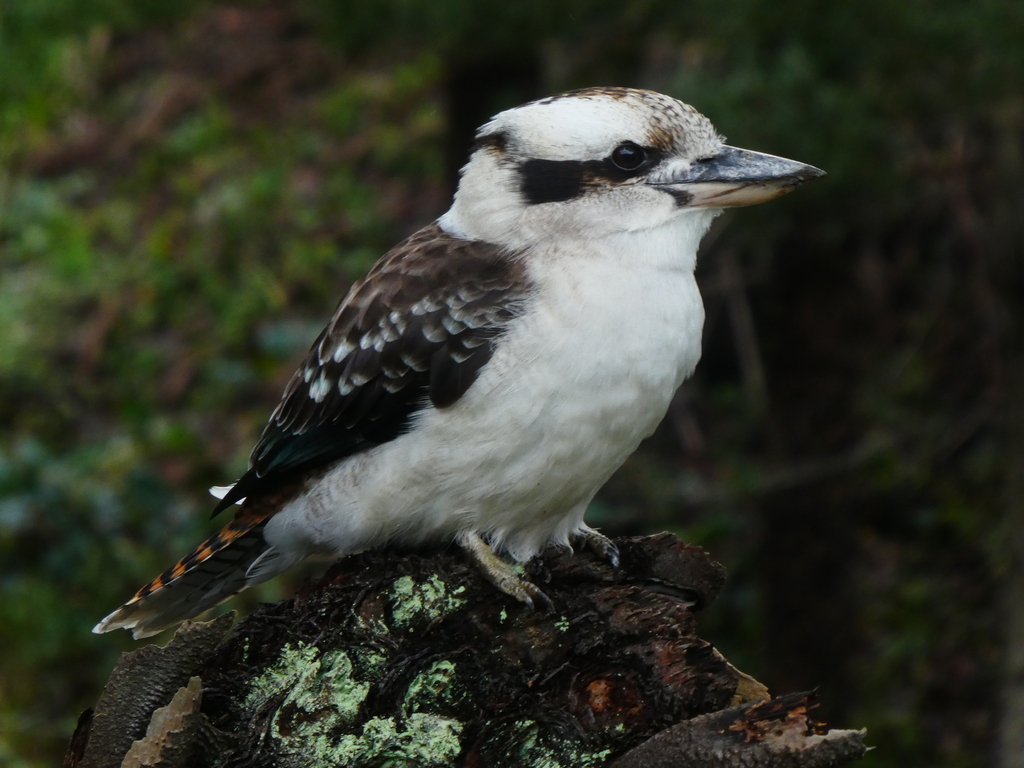
The laughing kookaburra is a bird in the kingfisher subfamily Halcyoninae. It is a large kingfisher with a whitish head and a brown eye-stripe. The upperparts are mostly dark brown but there is a mottled light-blue patch on the wing coverts. The underparts are cream-white and the tail is barred with rufous and black. The plumage of the male and female birds is similar. The territorial call is a distinctive laugh that is often delivered by several birds at the same time, and is widely used as a stock sound effect in situations that involve a jungle setting. Wikipedia
What it can do
- iKills snakes and lizards by bashing them against branches or dropping them
- iiFamily groups 'laugh' together to proclaim territory
- iiiCooperative breeder: older offspring help raise new chicks
In the field
Field marks
- aLarge, stocky kingfisher with a massive bill
- bOff-white head with a dark brown eye-stripe
- cBrown wings with a small pale-blue shoulder patch
- dRufous tail barred with black
- eDark eye
- Voice
- A loud, rollicking 'koo-koo-koo-ka-ka-ka' that rises into raucous laughter, often by several birds at once, especially at dawn and dusk.
- Not to be confused with
- Blue-winged kookaburra (northern Australia) has a pale eye, no dark eye-stripe, a blue rump and more extensive blue in the wing, and a harsher, cackling call.
- Where to see it
- Common in eastern Australian bushland, parks and gardens from Queensland to Victoria; Royal National Park (Sydney), Lamington National Park
- When
- Resident year-round
Listen
Looking for field recordings…
Life & habits
- Diet
- Insects, worms, lizards, snakes, small mammals and birds
- Habitat
- Dry eucalypt woodland, open forest, parks and gardens
- Size
- 39–42 cm; 300–450 g
- Lifespan
- Up to about 20 years
Groups of related birds call in chorus, one starting with low chuckles before the rest join in a crescendo of laughter.
Where it lives
Recorded sightings
—
geo-referenced records in GBIF, from museums, herbaria and field observers.
Native range
Eastern Australia; introduced to south-western Western Australia, Tasmania and New Zealand
Drag the globe to turn it. Dots are where records exist, not a range map; darker means more records.
In the stacks
Searching the stacks…
Every page naming Dacelo novaeguineae in the Biodiversity Heritage Library →
Marginalia
The name comes from the Wiradjuri word guuguubarra, imitating its call. A widely retold Aboriginal story says the kookaburra's laughter is the signal for the sky-people to light the sun each morning.
Curiosity
Its call has been widely used as a 'jungle' sound effect in films, even those set nowhere near Australia.
Kinship

Photographs: iNaturalist contributors under the licences shown. Records: GBIF.org. Historical plates: Source Library (CC BY-SA 4.0; originals public domain). Summary text: Nature Library editors and Wikipedia (CC BY-SA). Medicinal and edibility notes are historical and educational, not advice. iNaturalist taxon 2413.