 NL·0266
Herbarium of the Nature Library
- Name
- Bombus terrestris
- Family
- Apidae
- Native to
- Europe, North Africa and Western Asia; introduced to Chile, Argentina, Tasmania, New Zealand and Japan
- Habitat
- Temperate grassland, Woodland edge, Gardens, Farmland
Buff-tailed bumblebee
Bombus terrestris
Also calledErdhummel (German) · Bourdon terrestre (French) · Abejorro (Spanish) · Xióngfēng (Chinese, bumblebee)
A large, furry social bee that can fly in cold weather and is reared commercially to pollinate greenhouse tomatoes. It buzzes flowers at a precise frequency to shake out pollen honey bees cannot reach.
Bombus terrestris, the buff-tailed bumblebee or large earth bumblebee, is one of the most numerous bumblebee species in Europe. It is one of the main species used in greenhouse pollination, and so can be found in many countries and areas where it is not native, such as Tasmania. Moreover, it is a eusocial insect with an overlap of generations, a division of labour, and cooperative brood care. The queen is monogamous, which means she mates with only one male. B. terrestris workers learn flower colours and forage efficiently. Wikipedia
What it can do
- iSonication ('buzz pollination'): vibrates flight muscles to shake pollen from tomato and blueberry flowers
- iiWarms its thorax above 30 °C by shivering, allowing flight near freezing
- iiiDetects the weak electric field of flowers to tell recently visited blooms
- ivLearned to pull strings and roll balls for rewards in laboratory experiments
- vLeaves scent marks so nestmates skip emptied flowers
In the field
Field marks
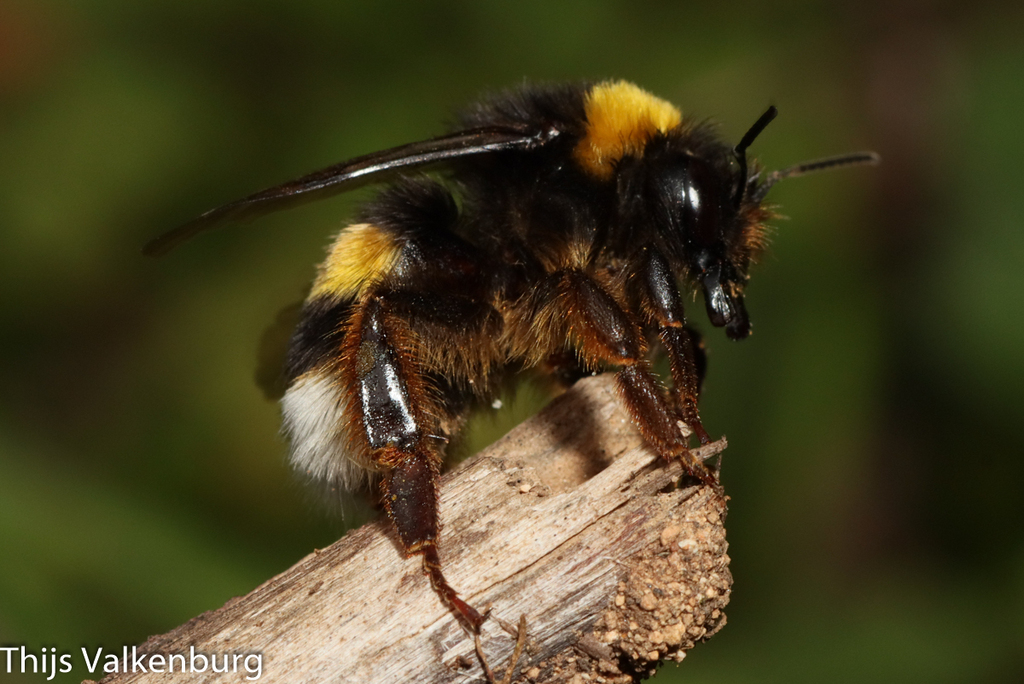
- aLarge, furry bumblebee, black with two dark-yellow bands (one on the collar, one on the abdomen)
- bQueens have a buff to off-white tail
- cWorkers have a white tail, often with a faint buff line where it meets the black
- dCollar band is darker, more orange-tinged yellow than in similar species
- Voice
- A deep, loud buzz; buzz-pollinates some flowers (e.g. tomatoes) with a higher-pitched vibration
- Not to be confused with
- White-tailed bumblebee (Bombus lucorum) has a cleaner, lemon-yellow collar and bright white tail; workers of the two are hard to separate reliably in the field. Garden bumblebee (B. hortorum) has an extra yellow band at the rear of the thorax and a very long face.
- Where to see it
- Gardens, parks and farmland across Europe; common on lavender, comfrey and winter-flowering shrubs
- When
- Queens emerge Feb–Mar; colonies peak in summer; in southern Britain some colonies stay active through winter on garden flowers
Listen
Looking for field recordings…
Life & habits
- Diet
- Nectar and pollen from a wide range of flowers
- Habitat
- Grassland, heath, gardens and farmland; nests underground in old rodent burrows
- Size
- Workers 11–17 mm; queens 20–27 mm
- Lifespan
- Workers a few weeks; queens about a year, including hibernation
Queens emerge from hibernation in early spring and found a colony alone, incubating their first brood on a wax pot like a bird on eggs.
Where it lives
Recorded sightings
—
geo-referenced records in GBIF, from museums, herbaria and field observers.
Native range
Europe, North Africa and Western Asia; introduced to Chile, Argentina, Tasmania, New Zealand and Japan
Drag the globe to turn it. Dots are where records exist, not a range map; darker means more records.
In the stacks
Searching the stacks…
Every page naming Bombus terrestris in the Biodiversity Heritage Library →
Marginalia
Since the late 1980s Belgian and Dutch breeders have shipped colonies worldwide for greenhouse pollination, replacing hand-vibration of tomato flowers. Its introductions to South America have harmed the native giant bumblebee Bombus dahlbomii.
Curiosity
The old myth that 'science says bumblebees can't fly' came from applying fixed-wing aerodynamics; their flapping wings generate lift from unsteady vortices.
Kinship




Photographs: iNaturalist contributors under the licences shown. Records: GBIF.org. Historical plates: Source Library (CC BY-SA 4.0; originals public domain). Summary text: Nature Library editors and Wikipedia (CC BY-SA). Medicinal and edibility notes are historical and educational, not advice. iNaturalist taxon 57516.