- Animals
- ›Arthropods
- ›Hexapods
- ›Insects
- ›Winged and Once-winged Insects
- ›Ants, Bees, Wasps, and Sawflies
- ›Sawflies, Horntails, and Wood Wasps
- ›Typical Sawflies
- ›Common Sawflies
- ›Nematinae
- ›Nematini
- ›Euura
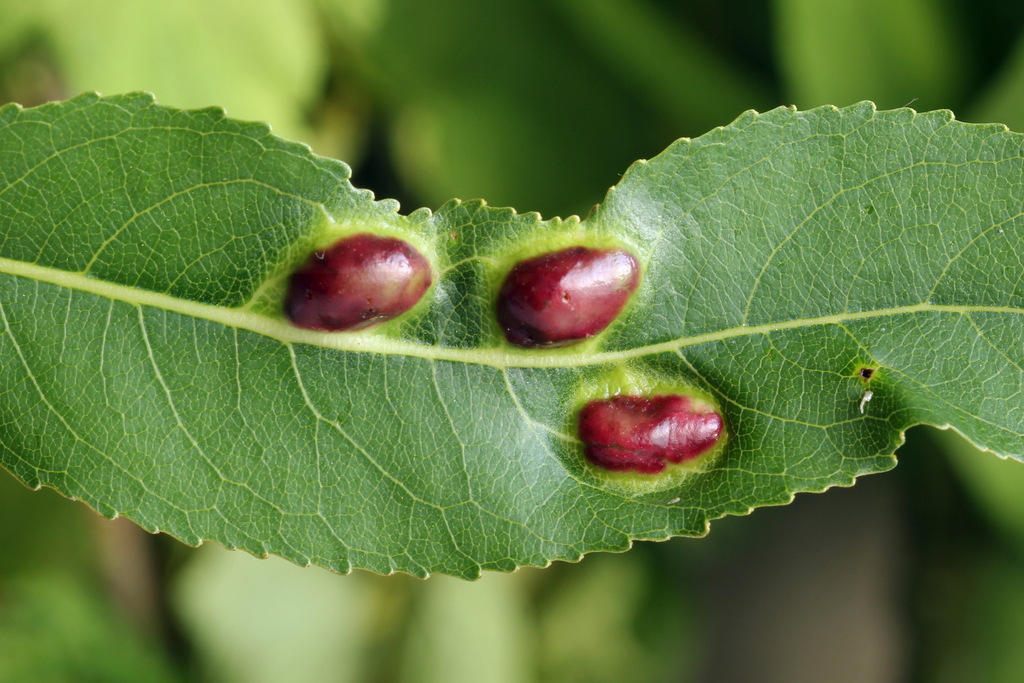
Willow Redgall Sawfly
Euura proxima
Euura proxima is a species of sawfly belonging to the family Tenthredinidae (common sawflies). The larvae feed on the leaves of willows (Salix species), creating galls. It was described by Jean Guillaume Audinet-Serville in 1823. The species was placed in the genus Euura in 2014 and was previously known as Nematus proximus and Pontania proxima.
From the article Euura proxima on Wikipedia (CC BY-SA), quoted section by section
Description
The larvae have a darkened head, typically seen as they increase in maturity. Once they emerge from the gall, they form a cocoon. This cocoon takes on soil particles and leafy matter, having a fibrous texture. Overall, it is described as being cylindrical in shape with a golden brown color, the thickness depending on the developmental stage of the specimen. The body of adult E. proxima is mostly black with a brown hue, the legs being a lighter, reddish-brown tone. A distinctive feature of this species is its thread like antenna which have shorter antennomeres compared to other similar species. This species is a part of Hymenoptera, which can be identified through multiple facets. For example, Hymenoptera have four membranous wings, mandibulate mouthparts and a true ovipositor. Mandibulate mouthparts are identified by multiple pairs of appendages coming from two unsegmented mandibles.
Range & habitat
Originally, this species was native to the Western Palearctic area; however, it has been distributed by accident around the globe. This species is now found throughout Europe, north to southern Finland and east to the Caucasus. It has been introduced to Australia, North America and New Zealand. The widespread range is due to the spread of its host plants such as Salix alba x fragilis. In New Zealand, the species has been observed in both main islands, covering a wide range of habitat. The only place with small numbers are the lower West Coast in the South Island, and the lower East Coast in the North Island.
Wikipedia: “Distribution”
What it does
Adults tend to come out in spring, during which they begin to search for a suitable willow specimen. It is suggested that they emerge in spring because spring is when their host plants begin a period of development, particularly in leaf growth. The species is most likely parthenogenic in places like New Zealand, with no male sightings seen in the country as of 2021. This is typical of the species group, explaining a pattern of uniform form in E. proxima. Most species in the group also go through multiple generations on an annual basis. In the Tenthredinidae family, the female continues the life cycle by inserting their ovipositor into the leaf structure. The egg is then implanted into the plant tissue itself, since the plant is a state of rapid growth. How galls form is not fully understood; however, there is evidence of chemical induction as well as the involvement of phytohormones. Phytohormones are plant hormones that can help regulate processes like plant growth. Sawfly galls form as soon as the egg is inserted into the leaf tissue. The eggs hatch after approximately 12–19 days, with the gall reaching its maximum size after two weeks. The larvae initially live in a small opening in the gall; however, it eats through the material until the walls grow thin. Sawflies typically leave the gall in autumn. After gall departure, E. …
Wikipedia: “Life Cycle and Phenology”
Listen
Looking for field recordings…
Where it lives
Recorded sightings
—
geo-referenced records in GBIF, from museums, herbaria and field observers.
Drag the globe to turn it. Dots are where records exist, not a range map; darker means more records.
In the stacks
Searching the stacks…
Every page naming Euura proxima in the Biodiversity Heritage Library →
This page is assembled live from iNaturalist, GBIF, Wikipedia, the Source Library and the Internet Archive. It is not yet part of the hand-edited codex. iNaturalist taxon 935778.