 NL·0368
Herbarium of the Nature Library
- Name
- Pantherophis guttatus
- Family
- Colubridae
- Native to
- Southeastern United States, from southern New Jersey to Florida and west to Louisiana and Kentucky
- Habitat
- Pine woodland, Overgrown fields, Farmland, Rocky hillsides
Corn snake
Pantherophis guttatus
Also calledRed rat snake · Red cornsnake · Culebra del maíz (Spanish)
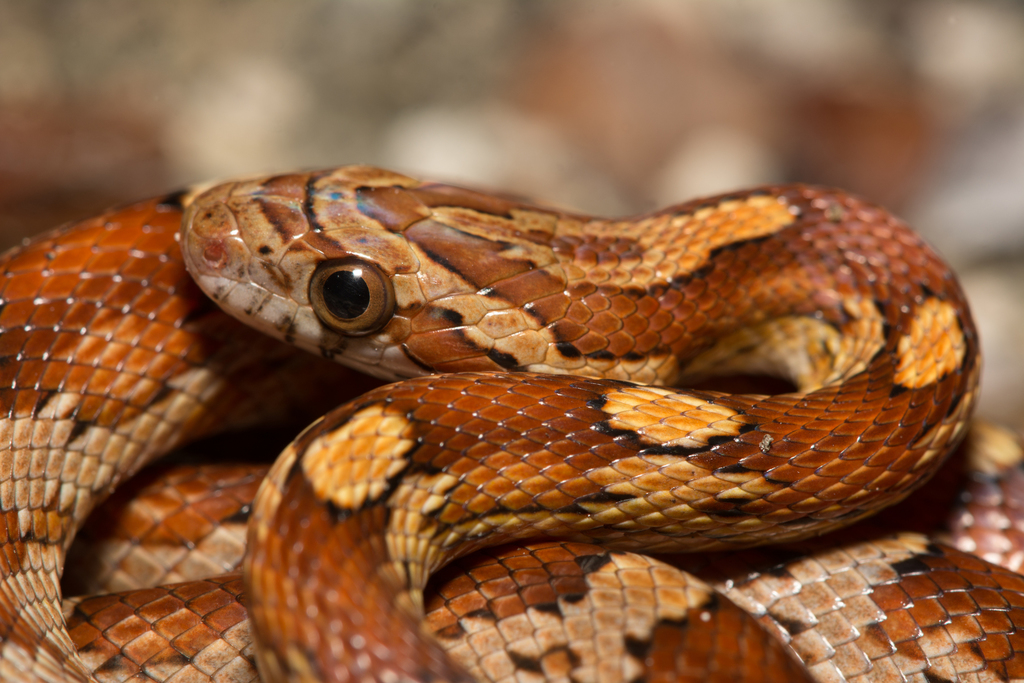
A gentle, orange-and-red constrictor of the southeastern US and one of the most widely kept pet snakes. It is a rat-catcher of farms and woodlands, and is often killed because people mistake it for a copperhead.
The corn snake, sometimes called the red rat snake, is a species of North American rat snake in the family Colubridae. The species subdues its small prey by constriction. It is found throughout the southeastern and central United States. Though superficially resembling the venomous copperhead and often killed as a result of this mistaken identity, the corn snake lacks functional venom and is harmless to humans. The corn snake is beneficial to humans because it helps control populations of wild rodent pests that damage crops and spread disease. Wikipedia
What it can do
- iClimbs trees and walls easily, using the corners of its belly scales as grips
- iiConstricts rodents and is a useful pest controller around barns
- iiiBred in captivity for decades, producing many colour forms
In the field
Field marks
- aOrange to brownish-grey body with large red or orange saddles edged in black
- bSpear-point mark on top of the head extending onto the neck
- cBlack-and-white checkerboard belly
- dSlender body, round pupils, no heat pits
- Not to be confused with
- The venomous copperhead (Agkistrodon contortrix) has hourglass-shaped tan-to-copper crossbands that are narrow on the back and wide on the sides, a plain unpatterned head, vertical pupils, heat pits and a heavy body. The corn snake has saddles that are widest on the back, a spear-point head pattern, round pupils and a checkered belly.
- Where to see it
- Pine flatwoods of Florida and the Carolinas, Great Smoky Mountains foothills; often found at night on roads in summer
- When
- Resident; active April–October in the north, nearly all year in Florida
Life & habits
- Diet
- Mice, rats, birds and eggs; juveniles eat lizards and frogs
- Habitat
- Pine forests, overgrown fields, old buildings, rock outcrops
- Size
- Usually 0.9–1.5 m
- Lifespan
- ~6–8 years in the wild; 20+ in captivity
Mostly active at dusk and night in hot weather. When threatened it vibrates its tail in leaf litter and may strike, but it is harmless.
Where it lives
Recorded sightings
—
geo-referenced records in GBIF, from museums, herbaria and field observers.
Native range
Southeastern United States, from southern New Jersey to Florida and west to Louisiana and Kentucky
Drag the globe to turn it. Dots are where records exist, not a range map; darker means more records.
In the stacks
Searching the stacks…
Every page naming Pantherophis guttatus in the Biodiversity Heritage Library →
Marginalia
The name may come from its checkered belly, which resembles kernels of 'Indian corn', or from its habit of hunting rats in corn cribs. Linnaeus named it Coluber guttatus in 1766.
Curiosity
Captive breeders have produced dozens of colour forms, with names like 'Snow', 'Anery' and 'Bloodred'.
Kinship


Photographs: iNaturalist contributors under the licences shown. Records: GBIF.org. Historical plates: Source Library (CC BY-SA 4.0; originals public domain). Summary text: Nature Library editors and Wikipedia (CC BY-SA). Medicinal and edibility notes are historical and educational, not advice. iNaturalist taxon 73887.