 NL·0424
Herbarium of the Nature Library
- Name
- Laticauda colubrina
- Family
- Elapidae
- Native to
- Tropical Indo-Pacific, from the Bay of Bengal and Andaman Sea through Southeast Asia to southern Japan, New Guinea, Fiji and Tonga
- Habitat
- Coral reef, Rocky shore, Mangrove
Banded sea krait
Laticauda colubrina
Also calledYellow-lipped sea krait · Aomadara-umihebi アオマダラウミヘビ (Japanese) · Ular laut (Malay/Indonesian) · Dadakulaci (Fijian)
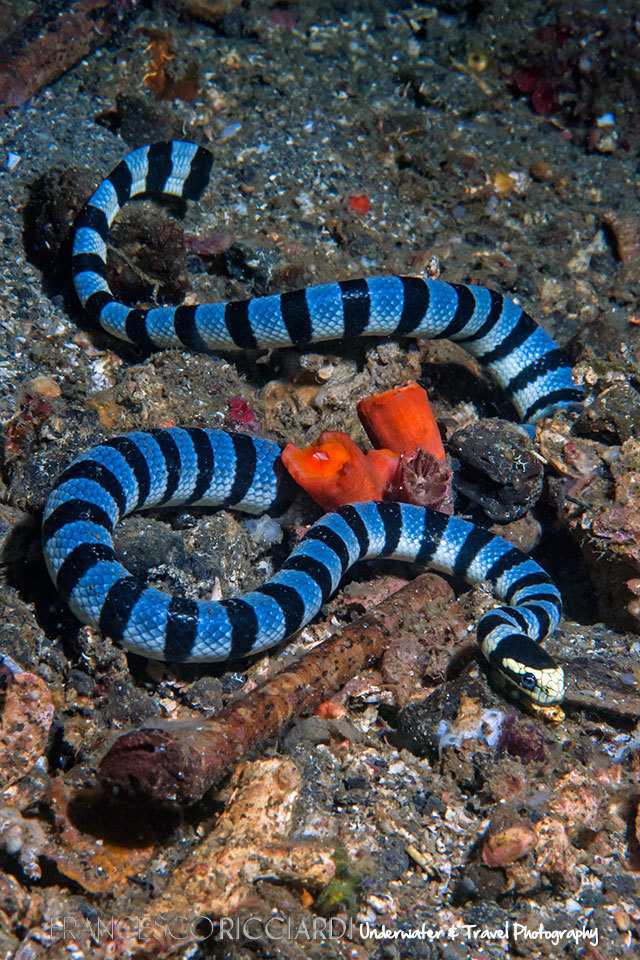
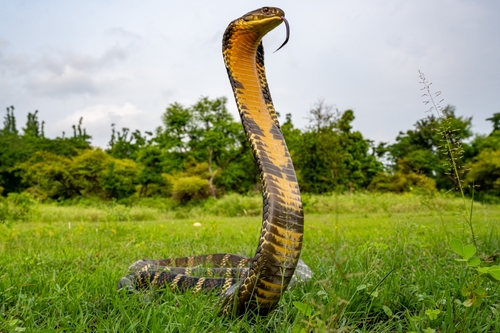
A banded black-and-silver-blue snake that hunts eels in coral reefs and comes ashore on small islands to digest, shed, mate and lay eggs. It has a powerful neurotoxic venom but is so docile that bites are very rare.
The yellow-lipped sea krait, also known as the banded sea krait or colubrine sea krait, is a species of highly venomous snake found in tropical Indo-Pacific oceanic waters. The snake has distinctive black stripes and a yellow snout, with a paddle-like tail for use in swimming. Wikipedia
What it can do
- iIts paddle-shaped tail drives it underwater, while broad belly scales still let it climb on land
- iiCan dive for long periods while hunting eels in crevices
- iiiVenom with strong neurotoxins kills eels quickly
- ivLays eggs on land in rock crevices, unlike true sea snakes, which bear live young at sea
In the field
Field marks
- aBold black rings on a pale blue-grey body
- bBright yellow upper lip and snout
- cFlattened paddle tail with a yellow-edged black tip
- dBroad belly scales (unlike most sea snakes)
- Not to be confused with
- The blue-lipped sea krait (L. laticaudata) has a dark upper lip. The banded snake eel (Myrichthys colubrinus), which is harmless to people, mimics the sea krait's banding but is a fish: it has a pointed tail with a fin, no scales and no yellow lip, and is never seen out of water.
- Where to see it
- Common on reefs in the Philippines, Indonesia (Bali, Komodo, Raja Ampat), Fiji, Vanuatu, New Caledonia, Okinawa; often seen by divers and resting on islet rocks
- When
- Resident year-round
Life & habits
- Diet
- Almost exclusively moray and conger eels
- Habitat
- Shallow coral reefs and their islands, rocky shores, mangroves
- Size
- Usually ~1 m; females larger, up to ~1.5 m
Hunts in groups, sometimes alongside trevallies and goatfish that catch prey the snake flushes out. Bites are rare and usually happen only when a snake is grabbed. Envenoming causes paralysis. First aid is a pressure-immobilisation bandage and splint, keeping the person still and getting them urgently to a hospital, where sea snake antivenom and breathing support may be needed.
Where it lives
Recorded sightings
—
geo-referenced records in GBIF, from museums, herbaria and field observers.
Native range
Tropical Indo-Pacific, from the Bay of Bengal and Andaman Sea through Southeast Asia to southern Japan, New Guinea, Fiji and Tonga
Drag the globe to turn it. Dots are where records exist, not a range map; darker means more records.
In the stacks
Searching the stacks…
Every page naming Laticauda colubrina in the Biodiversity Heritage Library →
Marginalia
In the Ryukyu Islands its relative the erabu sea snake was smoked and dried to make irabu-jiru, a traditional broth once served to the Ryukyu royal court.
Curiosity
Sea kraits have to drink fresh water. They cannot get what they need from seawater and seek out rain puddles and freshwater seeps on their island.
Kinship


Photographs: iNaturalist contributors under the licences shown. Records: GBIF.org. Historical plates: Source Library (CC BY-SA 4.0; originals public domain). Summary text: Nature Library editors and Wikipedia (CC BY-SA). Medicinal and edibility notes are historical and educational, not advice. iNaturalist taxon 68343.