 NL·0562
Herbarium of the Nature Library
- Name
- Danaus chrysippus
- Family
- Nymphalidae
- Native to
- Africa, southern Europe (Canary Islands, southern Spain), the Middle East, South and Southeast Asia, and Australia
- Habitat
- Savanna, Desert edge, Scrub, Gardens, Farmland
Plain tiger
Danaus chrysippus
Also calledAfrican monarch (English) · Jīn bāndié (Chinese) · Kabamadara (Japanese) · Mariposa tigre (Spanish)
An orange milkweed butterfly, a close relative of the monarch, that ranges across Africa, Asia and Australia. Its body holds toxins from milkweed, and many other butterflies have evolved to copy its pattern.
Danaus chrysippus, also known as the plain tiger, African queen, or African monarch, is a medium-sized butterfly widespread in Asia, Australia and Africa. It belongs to the Danainae subfamily of the brush-footed butterfly family Nymphalidae. Danainae primarily consume plants in the genus Asclepias, more commonly called milkweed. Milkweed contains toxic compounds, cardenolides, which are often consumed and stored by many butterflies. Because of their emetic properties, the plain tiger is unpalatable to most predators. As a result, its colouration is widely mimicked by other species of butterflies. The plain tiger inhabits a wide variety of habitats, although it is less likely to thrive in jungle-like conditions and is most often found in drier, wide-open areas. Wikipedia
What it can do
- iStores cardenolides from milkweed, making it distasteful to birds
- iiIts pattern is copied by mimics such as the female danaid eggfly (Hypolimnas misippus)
- iiiMales gather pyrrolizidine alkaloids from withered plants to make courtship pheromones
In the field
Field marks
- aTawny orange wings
- bForewing tip black with a slanting white band
- cBlack body spotted with white
- dMales have a black scent pouch on each hindwing with a white centre
- Not to be confused with
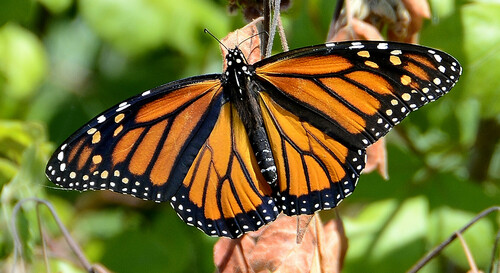
- Female danaid eggfly (Hypolimnas misippus) is a mimic with a similar pattern but lacks the white-spotted black body. Striped tiger (Danaus genutia) has bold black veins. Monarch (D. plexippus) is larger with black-lined veins.
- Where to see it
- Dry gardens and Calotropis scrub across India, East Africa, Arabia and the Canary Islands.
- When
- Year-round in the tropics
Listen
Looking for field recordings…
Life & habits
- Diet
- Adults sip nectar from many flowers; caterpillars eat milkweeds such as Calotropis and Asclepias
- Habitat
- Dry open country, wasteland, gardens and farmland
- Size
- Wingspan about 7–8 cm
It flies slowly and openly, relying on its toxicity and warning colours rather than speed.
Where it lives
Recorded sightings
—
geo-referenced records in GBIF, from museums, herbaria and field observers.
Native range
Africa, southern Europe (Canary Islands, southern Spain), the Middle East, South and Southeast Asia, and Australia
Drag the globe to turn it. Dots are where records exist, not a range map; darker means more records.
In the old herbals & bestiaries
No plate in the Source Library names this exact species, so these show its closest relatives as the old naturalists drew them: same genus, or the same kind of animal. Click a plate to read the page it came from, with translation.

The Tudor Pattern Book (Herbal-Bestiary)
Relative · Anonymous · 1525 · p.88

Cosmographey: das ist Beschreibung aller Laender
Relative · Münster, Sebastian · 1598 · p.1501

Valeriano: Hieroglyphica (1575)
Relative · Pierio Valeriano · 1556 · p.179

Sancai Tuhui (Vol. 92)
Relative · 王圻, 王思義 · 1609 · p.11

Sancai Tuhui, Juan 92 — Birds & Beasts (NCL Original)
Relative · 王圻、王思義 · 1609 · p.54

The Embassy of the Dutch East India Company to the Tartar Cham
Relative · Johan Nieuhof · 1665 · p.454

Ortus sanitatis
Relative · 1491 · p.594

Collected Illustrations of the Three Realms: Ceremonial Regulations
Relative · 王圻, 王思義 · 1609 · p.32

Compendium of Materia Medica: Illustrated Volume, Middle of the Lower Part
Relative · 李時珍 · 1596 · p.100

Collected Illustrations of the Three Realms: Birds and Beasts
Relative · 王圻, 王思義 · 1609 · p.18
In the stacks
Searching the stacks…
Every page naming Danaus chrysippus in the Biodiversity Heritage Library →
Marginalia
Butterflies identified as plain tigers appear in the wall painting from the tomb-chapel of Nebamun at Thebes (about 1350 BCE), now in the British Museum, among the oldest identifiable butterflies in art.
Curiosity
In East Africa, populations crossbreed in a hybrid zone where a bacterium kills male offspring of some matings, producing all-female broods.
Kinship


Photographs: iNaturalist contributors under the licences shown. Records: GBIF.org. Historical plates: Source Library (CC BY-SA 4.0; originals public domain). Summary text: Nature Library editors and Wikipedia (CC BY-SA). Medicinal and edibility notes are historical and educational, not advice. iNaturalist taxon 67835.