 NL·0096
Herbarium of the Nature Library
- Name
- Theobroma cacao
- Family
- Malvaceae
- Native to
- Upper Amazon basin (Ecuador, Peru, Colombia, Brazil); domesticated in Mesoamerica and South America; grown across the humid tropics
- Habitat
- Tropical rainforest understorey, Shaded agroforestry
Cacao
Theobroma cacao
Also calledKakaw (Maya) · Cacahuatl (Nahuatl) · Cacao (Spanish) · Kakao (Malay/Indonesian/Swahili) · Kěkě (Chinese) · Cocoa (English trade name)
A small understorey tree of the Amazon whose seeds become chocolate. Its tiny flowers sprout directly from the trunk and are pollinated almost entirely by minute midges, and Mesoamerican peoples prized its beans so highly they used them as money.
Theobroma cacao is a small evergreen tree in the Malvaceae family. Its seeds—cocoa beans when dried and fermented—are used to make chocolate liquor, cocoa powder, cocoa butter and chocolate. Although the tree is native to the tropics of the Americas, the largest producer of cocoa beans in 2022 was Côte d'Ivoire. Wikipedia
What it can do
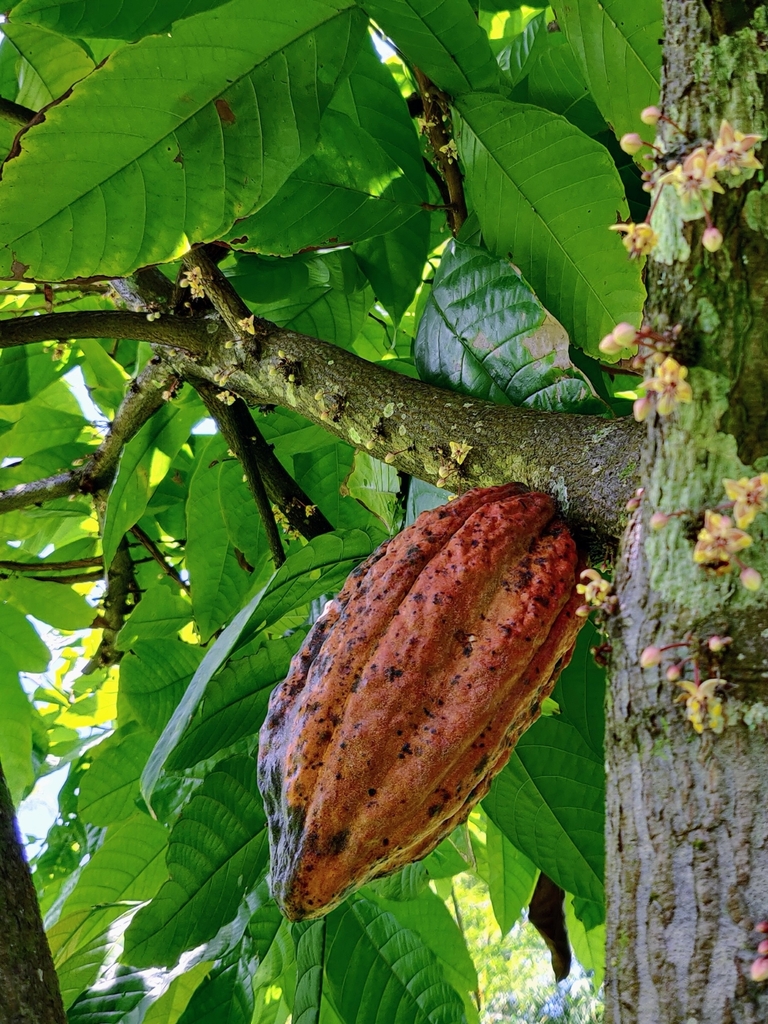
- iCauliflorous: flowers and pods grow straight from the trunk and old branches
- iiPollinated by biting midges (Forcipomyia) only a few millimetres long
- iiiThrives in deep shade beneath taller rainforest trees
- ivSeeds contain theobromine, a stimulant toxic to dogs
At the table
Eatenseeds (fermented, dried and roasted for cocoa and chocolate) · fruit pulp (fresh, juiced)
Beans and the sweet white pulp are safe for people. Theobromine makes chocolate dangerous to dogs, cats and horses.
In the medicine cabinet
| Tradition | Use |
|---|---|
| Aztec / Mesoamerican | Cacao drinks mixed with herbs for fatigue, fever and digestive complaints, recorded in the Florentine Codex |
| Modern nutrition science | Cocoa flavanols studied for improving blood-vessel function and lowering blood pressure |
Weight of evidence
Moderate. Some clinical trials with promising but limited or mixed results.
Active compounds
theobromine, caffeine, epicatechin, phenylethylamine, anandamide
Fruit & seed


Fruit
Berry (pod)
Ripens: Year-round, with two main harvests
Ridged, rugby-ball-shaped pod 15–30 cm long, green or red maturing to yellow, orange or purple, with a thick husk around 20–60 seeds in sweet-tart white pulp.
Seed
2–3 cm
Almond-shaped, flattened oval beans 2–3 cm long, purple to ivory-white inside (white in rare criollo types), coated in slippery white pulp
- Dispersal
- Monkeys, squirrels and bats crack pods to eat the pulp and discard seeds
- Germination
- Recalcitrant: sow within a week of opening the pod, 1 cm deep, at 25–30 °C in humid shade; sprouts in 1–2 weeks
Photographs from Wikimedia Commons under open licences; hover for the photographer, click for the file.
How to grow it
Hardiness (USDA zones)
Tropical only (USDA 11–12; damaged below about 10 °C). Survives winters down to about 4 °C.
- Light
- Partial shade (30–50%); young plants need shade
- Water
- High; 1,500–2,500 mm rain evenly spread
- Soil
- Deep, humus-rich, well-drained, pH 5–7.5
- Propagation
- Seed, or grafting / rooted cuttings of selected clones
- To harvest
- 3–5 years to first pods; pods ripen 5–6 months after pollination
- Climates
- Humid tropical, Equatorial
- 1Sow fresh seed in deep bags under shade, or buy grafted plants of a productive, disease-tolerant clone.
- 2Plant out under temporary shade (banana, plantain) and permanent shade trees (e.g. Gliricidia, Inga) about 3 m apart.
- 3Mulch heavily with leaf litter, which also breeds the pollinating midges; keep soil moist.
- 4Prune to a single trunk with a 'jorquette' of 3–5 main branches and remove diseased pods promptly against black pod and frosty pod rot.
- 5Cut ripe pods with a knife, scoop beans and pulp, ferment in covered heaps or boxes for 5–7 days, then sun-dry before roasting.
Can it grow where you are?
Where it lives
Recorded sightings
—
geo-referenced records in GBIF, from museums, herbaria and field observers.
Native range
Upper Amazon basin (Ecuador, Peru, Colombia, Brazil); domesticated in Mesoamerica and South America; grown across the humid tropics
Drag the globe to turn it. Dots are where records exist, not a range map; darker means more records.
In the old herbals & bestiaries
Woodcuts and engravings matched from the Source Library’s scanned books by name. Plates marked “relative” show a close kin rather than this exact species. Click a plate to read the page it came from, with translation.

Maria Sibylla Merian — Dissertatio de generatione et metamorphosibus insectorum Surinamensium (1719)
Maria Sibylla Merian · 1719 · p.95

The Ambonese Herbal (Herbarium Amboinense), Vol. 1
Georg Eberhard Rumphius · 1741 · p.280

History of the Plants of New Spain, Volume 3
Francisco Hernández (1517-1587) · 1946 · p.225

Elements of Botany
Joseph Pitton de Tournefort · 1719 · p.195

Mark Catesby — Piscium, serpentum, insectorum (pt. 2) (1777)
Mark Catesby · 1777 · p.96

History of the Plants of New Spain, Volume 3
Francisco Hernández (1517-1587) · 1946 · p.227

Metamorphosis Insectorum Surinamensium
Maria Sibylla Merian · 1705 · p.87

Maria Sibylla Merian — Dissertatio de generatione et metamorphosibus insectorum Surinamensium (1719)
Maria Sibylla Merian · 1719 · p.206

The natural history of Carolina, Florida, and the Bahama Islands : containing two hundred a...
Catesby, Mark, bioloog, kunstenaar · 1743 · p.374

Treasury of Medical Matters of New Spain
Francisco Hernández · 1651 · p.122
In the stacks
Searching the stacks…
Every page naming Theobroma cacao in the Biodiversity Heritage Library →
Marginalia
Residues on pottery at Santa Ana-La Florida in Ecuador show cacao was used about 5,300 years ago, and the Aztec emperor Moctezuma II is said to have drunk chocolate from golden cups. Linnaeus named the genus Theobroma, 'food of the gods'.
Curiosity
In the Aztec market, a turkey hen cost about 100 cacao beans and a tomato one bean — and counterfeiters filled empty bean husks with mud.
Kinship



Photographs: iNaturalist contributors under the licences shown. Records: GBIF.org. Historical plates: Source Library (CC BY-SA 4.0; originals public domain). Summary text: Nature Library editors and Wikipedia (CC BY-SA). Medicinal and edibility notes are historical and educational, not advice. iNaturalist taxon 64340.