 NL·0093
Herbarium of the Nature Library
- Name
- Althaea officinalis
- Family
- Malvaceae
- Native to
- Europe, North Africa and Western & Central Asia; especially coastal salt marshes and damp ground
- Habitat
- Salt marsh, Wet meadow, Riverbanks
Marsh mallow
Althaea officinalis
Also calledKhatmī خطمي (Arabic/Persian/Urdu, Unani) · Eibisch (German) · Malvavisco (Spanish) · Guimauve (French) · Yào shǔkuí 药蜀葵 (Chinese)
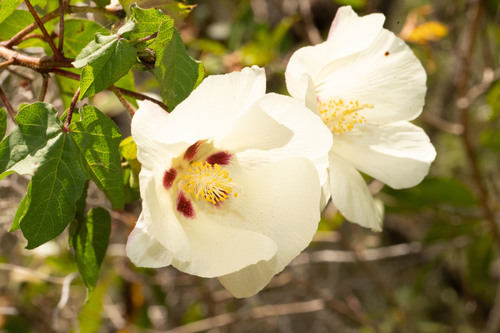
A velvety, pale-pink mallow of salt marshes whose roots are so full of slime that they soothe sore throats. The original marshmallow sweet was made from them.
Althaea officinalis, the marsh mallow or marshmallow, is a species of flowering plant indigenous to Europe, Western Asia and North Africa, which is used in herbalism and as an ornamental plant. Wikipedia
What it can do
- iRoots are rich in mucilage, which coats and soothes mucous membranes
- iiTolerates brackish, salt-influenced soils
- iiiVelvety hairs cover the whole plant
At the table
Eatenroots · leaves · flowers · young fruits
All parts are edible; roots were boiled and fried, and leaves eaten as a pot herb. Wild populations are scarce in some countries, so use cultivated plants.
In the medicine cabinet
| Tradition | Use |
|---|---|
| European folk medicine | Cold root infusion and syrup for dry cough, sore throat and gastritis; poultices for inflamed skin |
| Unani | Khatmi root and seed as a demulcent for cough, urinary burning and in softening poultices |
| Modern phytotherapy | EMA traditional-use monograph for dry cough and mouth/throat irritation |
Weight of evidence
Traditional. Long historical use; little or no modern clinical evidence.
Active compounds
rhamnogalacturonan mucilage, pectin, asparagine, flavonoids (hypolaetin glycosides), scopoletin
Fruit & seed
Fruit
Schizocarp
Ripens: Late summer–autumn
Flat ring of nutlets like a small round cheese.
Seed
~2 mm
Kidney-shaped, brown seeds
- Dispersal
- Gravity and water
- Germination
- Benefits from cold stratification; 2–3 weeks at 15–20 °C
How to grow it
Hardiness (USDA zones)
USDA 3–9. Survives winters down to about -40 °C.
- Light
- Full sun
- Water
- Moderate–high
- Soil
- Moist, rich; tolerates heavy and slightly saline soil
- Propagation
- Seed or division
- To harvest
- Roots in autumn of year 2
- Climates
- Temperate, Continental
- 1Sow in spring after chilling the seed in the fridge for 3–4 weeks
- 2Plant 60 cm apart in moist soil
- 3Harvest leaves before flowering
- 4Dig roots in autumn of year 2, peel and dry
Can it grow where you are?
Where it lives
Recorded sightings
—
geo-referenced records in GBIF, from museums, herbaria and field observers.
Native range
Europe, North Africa and Western & Central Asia; especially coastal salt marshes and damp ground
Drag the globe to turn it. Dots are where records exist, not a range map; darker means more records.
In the old herbals & bestiaries
Woodcuts and engravings matched from the Source Library’s scanned books by name. Plates marked “relative” show a close kin rather than this exact species. Click a plate to read the page it came from, with translation.

Latin Herbal with German Synonyms
1486 · p.18

Book of Herbs
Hieronymus Bock (Tragus) · 1546 · p.312

On the Names of Plants
Hieronymus Bock (Tragus) · 1552 · p.443

Herbarius
1485 · p.18

On the Virtues of Herbs
Macer Floridus · 1150 · p.56

The Book of Health: The Art of Distillation
Brunschwig, Hieronymus · 1505 · p.162

Notable Commentaries on the History of Plants
Leonhart Fuchs · 1542 · p.49

Notable Commentaries on the History of Plants
Leonhart Fuchs · 1549 · p.47

On Medical Materials in Six Books
Dioscorides · 1550 · p.493

De medicinali materia libri sex
Dioscorides · 1552 · p.501
In the stacks
Searching the stacks…
Every page naming Althaea officinalis in the Biodiversity Heritage Library →
Marginalia
Theophrastus and Dioscorides recommended althaia, from the Greek althein, 'to heal'. In 19th-century France, confectioners whipped the root mucilage with sugar and egg white into pâte de guimauve; gelatine later replaced the root.
Curiosity
Today's marshmallows contain no marshmallow: gelatine replaced the root in the late 19th century.
Kinship




Fact-checked: 1 correction made to this sheet. Photographs: iNaturalist contributors under the licences shown. Records: GBIF.org. Historical plates: Source Library (CC BY-SA 4.0; originals public domain). Summary text: Nature Library editors and Wikipedia (CC BY-SA). Medicinal and edibility notes are historical and educational, not advice. iNaturalist taxon 52565.