- Animals
- ›Arthropods
- ›Hexapods
- ›Insects
- ›Winged and Once-winged Insects
- ›Flies
- ›Nematoceran Flies
- ›Gnats and Allies
- ›Fungus Gnats and Gall Midges
- ›Gall and Forest Midges
- ›Gall Midges
- ›Lasiopteridi
- ›Dasineurini
- ›Dasineura
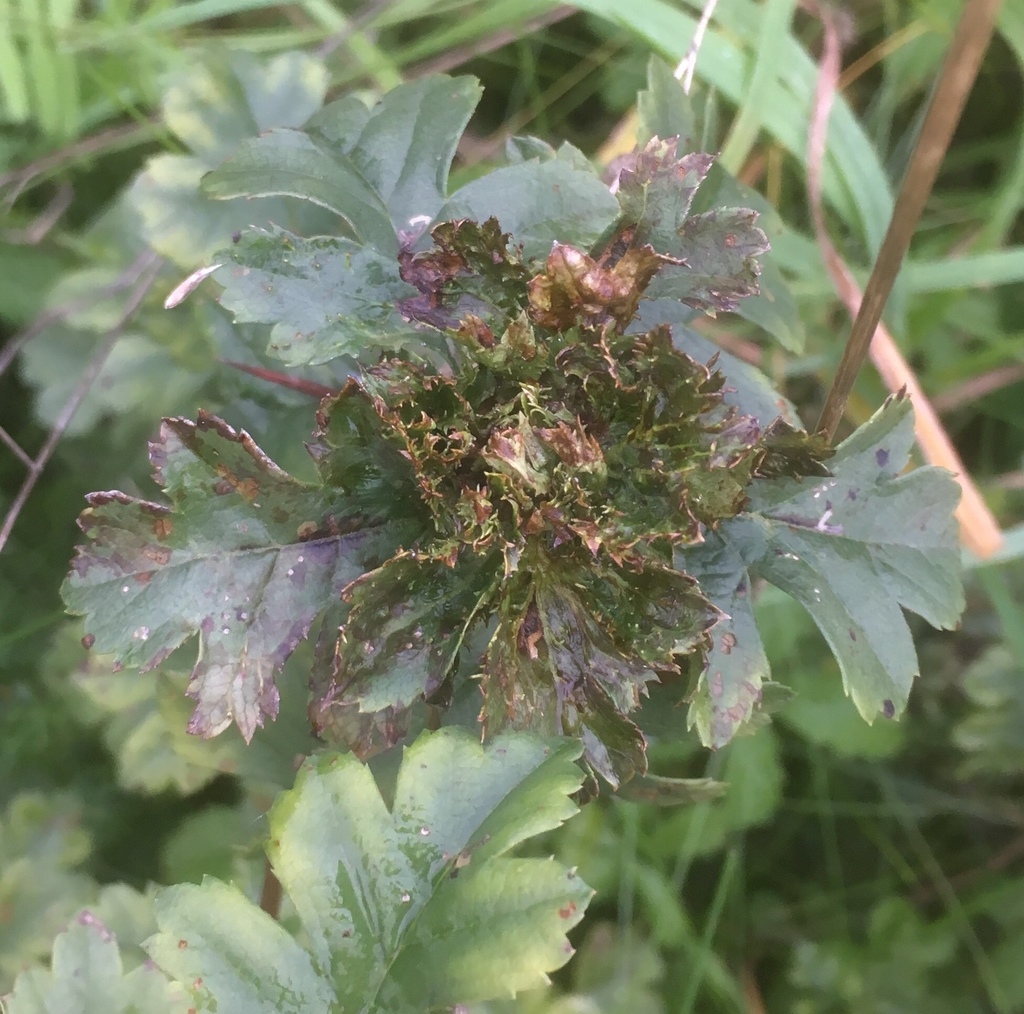
Hawthorn Button-top Midge
Dasineura crataegi
Dasineura crataegi (Winnertz, 1853), the hawthorn button-top gall-midge, is a dipteran gall-midge. It causes the hawthorn button-top gall, which develops in the terminal shoots of common hawthorn, Crataegus monogyna Jacq., midland hawthorn C laevigata (Poir.) DC and their hybrid, C × media Bechst. Synonyms are Perrisia crataegi and Cecidomyia crataegi (Winnertz, 1853).
From the article Dasineura crataegi on Wikipedia (CC BY-SA), quoted section by section
Description
The midge induces stunted and distorted rosettes in the host by inhibiting the elongation of the shoot; the rosette is formed from many (8 to 40 or more) slightly thickened and deformed leaves with reduced petioles. Many of the leaves have small green or red ligulate excrescences or projections. The midge larvae are of an orange-red colour. The gall is occasionally found on isolated plants, but infestation is more commonly in hedges, with the new growth resulting from hedge cutting being the site of high density populations. The rosettes stand out prominently against the sky. Old galls persist and new shoots grow from unaffected buds lying well behind the terminal bud.
Wikipedia: “Appearance of the gall”
Range & habitat
The hawthorn button-top gall midge shows a scattered distribution throughout England, however it is an under recorded species. The gall can be controlled by spraying with insecticide at the larval stage.
Wikipedia: “Distribution and control”
Listen
Looking for field recordings…
Where it lives
Recorded sightings
—
geo-referenced records in GBIF, from museums, herbaria and field observers.
Drag the globe to turn it. Dots are where records exist, not a range map; darker means more records.
In the stacks
Searching the stacks…
Every page naming Dasineura crataegi in the Biodiversity Heritage Library →
This page is assembled live from iNaturalist, GBIF, Wikipedia, the Source Library and the Internet Archive. It is not yet part of the hand-edited codex. iNaturalist taxon 469424.