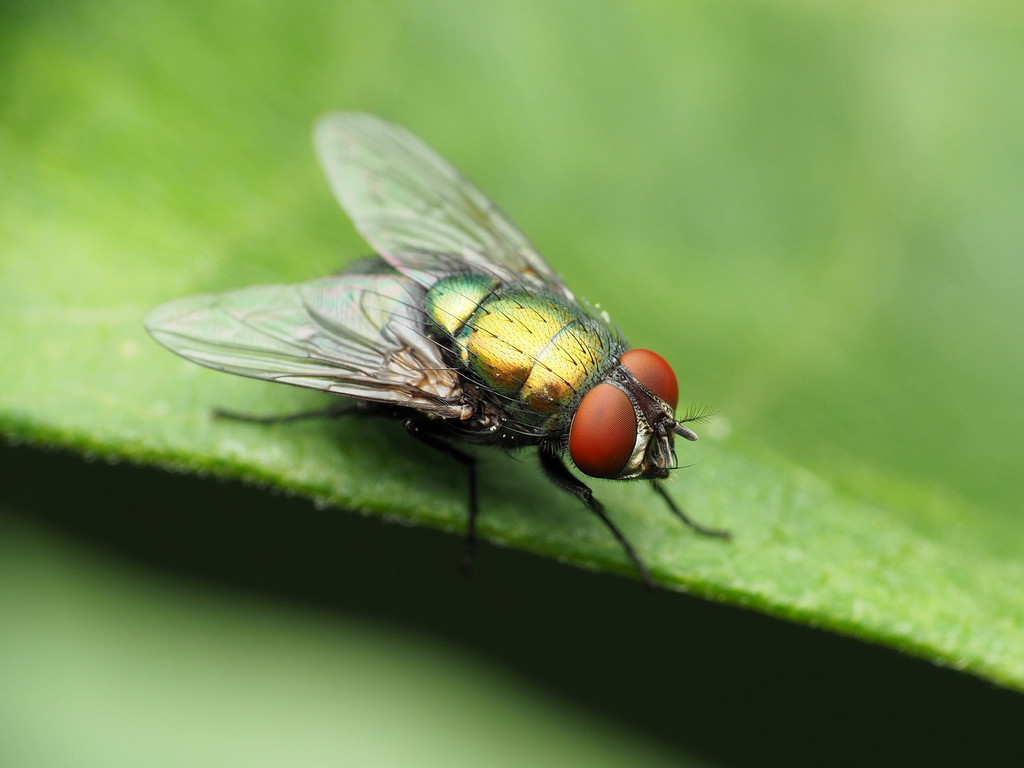
Flies
Diptera
A fly (pl. flies) is an insect of the order Diptera (from Ancient Greek δι- di- 'two' and πτερόν pteron 'wing'), named for the single pair of wings. The hindwings have evolved into halteres, organs that sense rotation, giving flies precise control of their flight. Diptera is a large order containing more than 150,000 species, including horse-flies, crane flies, hoverflies, mosquitoes and others.
Flies have a mobile head, with a pair of large compound eyes, and mouthparts designed either for piercing and sucking (in mosquitoes, black flies, and robber flies) or for lapping and sucking (in the other groups). Their wing arrangement gives them great manoeuvrability in flight, and claws and pads on their feet enable them to cling to smooth surfaces. Flies undergo complete metamorphosis; the eggs are often laid on the larval food-source, and the larvae, which lack true limbs, develop in a protected environment, often inside their food source. Other species are ovoviviparous, opportunistically depositing hatched or hatching larvae, instead of eggs, on carrion, dung, decaying material, or open wounds of mammals. Members of superfamily Hippoboscoidea exhibit adenotrophic viviparity, laying advanced pre-pupae on substrates suitable for burrowing and pupation. The pupa is a tough capsule from which the adult emerges when ready to do so; flies mostly have short lives as adults.
2 branches of this order, most-observed first
See this branch on the Wheel of Life →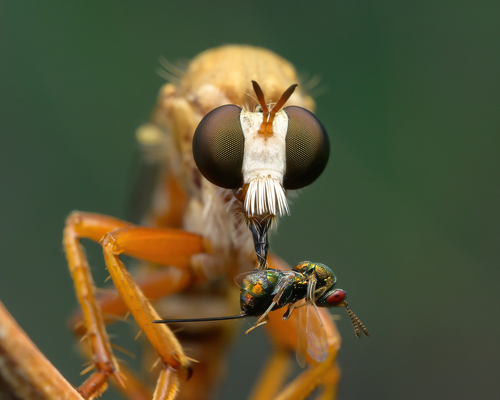

Where it lives
Recorded sightings
—
geo-referenced records in GBIF, from museums, herbaria and field observers.
Drag the globe to turn it. Dots are where records exist, not a range map; darker means more records.
In the stacks
Searching the stacks…
Every page naming Diptera in the Biodiversity Heritage Library →
This page is assembled live from iNaturalist, GBIF, Wikipedia, the Source Library and the Internet Archive. It is not yet part of the hand-edited codex. iNaturalist taxon 47822.