 NL·0446
Herbarium of the Nature Library
- Name
- Lynx lynx
- Family
- Felidae
- Native to
- Northern and central Europe, Russia, Central Asia, the Caucasus, Ladakh, Gilgit-Baltistan, Tibet and northeastern China
- Habitat
- Boreal forest, Temperate forest, Alpine scrub, Cold desert
Eurasian lynx
Lynx lynx
Also calledRys' (Russian) · Ilves (Finnish) · Gaupe (Norwegian) · Lince boreal (Spanish) · Lince-euroasiático (Portuguese) · Shīlūsī 猞猁 (Chinese)
The largest lynx and Europe's third-largest predator, a long-legged, tuft-eared cat of forest and mountain from Scandinavia to the Tibetan Plateau. Reintroductions have returned it to Switzerland, Germany and France, and the pale Himalayan form lives in Ladakh and northern Pakistan.
The Eurasian lynx is one of the four extant species within the medium-sized wild cat genus Lynx. It is widely distributed from Northern, Central and Eastern Europe to Central Asia and Siberia, the Tibetan Plateau and the Himalayas. It inhabits temperate and boreal forests up to an elevation of 5,500 m (18,000 ft). Despite its wide distribution, it is threatened by habitat loss and fragmentation, poaching and depletion of prey. Wikipedia
What it can do
- iKills deer such as roe deer and even reindeer, prey several times its weight
- iiLarge, fur-padded paws act as snowshoes
- iiiEar tufts and facial ruff help in visual communication
In the field
Field marks
- aSilhouette: long legs, short body and short bob tail with a black tip
- bBlack ear tufts and a broad facial ruff
- cCoat greyish to reddish with varying dark spots; Himalayan lynx pale sandy and faintly spotted
- dTracks: round, 7–9 cm, no claw marks; in snow very wide due to hairy feet; signs include roe-deer kills covered with snow or leaves
- Voice
- Mostly silent; in the late-winter breeding season gives far-carrying, mournful calls and hisses.
- Not to be confused with
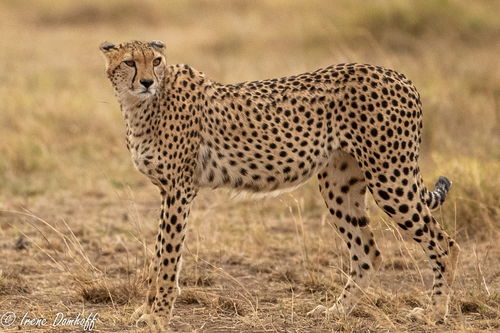
- Iberian lynx (Spain and Portugal only) is smaller with bold dark spots. Caracal (Pakistan and India lowlands) is plain tawny with very long ear tufts and no ruff or bob tail. Wildcat has a long, ringed tail.
- Where to see it
- Bohemian Forest (Czechia–Germany); Swiss Jura and Alps; Carpathians (Slovakia, Romania); Białowieża (Poland); Hemis and Changthang (Ladakh); Finnish taiga hides
- When
- Resident; winter snow makes tracking easiest (January–March is breeding season)
Listen
Looking for field recordings…
Life & habits
- Diet
- Roe deer, chamois, musk deer, reindeer, hares, marmots and birds
- Habitat
- Dense forest and rocky mountain terrain; in Ladakh, arid rocky slopes and willow scrub
- Size
- 18–30 kg (males larger); body 80–130 cm, short tail 11–25 cm
- Lifespan
- About 15 years in the wild
Solitary hunter that ambushes from cover or stalks; returns to large kills for several nights.
Where it lives
Recorded sightings
—
geo-referenced records in GBIF, from museums, herbaria and field observers.
Native range
Northern and central Europe, Russia, Central Asia, the Caucasus, Ladakh, Gilgit-Baltistan, Tibet and northeastern China
Drag the globe to turn it. Dots are where records exist, not a range map; darker means more records.
In the old herbals & bestiaries
Woodcuts and engravings matched from the Source Library’s scanned books by name. Plates marked “relative” show a close kin rather than this exact species. Click a plate to read the page it came from, with translation.

Garden of Health
Jacob Meydenbach · 1491 · p.777

Ortus sanitatis
1491 · p.779

Ortus sanitatis
1491 · p.564

Garden of Health
Jacob Meydenbach · 1491 · p.562

Introductory Book
Michael Scot · 1350 · p.154

Introductory Book
Michael Scot · 1350 · p.132

Thesaurus of Medical Things of New Spain, or History of Mexican Plants, Animals, and Minerals
Francisco Hernández; Nardo Antonio Recchi (ed.) · 1651 · p.549
In the stacks
Searching the stacks…
Every page naming Lynx lynx in the Biodiversity Heritage Library →
Marginalia
Greek legend linked the lynx to Lynceus, the Argonaut who could see through walls, and the 'lynx-eyed' ideal named Rome's Accademia dei Lincei (founded 1603). Theophrastus described 'lyngurium', a gem supposedly formed from hardened lynx urine.
Curiosity
The Accademia dei Lincei, named after the lynx's keen sight, counted Galileo among its early members.
Kinship
Photographs: iNaturalist contributors under the licences shown. Records: GBIF.org. Historical plates: Source Library (CC BY-SA 4.0; originals public domain). Summary text: Nature Library editors and Wikipedia (CC BY-SA). Medicinal and edibility notes are historical and educational, not advice. iNaturalist taxon 41979.