 NL·0449
Herbarium of the Nature Library
- Name
- Panthera pardus
- Family
- Felidae
- Native to
- Sub-Saharan Africa, scattered in North Africa and Arabia, Caucasus and Iran, South Asia, Southeast Asia, China and the Russian Far East
- Habitat
- Savanna, Tropical forest, Dry forest, Mountains, Desert edge, Urban fringe
Leopard
Panthera pardus
Also calledTenduā / Guldār (Hindi) · Chītā (Urdu, traditional) · Palang (Persian) · Namir (Arabic) · Chui (Swahili) · Ingwe (Zulu) · Leopardo (Spanish/Portuguese)
The most adaptable big cat, found from the Cape to the Russian Far East and from rainforest to desert and the edges of Mumbai. A stealthy, solitary hunter, it is strong enough to drag prey heavier than itself up into trees. It has lost much of its historic range, and some subspecies, such as the Amur and Arabian leopards, are critically endangered.
The leopard is one of the five extant cat species in the genus Panthera. It has a pale yellowish to dark golden fur with dark spots grouped in rosettes. Its body is slender and muscular, reaching a length of 92–183 cm (36–72 in) with a 66–102 cm (26–40 in) long tail and a shoulder height of 60–70 cm (24–28 in). Males typically weigh 30.9–72 kg (68–159 lb), and females 20.5–43 kg (45–95 lb). Wikipedia
What it can do
- iHoists carcasses of antelope and young giraffe into trees to keep them from lions and hyenas
- iiEats prey from dung beetles to eland; one of the broadest diets of any cat
- iiiLives in and around large cities such as Mumbai, hunting dogs and pigs at night
In the field
Field marks
- aGolden to tawny coat with black rosettes (rings without central spots) on the body, solid spots on head and legs
- bLong tail, often with white underside of the tip, used as a signal
- cCompact, low-slung build; relatively large head
- dTracks: rounded, about 7–10 cm wide, four toes and no claw marks; signs include kills cached in trees and scratch marks on trunks
- Voice
- A harsh, repeated rasping cough like a saw cutting wood, given to advertise territory.
- Not to be confused with
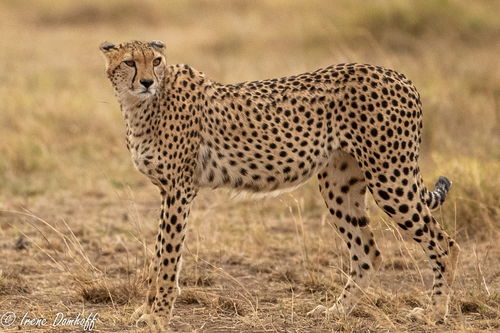
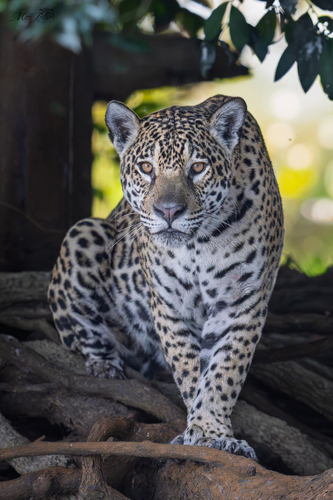
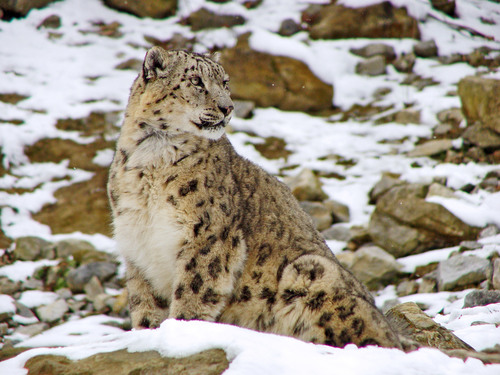
- Cheetah has solid round spots (not rosettes), black 'tear lines' and a slender build. Jaguar (Americas only) is heavier with larger rosettes containing central spots. Snow leopard is grey-white with a very thick tail.
- Where to see it
- Yala National Park (Sri Lanka); Jhalana Leopard Reserve (Jaipur); Sanjay Gandhi National Park (Mumbai); Bera (Rajasthan); Margalla Hills (Islamabad); Sabi Sands (South Africa); Maasai Mara (Kenya); South Luangwa (Zambia)
- When
- Resident year-round
Listen
Looking for field recordings…
Life & habits
- Diet
- Carnivore: antelope, deer, monkeys, wild pigs, rodents, birds, dogs and livestock
- Habitat
- Almost any habitat with cover: forests, savanna, rocky hills, mountains and farmland
- Size
- Males 37–90 kg, females 28–60 kg; 1.6–2.9 m including tail
- Lifespan
- About 12–17 years in the wild
Solitary and mainly nocturnal, stalking to close range before pouncing. Females raise cubs alone, moving them between hidden dens.
Where it lives
Recorded sightings
—
geo-referenced records in GBIF, from museums, herbaria and field observers.
Native range
Sub-Saharan Africa, scattered in North Africa and Arabia, Caucasus and Iran, South Asia, Southeast Asia, China and the Russian Far East
Drag the globe to turn it. Dots are where records exist, not a range map; darker means more records.
In the old herbals & bestiaries
Woodcuts and engravings matched from the Source Library’s scanned books by name. Plates marked “relative” show a close kin rather than this exact species. Click a plate to read the page it came from, with translation.

Beowulf (Cotton MS Vitellius A.xv)
Anonymous · 1000 · p.210

Collected Illustrations of the Three Powers (Sancai Tuhui), Vol. 63
王圻, 王思義 · 1609 · p.60

Introductory Book
Michael Scot · 1350 · p.137

Introductory Book
Michael Scot · 1350 · p.154

Ortus sanitatis
1491 · p.561

Garden of Health
Jacob Meydenbach · 1491 · p.559

Garden of Health
Jacob Meydenbach · 1491 · p.573

Garden of Health (Hortus Sanitatis)
Jacob Meydenbach · 1491 · p.527

Garden of Health
1507 · p.457

Garden of Health
1507 · p.470
In the stacks
Searching the stacks…
Every page naming Panthera pardus in the Biodiversity Heritage Library →
Marginalia
Jim Corbett's 'The Man-eating Leopard of Rudraprayag' tells of a leopard that killed over 120 people in Garhwal before he shot it in 1926. The leopard-skin was the regalia of many African kings and chiefs.
Curiosity
Black panthers are melanistic leopards (or jaguars): in strong light the rosettes still show through the black coat.
Kinship
Fact-checked: 1 correction made to this sheet. Photographs: iNaturalist contributors under the licences shown. Records: GBIF.org. Historical plates: Source Library (CC BY-SA 4.0; originals public domain). Summary text: Nature Library editors and Wikipedia (CC BY-SA). Medicinal and edibility notes are historical and educational, not advice. iNaturalist taxon 41963.