- Animals
- ›Arthropods
- ›Hexapods
- ›Insects
- ›Winged and Once-winged Insects
- ›Flies
- ›Nematoceran Flies
- ›Gnats and Allies
- ›Fungus Gnats and Gall Midges
- ›Gall and Forest Midges
- ›Gall Midges
- ›Lasiopteridi
- ›Dasineurini
- ›Dasineura
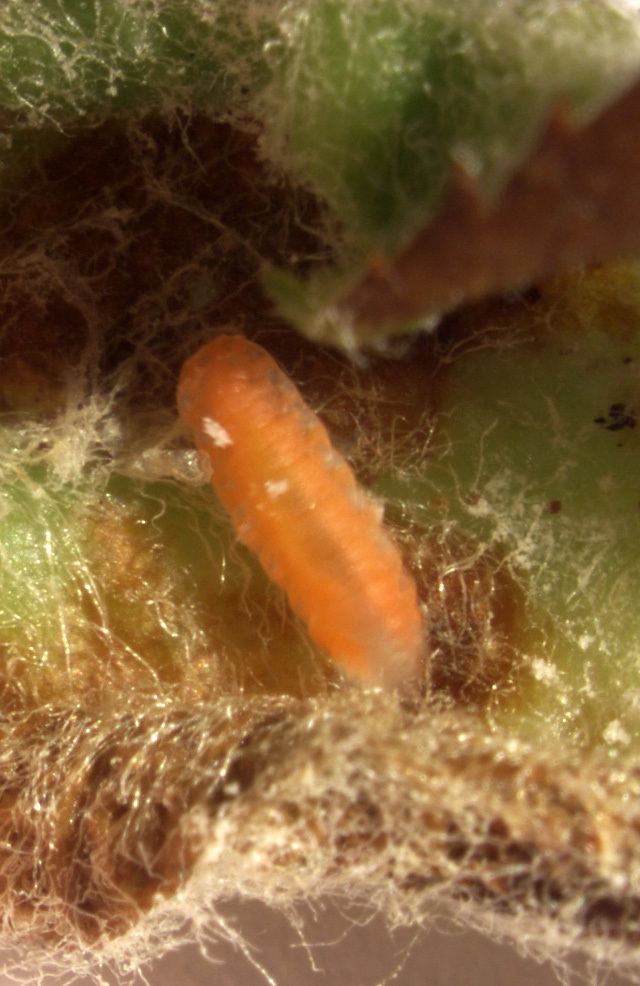
Apple Leafcurling Midge
Dasineura mali
Dasineura mali, commonly known as the apple leaf curling midge or the apple leaf midge, is a species of gall midge belonging to the family Cecidomyiidae, within the order Diptera.
As a member of the family Cecidomyiidae, D. mali is grouped with other midges, a diverse selection of tiny flies, some of which are known for their ability to induce gall formation on host plants.
From the article Dasineura mali on Wikipedia (CC BY-SA), quoted section by section
Description
Dasineura mali is a minute and delicate species of dipteran, belonging to the family Cecidomyiidae. Adults measure between 2 and 3 mm (0.08 and 0.12 in) in length. Identifying features include the long moniliform antennae with whorls of fine hairs, which are used for sensory perception and navigation. It has small, simple ocelli which enable light detection and orientation. Its wings appear fringed with fine hairs, with a low number of longitudinal veins and lacking obvious cross veins; these factors contribute to its fragile appearance. This midge's coxae are not elongated, and its tibiae lack spurs, which distinguishes it from related species. Its tibiae provide support and stability during movement. Larvae with red or orange hues are characteristic of D. mali, though differentiation from other species can be challenging, as larvae may also exhibit a yellow or white colour. To identify D. mali larvae, the length of setose papillae on the first thoracic segment and the shape of the sternal spatula are measured. Larval characteristics include small heads with pigment spots but no eyes. The body has thirteen visible trunk segments and nine pairs of spiracles on the prothorax and first eight abdominal segments, facilitating respiration during development. The sternal spatula, a mid-ventral structure on the thorax, is a distinguishing feature of D. …
Range & habitat
Dasineura mali originated in the Palaearctic region, where it evolved alongside its primary host, the apple (Malus domestica). Accidental introductions to new regions expanded its distribution, reaching North America and New Zealand. These introductions provided opportunities for D. mali to establish populations beyond its native range. It has spread to three regions: Europe, America, and New Zealand, where it prefers host plants belonging to Rosaceae, which includes apples, peaches, pears, and cherries. In North America, insects that initially fed on wild relatives of these host plants, such as native roses, may have gradually adapted to cultivated apple trees. The historical association between D. mali and the wild species within the Rosaceae family likely facilitated its transition to cultivated apple trees as its primary host.
Wikipedia: “Natural global range”
What it does
Dasineura mali undergoes four generations yearly in most of New Zealand, from early spring to mid-autumn. In Central Otago, there are typically three or four generations based on summer temperatures. Adults emerge from soil litter, immediately mate, and lay eggs on growing shoots. Larvae develop within tightly rolled leaves for 2–3 weeks, during which time they are protected from insecticides. Mature larvae pupate in the ground and other sheltered locations. Overwintering as mature larvae in the soil is common among successive generations. The life cycle of D. mali begins with females laying their eggs on growing shoot tips of the host plant. The eggs incubate for 3–5 days, depending on the ambient temperature. When larvae emerge, they feed on the young leaves of the host plant. Feeding induces the formation of leaf galls on the outer edges of the leaves, providing a protective tent for larval development. As the larvae mature, they exit the leaf galls and descend to the soil, where they undergo pupation. The D. mali lifecycle exhibits distinct seasonal patterns, with larvae from the late third generation and all individuals in the fourth generation undergoing overwintering. During the winter months, they remain in their larval stage, awaiting the onset of spring. …
Wikipedia: “Life cycle and phenology”
Listen
Looking for field recordings…
Where it lives
Recorded sightings
—
geo-referenced records in GBIF, from museums, herbaria and field observers.
Drag the globe to turn it. Dots are where records exist, not a range map; darker means more records.
In the stacks
Searching the stacks…
Every page naming Dasineura mali in the Biodiversity Heritage Library →
This page is assembled live from iNaturalist, GBIF, Wikipedia, the Source Library and the Internet Archive. It is not yet part of the hand-edited codex. iNaturalist taxon 388390.