- Animals
- ›Chordates
- ›Vertebrates
- ›Reptiles
- ›Snakes and Lizards
- ›Snakes
- ›Elapid Snakes
- ›Australian Elapids (inc. Sea Snakes)
- ›True sea snakes
- ›Emydocephalus
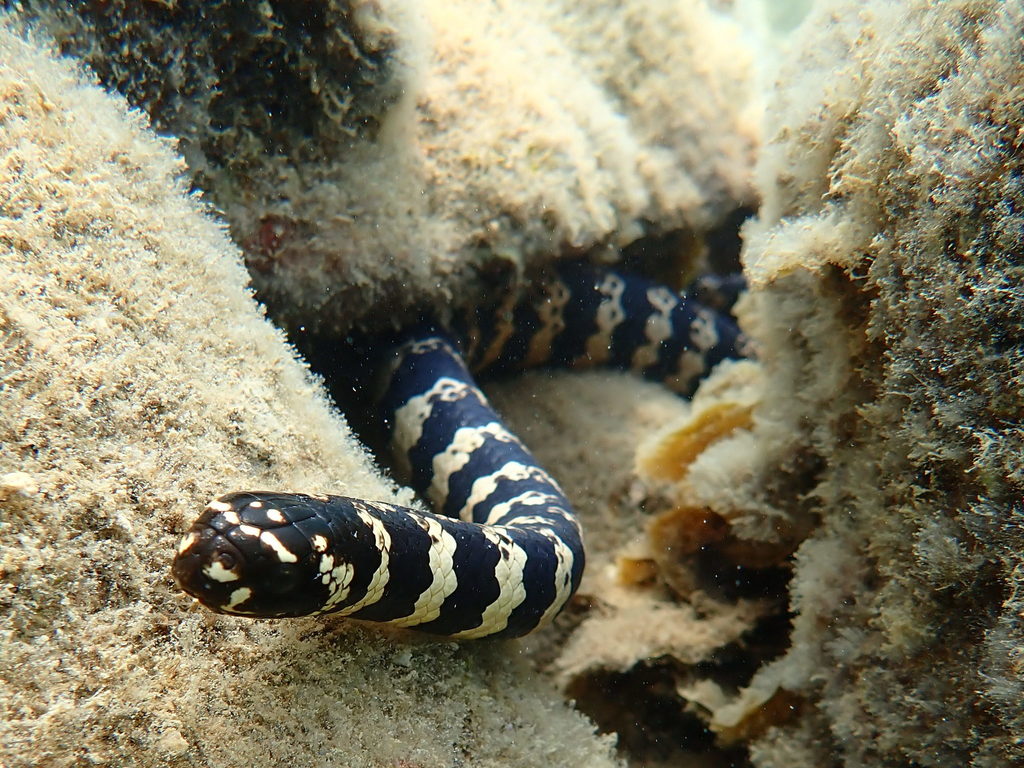
Eastern Turtle-headed Sea Snake
Emydocephalus annulatus
Emydocephalus annulatus, commonly known as the turtleheaded sea snake or egg-eating sea snake, is a species of sea snake that can be found in waters of Oceania near Australia and some Pacific Islands such as the Philippines and the Loyalty Islands of New Caledonia. The geographic range is sporadic, for example, with populations distributed near the eastern and western coasts of Australia in the Great Barrier Reef and the Timor Sea reefs, respectively. They do not, however, occur in the Gulf of Carpentaria along the north coast.
From the article Emydocephalus annulatus on Wikipedia (CC BY-SA), quoted section by section
Description
Named for its short, blunt head, this medium-sized snake has a slender build and varies in color. A single snake may exhibit only one color or may have banded patterns of white or yellow with dark rings. The scales on top of the head are large, regular, and entire. The rostral scale on the tip of the snout is conical in shape, and the second of three supralabial scales is the largest. The body has 15–17 rows of smooth, overlapping scales. It has 125–145 ventral scales, a single anal scale, and 20–33 single subcaudal scales. It may grow to 103 cm (41 in) in length. An individual snake's color affects the amount of algal fouling that accumulates on its body. A snake of a darker, more monotonous color has a higher level of algae build-up than one of a paler, patterned variety. The added weight of algae affects an individual's speed, reducing it by up to 20%. Those whose locomotive skills were affected had a tendency to be more inactive and choose to hide among the coral, while those with little to no algal fouling were found actively foraging. The inactivity, however, did not affect their survival rates; lighter-colored snakes were not more likely to survive than their darker-colored counterparts.
What it does
Curiously, Emydocephalus is the only sea snake that does not possess palatal teeth. Contrary to the foraging habits of other snakes, the turtle-head tends to eat smaller, more frequent meals rather than larger, infrequent prey: this sea snake feeds solely on fish eggs; specifically, the eggs of demersal fish that attach to the substrate, such as those of damselfish, blennies, and gobies. The larger the snake, the more likely it is to feed on damselfish eggs, which lie in exposed areas, rather than blennies' and gobies', whose eggs are located in narrow crevices. E. annulatus populations tend to stay where they are and rarely move between territories; they tend to be sedentary. This could possibly be related to the spatial memory of snakes and their ability to remember where nests are located. If they stay in the same area, then the snakes are able to feed regularly on the same sites. The feeding strategy of Emydocephalus has been compared to that of a grazing mammal. This atypical method of feeding is evidence of the great adaptive radiation of snakes.
Wikipedia: “Dietary habits”
Where it lives
Recorded sightings
—
geo-referenced records in GBIF, from museums, herbaria and field observers.
Drag the globe to turn it. Dots are where records exist, not a range map; darker means more records.
In the stacks
Searching the stacks…
Every page naming Emydocephalus annulatus in the Biodiversity Heritage Library →
This page is assembled live from iNaturalist, GBIF, Wikipedia, the Source Library and the Internet Archive. It is not yet part of the hand-edited codex. iNaturalist taxon 35256.