- Animals
- ›Chordates
- ›Vertebrates
- ›Reptiles
- ›Snakes and Lizards
- ›Snakes
- ›Elapid Snakes
- ›Australian Elapids (inc. Sea Snakes)
- ›Hemiaspis
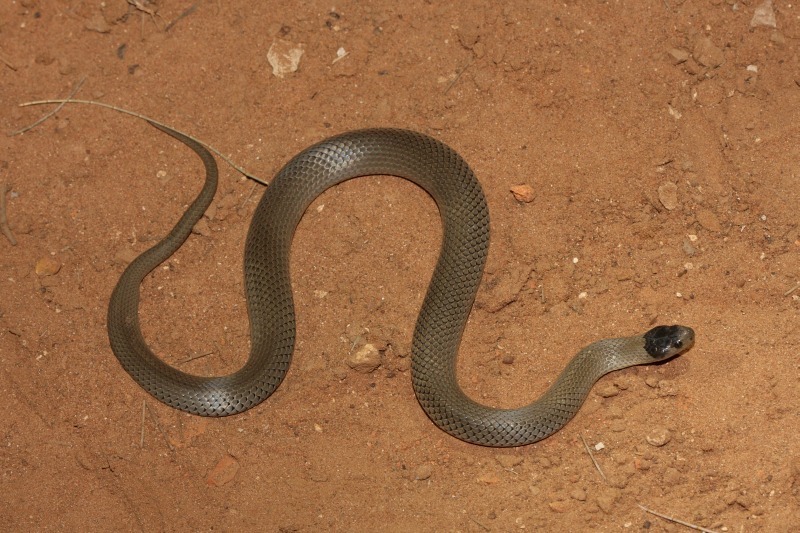
Grey Snake
Hemiaspis damelii
Hemiaspis damelii is a species of venomous snake in the family Elapidae. It is a relatively small species of elapid with a mean snout-vent length (SVL) of 42.6 to 60 cm (16.8 to 23.6 in). The species is endemic to eastern Australia and is most commonly found across central inland New South Wales through to the interior of south-eastern Queensland. Common names for this species include ngabi, grey snake and Dämel's Snake. The specific name, damelii, is in honor of German entomologist Edward Dämel, who collected Australian specimens for Museum Godeffroy.
From the article Hemiaspis damelii on Wikipedia (CC BY-SA), quoted section by section
Description
H. damelii is a relatively small snake with an average snout-to-vent length (SVL) of 50 centimetres (20 inches). Minor size differences occur between sexes, with the males averaging a slightly larger size than females. It is olive to grey dorsally, and white to yellowish white ventrally, often flecked with dark grey. In some grey snakes, each scale may be tipped with black anteriorly, particularly on the flanks. It has smooth dorsal scales which are in 17 rows at mid-body, 140-170 ventral scales, and 35-50 subcaudals which are single (undivided). This species also has a paired (divided) anal scale. Juvenile grey snakes have a distinctive black head which fades or sometimes completely disappears as the snake matures, occurring from the top of the head to the second scale row behind the parietals.
Range & habitat
The distribution and ecology of H. damelii is poorly known. Existing records of the grey snake are most commonly found in south-eastern Queensland and north-central New South Wales, however small populations have also been found to occur in north-eastern South Australia and south-western New South Wales. It tends to favour dry sclerophyll forests and woodlands on clay soils where water bodies or gullies are present. It shelters under rocks, logs and other debris, as well as in cracks in soil.
Wikipedia: “Distribution and habitat”
What it does
The breeding period for H. damelii occurs from January to March. During Spring (September-October) adult females' ovarian follicles increase in size following ovulation in preparation of the breeding season. H. damelii has a relatively high fecundity, partly due to its large maternal snout-vent length (SVL), which has been found to significantly correlate with litter size. Litter size can range from 4-16 live young which are born fully formed (viviparous). The newborns take an average of 12 months to mature after birth.
Wikipedia: “Reproduction and life cycle”
Toxicity
The venom of H. damelii is fairly mild and is unlikely to cause fatalities in humans; however, a bite from a larger specimen may be very painful. The venom contains procoagulants and causes local pain and swelling.
Wikipedia: “Venom and symptoms”
Where it lives
Recorded sightings
—
geo-referenced records in GBIF, from museums, herbaria and field observers.
Drag the globe to turn it. Dots are where records exist, not a range map; darker means more records.
In the old herbals & bestiaries

In the stacks
Searching the stacks…
Every page naming Hemiaspis damelii in the Biodiversity Heritage Library →
This page is assembled live from iNaturalist, GBIF, Wikipedia, the Source Library and the Internet Archive. It is not yet part of the hand-edited codex. iNaturalist taxon 35244.