- Animals
- ›Chordates
- ›Vertebrates
- ›Reptiles
- ›Snakes and Lizards
- ›Snakes
- ›Elapid Snakes
- ›Australian Elapids (inc. Sea Snakes)
- ›Hoplocephalus
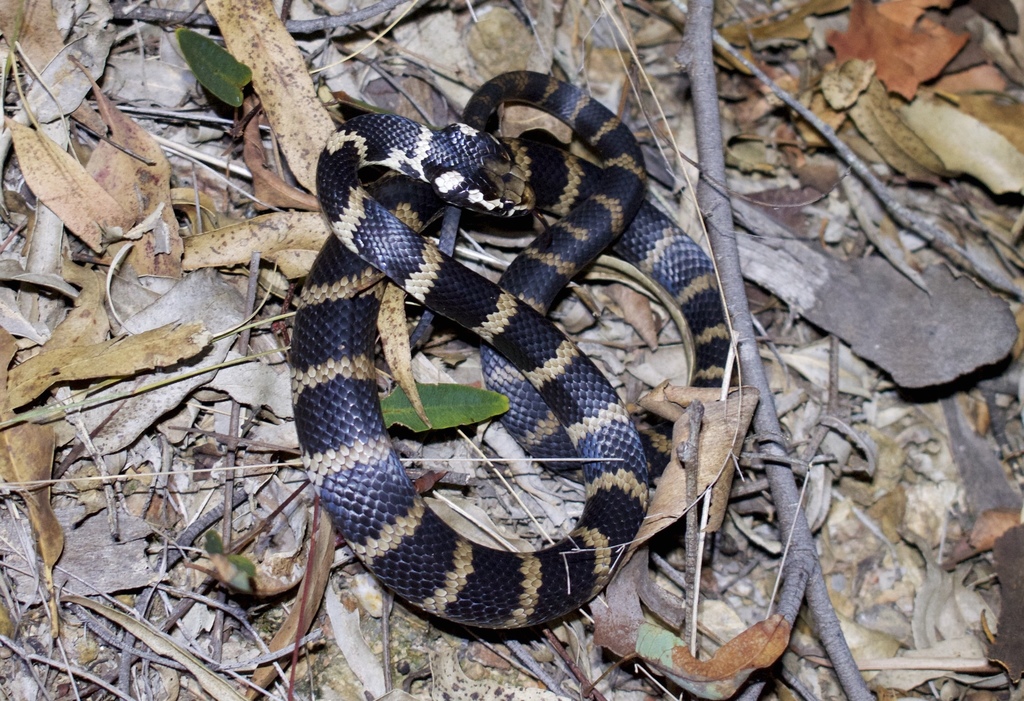
Stephens' Banded Snake
Hoplocephalus stephensii
Stephens's banded snake (Hoplocephalus stephensii) is a species of highly venomous tree snake in the family Elapidae. The species is endemic to Australia.
From the article Stephens's banded snake on Wikipedia (CC BY-SA), quoted section by section
Description
H. stephensii grows up to 1 meter (39 inches) in total length (including tail), with some specimens having been recorded as having a total length upwards of 120 cm (47 in). The Stephens' banded snake is the largest species within the genus Hoplocephalus, weighing up to 250 g (8.8 oz) as an adult. On average, females of this species are larger than males. This slight sexual dimorphism is an adaptation that likely improves the reproductive capabilities of females. The anterior scalation of Stephens's banded snake consists of 21 rows of midbody dorsal scales, and 220 to 250 ventral scales. Posteriorly, its singular subcaudal scales can range between 50 and 70 scales from the anal plate to the tip of the tail. This species has a singular (undivided) anal plate that covers its cloacal opening. The ventral scales of the genus Hoplocephalus differ from other elapids as they have lateral notches along the caudal border of each of these scales. This adaptation aids with gripping onto branches whilst climbing. Additionally, the occipital scales on the head of this snake are elongated. The body of the Stephens's banded snake is adorned with alternating grey or black and dirty-white bands of colouration on the dorsal side of the snake. These snakes may have over 40 of each colour band from the back of the head to the tip of the tail. …
Range & habitat
The Stephens's banded snake is endemic to the east coast of Australia. The distribution of this snake spans from its northern most range in the Kroombit tops of south-eastern Queensland down to the Gosford Area of New South Wales. Within this coastal range, the species is typically restricted to high-rainfall remnant forest regions, secluded from human intervention. The Stephens's banded snake can be found up to an altitude of 950 m (3,120 ft) above sea level within its geographical range. Studies on the habitat preferences of this species have found that it prefers to reside around 20 m (66 ft) high in canopy trees. H. stephensii has a broad tolerance for variations in abiotic and biotic factors such as vegetal communities and climatic changes within the constraints of its remnant forest habitats. The species will favour areas with less rugged terrain as well as hollow bearing trees, dense understory vegetation or rocky outcrops that it may utilise to seek refuge. Individual male Stephens's banded snakes occupy an average home range of 20.2 hectares (49.9 acres). Whilst the females of the species have a much smaller average home range of 5.4 hectares (13.3 acres). This difference is likely due to the fact that males may venture out of their typical territories in order to find a viable mate.
Wikipedia: “Distribution and habitat”
What it does
Stephens's banded snake has been described as having a nervous and defensive temperament towards other animals. This species of snake is a relatively solitary animal, only voluntarily interacting with other individuals of the same species during mating season, in which males will actively pursue females to reproduce. If females are apprehensive to reproduce upon the pursuit of potential mates, they may assume a stereotypical posture that is used to prevent males from engaging in copulation. The female will form a tight coil with its body, with its vent in the centre coil, out of reach from the male. Stephens's banded snake is one of the few predominantly arboreal elapid species in Australia. Other Australian elapidae that exhibit similar arboreality include the broad-headed snake and the pale-headed snake, both of which belong to the genus Hoplocephalus. Stephens's banded snake is also capable of living a terrestrial lifestyle depending on the available resources in its environment. The species is nocturnal; thus, it spends a large portion of the day sequestering in the canopy tree hollows within the mesic forests in which it resides. The Stephens's banded snake displays significant reluctance with its heliothermic behaviours. Due to its small size it is at risk of predation. Therefore, this snake will spend minimal time basking amongst the branches of trees. …
Wikipedia: “Behavior”
Toxicity
The Stephens's banded snake has been described as a ready biter with its subsequent envenoming being potentially fatal. The venom of H. stephensii is a procoagulant and has typically been described as exhibiting a defibrination-type coagulopathy in patients. Therefore, envenomation will result in a reaction known as venom-induced consumption coagulopathy (VICC). Systemic symptoms of VICC include nausea, headache, abdominal pain, vomiting and diarrhoea as well as diaphoresis. The venom contains prothrombinase, a complex that prompts the production of the thrombin enzyme in the blood. This enzymatic reaction induces micro clotting in the bloodstream of its victims. Effectually, this blocks the flow of blood throughout the body. If left untreated, the clotting will cause blood vessels to rupture. Consequentially, the envenomated victim will experience excessive bleeding. Presently, no anti-venom has been derived from the venom of the Stephens's banded snake. Despite this, it has been documented that victims of this snake's envenomation have been successfully treated using up to 4 doses of 3,000 unit tiger snake anti-venom. Despite the lethality of the venom of H. stephensii, there has only been one recorded fatality of its envenomation. The victim of this fatal encounter was an elderly man in his 60s from the town of Kalang in New South Wales. …
Wikipedia: “Venom”
Where it lives
Recorded sightings
—
geo-referenced records in GBIF, from museums, herbaria and field observers.
Drag the globe to turn it. Dots are where records exist, not a range map; darker means more records.
In the stacks
Searching the stacks…
Every page naming Hoplocephalus stephensii in the Biodiversity Heritage Library →
This page is assembled live from iNaturalist, GBIF, Wikipedia, the Source Library and the Internet Archive. It is not yet part of the hand-edited codex. iNaturalist taxon 35233.