- Animals
- ›Chordates
- ›Vertebrates
- ›Reptiles
- ›Snakes and Lizards
- ›Snakes
- ›Elapid Snakes
- ›Australian Elapids (inc. Sea Snakes)
- ›Pseudechis
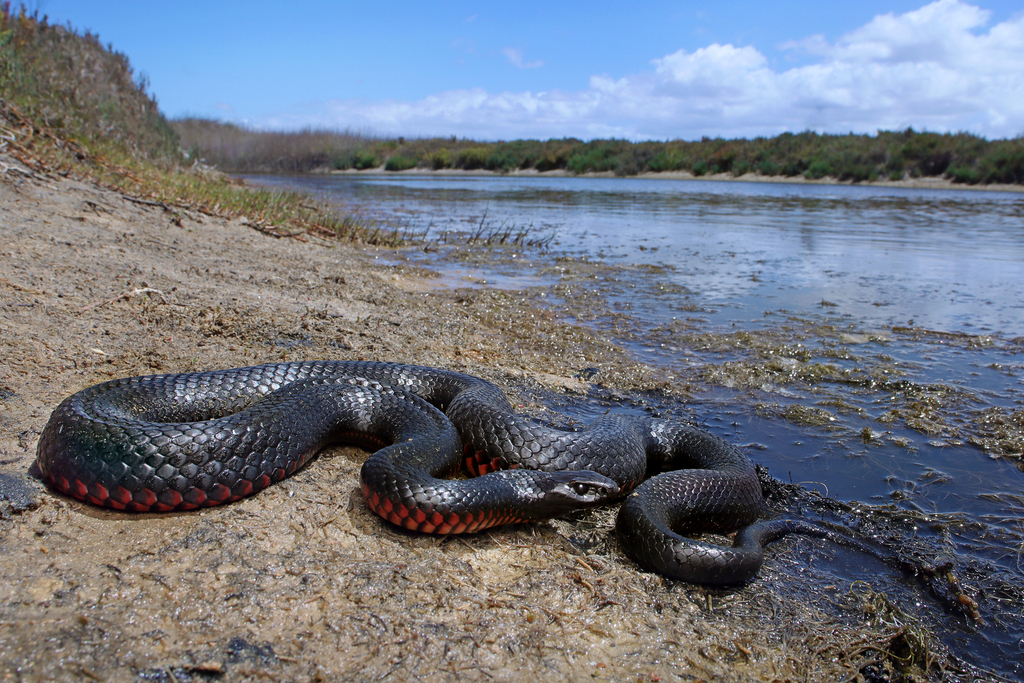
Red-bellied Black Snake
Pseudechis porphyriacus
The red-bellied black snake (Pseudechis porphyriacus) is a species of venomous snake in the family Elapidae. The species is indigenous to Australia. Originally described by George Shaw in 1794 as a species new to science, it is one of eastern Australia's most commonly encountered snakes. Averaging around 1.25 m (4 ft 1 in) in total length (tail included), it has glossy black upperparts, bright red or orange flanks, and a pink or dull red belly. It is not aggressive and generally retreats from human encounters, but will defend itself if provoked. Although its venom can cause significant illness, no deaths have been recorded from its bite, which is less venomous than other Australian elapid snakes. The venom contains neurotoxins, myotoxins, and coagulants and has haemolytic properties. Victims can also lose their sense of smell.
Common in woodlands, forests, swamplands, and along river banks and waterways, the red-bellied black snake often ventures into nearby urban areas. It forages in bodies of shallow water, commonly with tangles of water plants and logs, where it hunts its main prey item, frogs, as well as fish, reptiles, and small mammals. The snake is a least-concern species according to the IUCN, but its numbers are thought to be declining due to habitat fragmentation and decline of frog populations.
From the article Red-bellied black snake on Wikipedia (CC BY-SA), quoted section by section
Description
The red-bellied black snake has a glossy black top body with a light-grey snout and brown mouth, and a completely black tail. It lacks a well-defined neck; its head merges seamlessly into the body. Its flanks are bright red or orange, fading to pink or dull red on the belly. All these scales have black margins. Snakes from northern populations tend to have lighter, more cream or pink bellies. The red-bellied black snake is on average around 1.25 m (4 ft 1 in) in total length (tail included), the longest individual recorded at 2.55 m (8 ft 4 in). Males are generally slightly larger than females. A large 2 m (6 ft 7 in) specimen caught in Newcastle has been estimated to weigh around 10 kg (22 lb). The red-bellied black snake can have a strong smell, which some field experts have used to find the snakes in the wild. Like all elapid snakes, it is proteroglyphous (front-fanged). Juveniles are similar to the eastern small-eyed snake (Cryptophis nigrescens), with which they can be easily confused, although the latter species lacks the red flanks. Other similar species include the blue-bellied black snake (Pseudechis guttatus) and copperheads of the genus Austrelaps. An early misconception was that the red-bellied black snake was sexually dimorphic, and that the eastern brown snake (Pseudonaja textilis) was the female form. …
Range & habitat
The red-bellied black snake is native to the east coast of Australia, where it is one of the most commonly encountered snakes. It can be found in the urban forest, woodland, plains, and bushland areas of the Blue Mountains, Canberra, Sydney, Brisbane, Melbourne, Cairns, and Adelaide. The Macquarie Marshes mark a western border to its distribution in New South Wales, and Gladstone in central Queensland marks the northern limit to the main population. To the south, it occurs across eastern and central Victoria, and extends along the Murray River into South Australia. Disjunct populations occur in the southern Mount Lofty Ranges in South Australia and in North Queensland. The red-bellied black snake is most commonly seen close to dams, streams, billabongs, and other bodies of water, although they can venture up to 100 m (350 ft) away, including into nearby backyards. In particular, it prefers areas of shallow water with tangles of water plants, logs, or debris.
Wikipedia: “Distribution and habitat”
What it does
The red-bellied black snake can hide in many places in its habitat, including logs, old mammal burrows, and grass tussocks. It can flee into water and hide there; one was reported as staying submerged for 23 minutes. When swimming, it may hold its full head or its nostrils above the water's surface. At times, it may float without moving on the water surface, thus looking like a stick. Within its habitat, the red-bellied black snake appears to have a home range or territory with which it is familiar and within which it generally remains. A 1987 field study in three New South Wales localities found that these areas vary widely, from 0.02 to 40 ha (0.05 to 100 acres) in size. Within its territory, it may have some preferred places to reside. The red-bellied black snake is generally not an aggressive species, typically withdrawing when approached. If provoked, it recoils into a striking stance as a threat, holding its head and front part of its body horizontally above the ground and widening and flattening its neck. It may bite as a last resort. It is generally active by day, though nighttime activity occasionally has been recorded. When not hunting or basking, it may be found beneath timber, rocks, and rubbish or down holes and burrows. The red-bellied black snake is active when its body temperature is between 28 and 31 °C (82 and 88 °F). …
Wikipedia: “Behaviour”
Toxicity
Early settlers feared the red-bellied black snake, though it turned out to be much less dangerous than many other species. The murine median lethal dose (LD50) is 2.52 mg/kg when administered subcutaneously. A red-bellied black snake yields an average of 37 mg of venom when milked, with the maximum recorded being 94 mg. It accounted for 16% of identified snakebite victims in Australia between 2005 and 2015, with no deaths recorded. Its venom contains neurotoxins, myotoxins, and coagulants and also has haemolytic properties.
Bites from red-bellied black snakes can be very painful—needing analgesia—and result in local swelling, prolonged bleeding, and even local necrosis, particularly if the bite is on a finger. Severe local reactions may require surgical debridement or even amputation. Symptoms of systemic envenomation—including nausea, vomiting, headache, abdominal pain, diarrhoea, or excessive sweating—were thought to be rare, but a 2010 review found they occurred in most bite victims. Most people also go on to develop an anticoagulant coagulopathy in a few hours. This is characterised by a raised activated partial thromboplastin time (aPTT), and subsides over 24 hours. It resolves quickly with antivenom. A few people go on to develop a myotoxicity and associated generalised muscle pain and occasionally weakness, which may last up to 7 days. …
Wikipedia: “Venom”
In human culture
The red-bellied black snake was first described and named by English naturalist George Shaw in Zoology of New Holland (1794) as Coluber porphyriacus. Incorrectly assuming it was harmless and not venomous, he wrote, "This beautiful snake, which appears to be unprovided with tubular teeth or fangs, and consequently not of a venomous nature, is three, sometimes four, feet in nature." The specific name, porphyriacus, is derived from the Greek porphyrous, which can mean "dark purple", "red-purple" or "beauteous". It was the first Australian elapid described. The syntype is presumed lost. French naturalist Bernard Germain de Lacépède described it under the name Trimeresurus leptocephalus in 1804. His countryman René Lesson described it as Acanthophis tortor in 1826. German biologist Hermann Schlegel felt it was allied with cobras and called it Naja porphyrica in 1837.
The genus Pseudechis was created for this species by German biologist Johann Georg Wagler in 1830; several more species have been added to the genus subsequently. The generic name, Pseudechis, is derived from the Greek words pseudēs "false", and echis "viper". Snake expert Eric Worrell, in 1961, analysed the skulls of the genus and found that of the red-bellied black snake to be the most divergent. …
Wikipedia: “Taxonomy and etymology”
Where it lives
Recorded sightings
—
geo-referenced records in GBIF, from museums, herbaria and field observers.
Drag the globe to turn it. Dots are where records exist, not a range map; darker means more records.
In the stacks
Searching the stacks…
Every page naming Pseudechis porphyriacus in the Biodiversity Heritage Library →
This page is assembled live from iNaturalist, GBIF, Wikipedia, the Source Library and the Internet Archive. It is not yet part of the hand-edited codex. iNaturalist taxon 35153.