- Animals
- ›Chordates
- ›Vertebrates
- ›Reptiles
- ›Snakes and Lizards
- ›Snakes
- ›Elapid Snakes
- ›Australian Elapids (inc. Sea Snakes)
- ›Pseudonaja
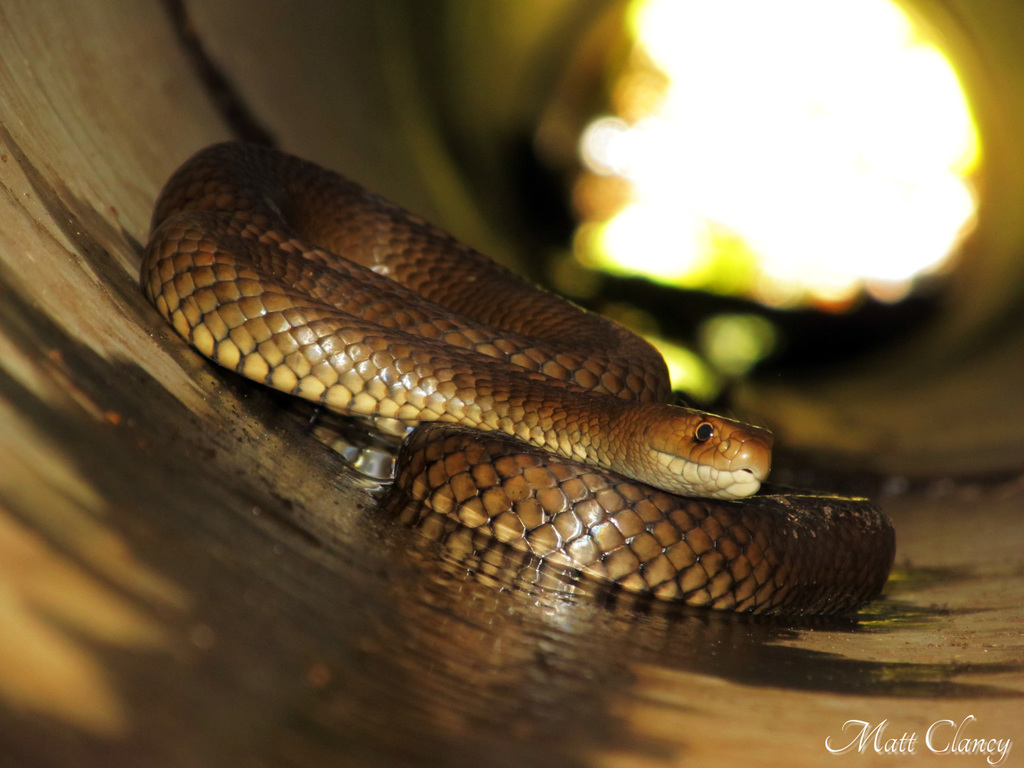
Eastern Brown Snake
Pseudonaja textilis
The eastern brown snake (Pseudonaja textilis), often referred to as the common brown snake, is a species of extremely venomous snake in the family Elapidae. The species is native to eastern and central Australia and southern New Guinea. It was first described by André Marie Constant Duméril, Gabriel Bibron, and Auguste Duméril in 1854. The adult eastern brown snake has a slender build and can grow to 2 m (7 ft) in length. The colour of its surface ranges from pale brown to black, while its underside is pale cream-yellow, often with orange or grey splotches. The eastern brown snake is found in most habitats except dense forests, often in farmland and on the outskirts of urban areas, as such places are populated by its main prey, the house mouse. The species is oviparous. The International Union for Conservation of Nature classifies the snake as a least-concern species, though its status in New Guinea is unclear.
It is considered the world's second-most venomous land snake after the inland taipan (Oxyuranus microlepidotus), based on its LD50 value (subcutaneous) in mice. The main effects of its venom are on the circulatory system: coagulopathy, haemorrhage (bleeding), cardiovascular collapse, and cardiac arrest. One of the main components of the venom is the prothrombinase complex pseutarin-C, which breaks down prothrombin.
From the article Eastern brown snake on Wikipedia (CC BY-SA), quoted section by section
Description
The eastern brown snake is of slender to average build with no demarcation between its head and neck. Its snout appears rounded when viewed from above. Most specimens have a total length (including tail) up to 1.5 m (4.9 ft), with some large individuals reaching 2 m (6.6 ft). The maximum recorded total length for the species is 2.4 m (7.9 ft). Evidence indicates that snakes from the northern populations tend to be larger than those from southern populations. The adult eastern brown snake is variable in colour. Its upper parts range from pale to dark brown, or sometimes shades of orange or russet, with the pigment more richly coloured in the posterior part of the dorsal scales. Eastern brown snakes from Merauke have tan to olive upper parts, while those from eastern Papua New Guinea are very dark grey-brown to blackish. The eastern brown snake's fangs are small compared to those of other Australian venomous snakes, averaging 2.8 mm (0.11 in) in length or up to 4 mm (0.16 in) in larger specimens, and are 11 mm (0.43 in) apart. The tongue is dark. The iris is blackish with a paler yellow-brown or orange ring around the pupil. The snake's chin and under parts are cream or pale yellow, sometimes fading to brown or grey-brown towards the tail. Often, orange, brown, or dark grey blotches occur on the under parts, more prominent anteriorly. …
Range & habitat
The eastern brown snake is found along the east coast of Australia, from Malanda in far north Queensland, along the coasts and inland ranges of Queensland, New South Wales, Victoria, and to the Yorke Peninsula in South Australia. Disjunct populations occur on the Barkly Tableland and the MacDonnell Ranges in the Northern Territory. and the far east of the Kimberley in Western Australia, and discontinuously in parts of New Guinea, specifically northern Milne Bay Province and Central Province in Papua New Guinea, and the Merauke region of South Papua, in the Indonesian part of New Guinea. It is common in southeastern Queensland between Ipswich and Beenleigh. The eastern brown snake occupies a varied range of habitats from dry sclerophyll forests (eucalypt forests) and heaths of coastal ranges, through to savannah woodlands, inner grasslands, and arid scrublands and farmland, as well as drier areas that are intermittently flooded. It is more common in open habitat and also farmland and the outskirts of urban areas. It is not found in alpine regions, or on Phillip Island. Because of its mainly rodent diet, it can often be found near houses and farms. …
Wikipedia: “Distribution and habitat”
What it does
The eastern brown snake is generally solitary, with females and younger males avoiding adult males. It is active during the day, though it may retire in the heat of hot days to come out again in the late afternoon. It is most active in spring, the males venturing out earlier in the season than females, and is sometimes active on warm winter days. Individuals have been recorded basking on days with temperatures as low as 14 °C (57 °F). Occasional nocturnal activity has been reported. At night, it retires to a crack in the soil or burrow that has been used by a house mouse, or (less commonly) skink, rat, or rabbit. Snakes may use the refuge for a few days before moving on, and may remain above ground during hot summer nights. During winter, they brumate, emerging on warm days to sunbathe. Fieldwork in the Murrumbidgee Irrigation Area found that snakes spent on average 140 days in a burrow over winter, and that most males had entered brumation by the beginning of May (autumn) while females did not begin till mid-May; the males mostly became active in the first week of September (spring), while the females not until the end of the month. …
Wikipedia: “Behaviour”
Toxicity
The eastern brown snake is considered the second-most venomous terrestrial snake in the world, behind only the inland taipan (Oxyuranus microlepidotus) of central east Australia. Responsible for more deaths from snakebite in Australia than any other species, it is the most commonly encountered dangerous snake in Adelaide, and is also found in Melbourne, Canberra, Sydney, and Brisbane. As a genus, brown snakes were responsible for 41% of identified snakebite victims in Australia between 2005 and 2015, and for 15 of the 19 deaths during this period. Within the genus, the eastern brown snake is the species most commonly implicated. It is classified as a snake of medical importance by the World Health Organization.
Clinically, the venom of the eastern brown snake causes venom-induced consumption coagulopathy; a third of cases develop serious systemic envenoming including hypotension and collapse, thrombotic microangiopathy, severe haemorrhage, and cardiac arrest. Other common systemic symptoms include nausea and vomiting, diaphoresis (sweating), and abdominal pain. Acute kidney injury and seizures can also occur. Onset of symptoms can be rapid, with a headache developing in 15 minutes and clotting abnormalities within 30 minutes; collapse has been recorded as occurring as little as two minutes after being bitten. …
Wikipedia: “Venom”
Where it lives
Recorded sightings
—
geo-referenced records in GBIF, from museums, herbaria and field observers.
Drag the globe to turn it. Dots are where records exist, not a range map; darker means more records.
In the stacks
Searching the stacks…
Every page naming Pseudonaja textilis in the Biodiversity Heritage Library →
This page is assembled live from iNaturalist, GBIF, Wikipedia, the Source Library and the Internet Archive. It is not yet part of the hand-edited codex. iNaturalist taxon 35140.