- Animals
- ›Chordates
- ›Vertebrates
- ›Reptiles
- ›Snakes and Lizards
- ›Snakes
- ›Elapid Snakes
- ›Australian Elapids (inc. Sea Snakes)
- ›Vermicella
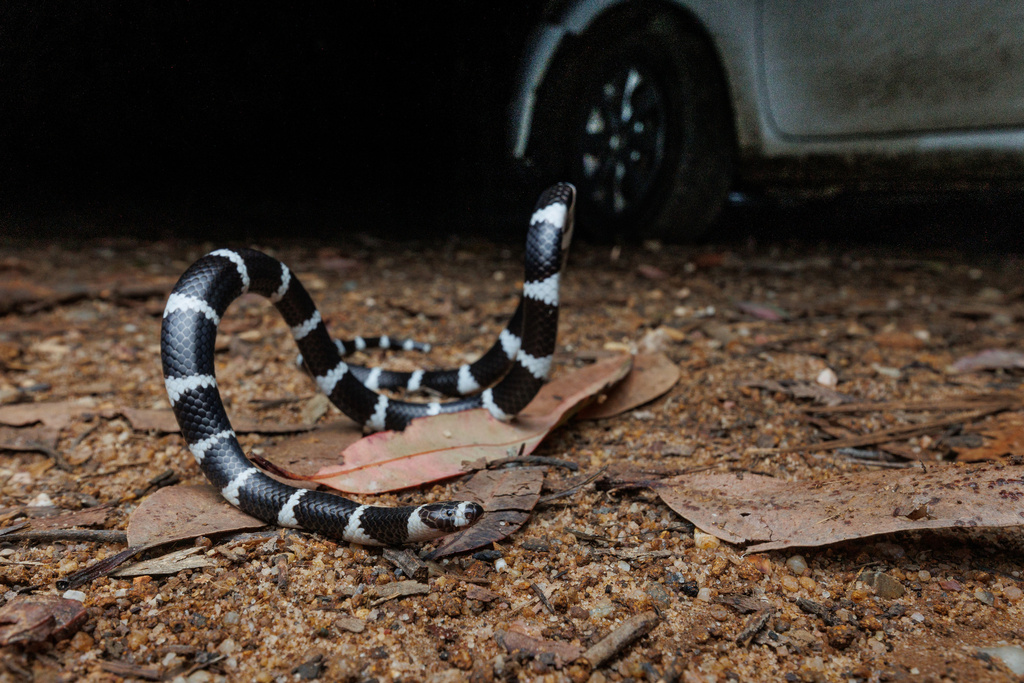
Eastern Bandy Bandy
Vermicella annulata
The bandy-bandy (Vermicella annulata), also commonly known as the hoop snake, is a species of venomous snake in the family Elapidae. The word bandy-bandy (bandi-bandi) traces back to the indigenous dialect of Kattang, from the Taree region, New South Wales. There are 5 known species of bandy-bandy, all of which are endemic to Australia.
From the article Bandy-bandy on Wikipedia (CC BY-SA), quoted section by section
Description
The bandy-bandy is a smooth-scaled, glossy snake with a distinctive pattern of sharply contrasting black and white rings that continue right around the body. Bandy-bandys are strikingly distinguishable from other Australian land snakes by their unique banding pattern, which gives the species both its common names and its scientific name (from the diminutive form, annul-, of the Latin anus, meaning "ring"). Their tail is relatively short, having fewer than 35 subcaudals and the tip is blunt, unlike other elapids. The dorsal scales are in 15 rows at mid body. The average total length (including tail) is 50 to 60 cm (20 to 24 in), but size is highly variable between sexes.
Range & habitat
Bandy-bandys occupy a large variety of habitats from desert regions to wet rainforest. Their distribution especially V.annulata spans across the east coast of Australia, whilst other species occupy far northern Australia and arid regions of western and central Australia. The bandy-bandy is found mainly in suburbs with woodland habitats such as Mt Cotton, Mt Crosby, Kholo, Brisbane, and Lockyer Valley. It is most common in areas of remnant habitat structure such as the foothills of Mt Glorious and Brisbane Forest Park. It has also been found at Cannonvale in the Whitsundays region of North Queensland, in late 2019 in the Coffs Harbour region, and in late 2021 north of Murwillumbah in the Far North Coast region of New South Wales. In Southeast Queensland, it is found across a wide range of habitats and vegetation types, from coastal forest and woodland, to scrubland, mulga, and outback desert. It is found also in central New South Wales (Dubbo/Parkes) and Lower North Coast NSW (Pacific Palms/Hunter Valley). The bandy-bandy has also been spotted in the White Rock and Spring Mountain Conservation Park near Ipswich, Queensland. The bandy-bandy is also found in the south-eastern side of South Australia.
Wikipedia: “Distribution and habitat”
What it does
The bandy-bandy is oviparous i.e. produces offspring within eggs that are hatched after birth. Females seasonally produce offspring, laying eggs in the late summer (February - March) after undergoing vitellogenesis in October. Both live-bearing and oviparous Australian elapid snakes follow a similar seasonal reproductive cycle. Live-bearing elapids undergoing ovulation in October - December and give birth in February - April after a 14 week gestation period. Oviparous elapids undergo ovulation at the same time (October - December), where the eggs are then laid shortly after without the need of a gestation period. Newly hatched young only emerge at the same time as live-bearing snakes give birth (February - March). However, evidence exists that oviparous elapids may be able to produce a second clutch of eggs in the late summer, whereby newly hatched offspring emerge around April. The size of a clutch of V.annulata averages at 7.7 offspring, but up to 13 offspring have been recorded in a single clutch. Sexual dimorphism is evident in bandy-bandys, where females are much larger in size compared to males. In one study, female V.annulata had a mean snout-vent length of 54.4 cm compared to 39.2 cm in males. In many reptiles, the size of the clutch is dependent on the size of the mother. …
Wikipedia: “Reproduction”
Toxicity
Elapids carry neurotoxins in their venom that can be notoriously deadly to humans. Different species of elapids carry varying molecular compositions of neurotoxins, adapted to suit their diet. However, neurotoxins in Australian elapid snakes are subject to mutagenesis, which is thought to not only be adaptable to different prey types and potency, but to be a means of preventing venom resistance in prey. V. annulata is weakly venomous with localised symptoms around the bite area. It is generally considered harmless due to the small size of its mouth and its inoffensive nature.
Wikipedia: “Venom”
Where it lives
Recorded sightings
—
geo-referenced records in GBIF, from museums, herbaria and field observers.
Drag the globe to turn it. Dots are where records exist, not a range map; darker means more records.
In the stacks
Searching the stacks…
Every page naming Vermicella annulata in the Biodiversity Heritage Library →
This page is assembled live from iNaturalist, GBIF, Wikipedia, the Source Library and the Internet Archive. It is not yet part of the hand-edited codex. iNaturalist taxon 35073.