Mayan Coralsnake
Micrurus hippocrepis
Micrurus hippocrepis, also known commonly as the Belize coral snake, the Mayan coral snake, and coralillo de Belize in Central American Spanish, is a species of venomous snake in the family Elapidae. The species is native to Central America. There are no subspecies that are recognized as being valid.
From the article Micrurus hippocrepis on Wikipedia (CC BY-SA), quoted section by section
Description
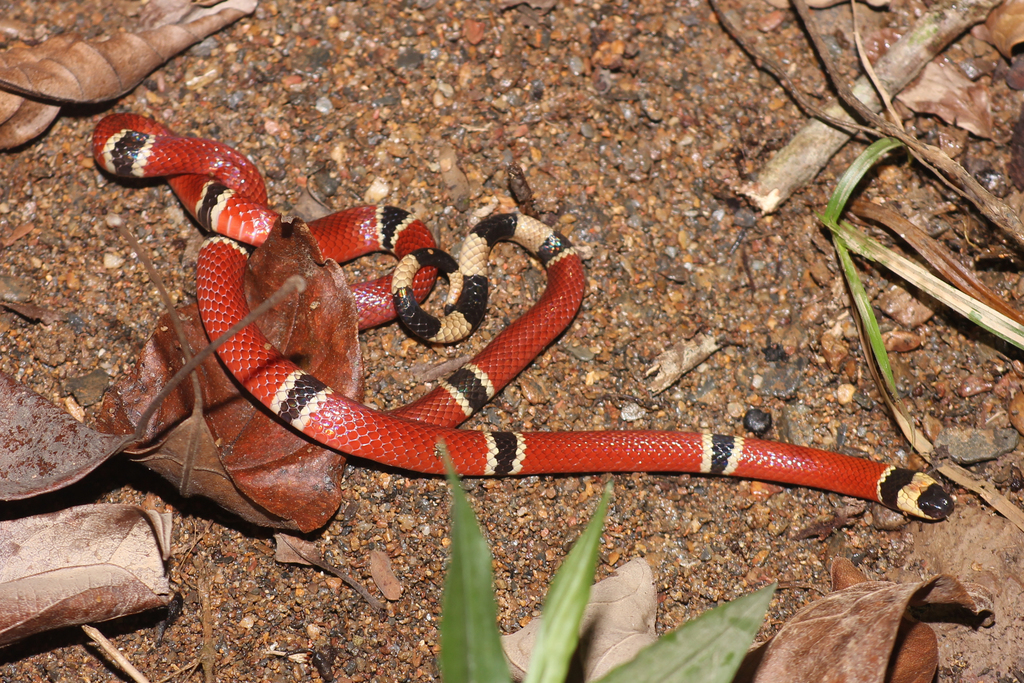
Medium-sized for the genus Micrurus, adults of Micrurus hippocrepis usually have a total length (tail included) of 47–65 cm (19–26 in), and the longest recorded total length is 71 cm (28 in). Like most coral snakes the color pattern consists of red, black, and yellow rings. The red rings are extremely wide. The black rings are narrow and not arranged in triads. The yellow rings, which separate the red from the black, are the narrowest.
Range & habitat
The preferred natural habitat of Micrurus hippocrepis is forest, at elevations of 50–600 m (160–1,970 ft).
Wikipedia: “Habitat”
What it does
Micrurus hippocrepis preys upon small snakes of the family Colubridae, especially Ninia sebae.
Wikipedia: “Diet”
In human culture
The specific name hippocrepis, Greek for "horseshoe", refers to a marking on the snake's head which may resemble a horseshoe.
Wikipedia: “Etymology”
Where it lives
Recorded sightings
—
geo-referenced records in GBIF, from museums, herbaria and field observers.
Drag the globe to turn it. Dots are where records exist, not a range map; darker means more records.
In the stacks
Searching the stacks…
Every page naming Micrurus hippocrepis in the Biodiversity Heritage Library →
This page is assembled live from iNaturalist, GBIF, Wikipedia, the Source Library and the Internet Archive. It is not yet part of the hand-edited codex. iNaturalist taxon 30559.