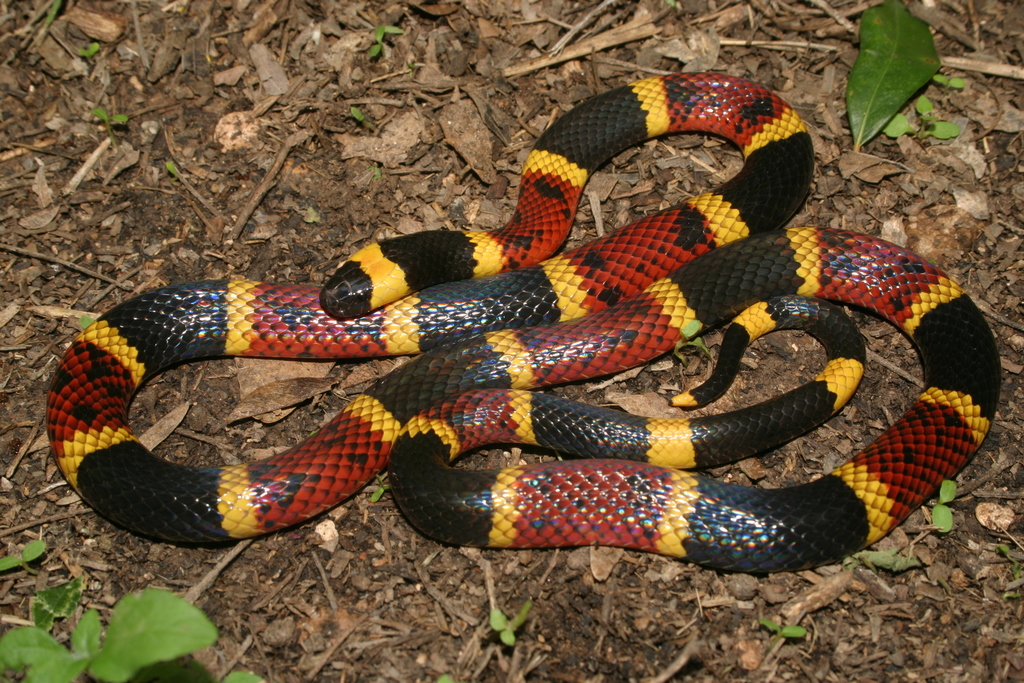
Texas Coralsnake
Micrurus tener
Micrurus tener, commonly known as the Texas coral snake and el coralillo tejano in Mexican Spanish, is a species of venomous snake in the family Elapidae. The species is native to the southern and southwestern United States and adjacent northeastern and central Mexico. Six subspecies are recognized as being valid, including the nominotypical subspecies, Micrurus tener tener. Although originally described as a species new to science, Micrurus tener was for many years considered to be a subspecies of the eastern coral snake (Micrurus fulvius).
From the article Texas coral snake on Wikipedia (CC BY-SA), quoted section by section
Description
The Texas coral snake has the traditional coloration associated with coral snakes: black, yellow, and red rings. These rings extend onto the belly. It is capable of growing to 48 in (122 cm) in total length (tail included), but most are closer to 24 in (61 cm). Males are typically smaller than females. It has smooth dorsal scales, a rounded head, and the eyes have round pupils. Albinistic (lacking black pigment) and anerythristic (lacking red pigment) specimens have been found in the wild. "Pastel" (pink, translucent cream, and very light blue) coloration has been noted, and completely black (melanistic) specimens, are known. The Texas coral snake is somewhat larger (longer and stouter) than the eastern coral snake (Micrurus fulvius), and has a somewhat larger venom yield.
Range & habitat
The Texas coral snake ranges from the southern United States south to northeastern and central Mexico. It is found in the U.S. states of Arkansas, Louisiana, and Texas; and the Mexican states of Guanajato, Morelos, Querétaro, San Luis Potosí, and Tamaulipas.
Wikipedia: “Geographic distribution”
What it does
All coral snakes are shy, secretive animals, typically nocturnal. They spend most of their time hiding in leaf litter, under logs. They can be seen crawling on the surface, after heavy rains, when the nighttime temperatures rise above 78 °F (26 °C). When grabbed suddenly, or sometimes just when touched, they may thrash about, swing around, and bite.
Wikipedia: “Behavior”
Toxicity
New World coral snakes of the genus Micrurus are proteroglyphous, meaning they have a pair of deeply grooved, semihollow, chisel-shaped, fixed fangs in the front of the upper jaw, through which venom is injected. Though it was previously thought that they to need to gnaw to inject venom, coral snakes need only a quick bite to deliver a significant amount of venom. Many bites from coral snakes do not inject any venom at all (known as a dry bite). Texas coral snake venom contains neurotoxin and myotoxin. Bite victims may experience potentially lethal paralysis or myolysis. Immediate first aid measures for a bite can include removing any jewelry on a limb that has been bitten (in case of severe swelling) and wrapping the bite area moderately tightly in a wide cloth; however, the bitten limb should be moved as little as possible. Bite victims should be taken to the nearest hospital as soon as possible for more advanced lifesaving measures, such as application of antivenom. The Texas coral snake can deliver 10–12 mg (dry weight) of venom in a single bite, which is approximately twice the lethal dose for an adult human of 5–7 mg (dry weight). North American Coral Snake Antivenin (NACSA), formerly produced by Wyeth Pharmaceuticals, a wholly owned subsidiary of Pfizer, is the only antivenom approved by the FDA for use in the United States. …
Wikipedia: “Venom”
In human culture
The Latin specific name, tener, means "soft or delicate". This is in reference to the graceful features of the snake. The subspecific name, bernadi, is in honor of French physician Santiago Bernad, who practiced medicine in Zacualtipán, Hidalgo, Mexico, where he collected the holotype. The subspecific name, fitzingeri, is in honor of Austrian herpetologist Leopold Fitzinger. The name maculatus (Latin for "spotted") refers to the presence of some large black spots in the red rings. The name microgalbineus is derived from a modern Latin adaptation of the original Greek word micro meaning "small or tiny" and galbineus, Latin for "greenish yellow". The name microgalbineus alludes to the narrow yellowish rings of this subspecies.
Wikipedia: “Etymology”
Where it lives
Recorded sightings
—
geo-referenced records in GBIF, from museums, herbaria and field observers.
Drag the globe to turn it. Dots are where records exist, not a range map; darker means more records.
In the stacks
Searching the stacks…
Every page naming Micrurus tener in the Biodiversity Heritage Library →
This page is assembled live from iNaturalist, GBIF, Wikipedia, the Source Library and the Internet Archive. It is not yet part of the hand-edited codex. iNaturalist taxon 30494.