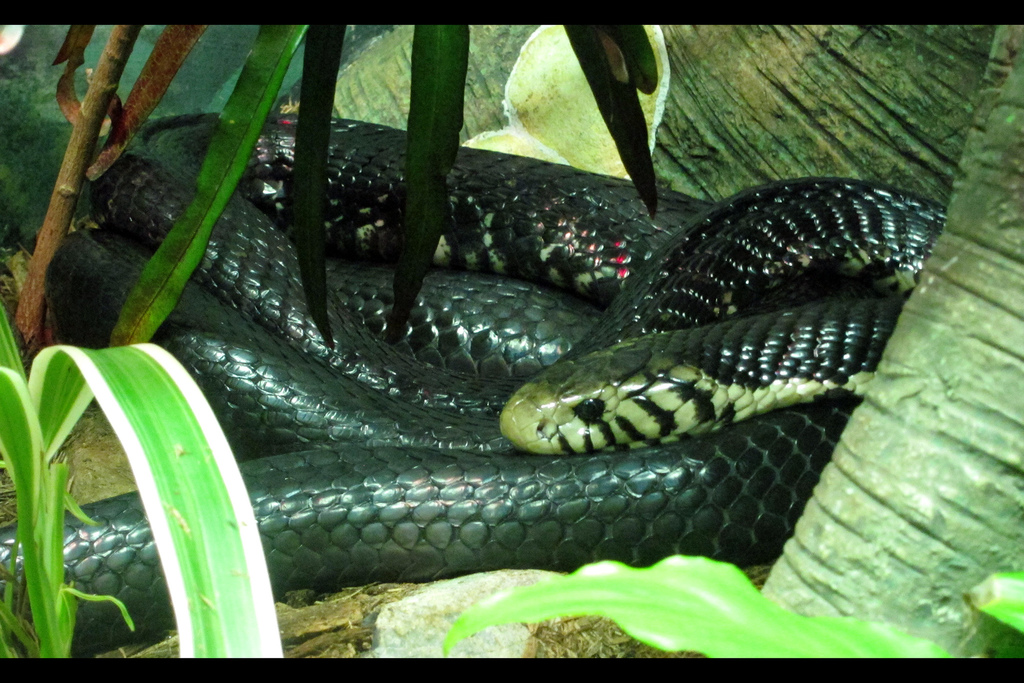
Forest Cobra
Naja melanoleuca
The forest cobra (Naja melanoleuca), also commonly called the black cobra and the black and white-lipped cobra, is a species of venomous snake in the family Elapidae. The species is native to Africa, mostly the central and western parts of the continent. It is the largest true cobra species with a total length (including tail) of up to 3.1 meters (10 feet). Although it prefers lowland forest and moist savanna habitats, this cobra is highly adaptable...
From the article Forest cobra on Wikipedia (CC BY-SA), quoted section by section
Description
The forest cobra is Africa's largest cobra of the genus Naja and possibly the largest of all the true cobra (Naja) species in the world. The length of an average adult is 1.4 to 2.2 m (4.6 to 7.2 ft), and they regularly attain lengths of 2.7 m (8.9 ft), and lengths up to 3.2 m (10 ft) have been recorded in the wild. The mean body mass of the species in one survey, which did not exclude juvenile cobras per se, was reported at a mean of 509.5 g (1.123 lb) while large, mature forest cobras are known to obtain weights of up to 2,000 to 3,600 g (4.4 to 7.9 lb). Males and females grow to be similar in length, as there is no sexual dimorphism within this species. The head of this snake is large, broad, flattened and is slightly distinct from the neck. It is a slightly depressed, tapered and moderately thick bodied snake with a slender tail that is medium in length. The body is compressed dorsoventrally (where the dorsal upper scales and the ventral lower scales meet at either side of the body) and sub-cylindrical posteriorly (the tail end of the body). The forest cobra has long cervical ribs capable of expansion to form a long, wedge shaped hood when threatened. The angle between the crown of the head and the side of the head between the eye, also known as the canthus, is distinct, while the snout is rounded. Its eyes are large with round pupils. …
Range & habitat
The forest cobra occurs mainly in central Africa. It has been recorded from Benin, Nigeria, Equatorial Guinea, Cameroon, Gabon, the Republic of Congo, the Democratic Republic of Congo, Central African Republic, and northern Angola.
A snake of forest or woodland, it is the only one of Africa's cobras that will live in high forest. The forest cobras are snakes that are well adapted to many environments and the habitat of the forest cobra is strongly dependent on what part of its African range the snake originates from. Forest cobras originating in the southern African regions are typically found in savanna and grassland, but they can also be found in broken rock country. They are mainly found in the tropical and subtropical rainforest regions of west and central Africa. It also inhabits mangroves in western Africa. The banded form of forest cobra in west Africa lives in savanna and grassland (but usually along streams) and well-vegetated areas, especially riverine forest, up to latitude 14 N. The species' preferred habitat are lowland forest and moist savanna where it favors coastal thickets. This snake seems to be highly adaptable and will readily move into drier areas if it can. In western Kenya, the forest cobra has been found in wide stretched grassland areas. The population of forest cobras in Uganda are almost always found close to water. …
Wikipedia: “Distribution and habitat”
What it does
The forest cobra is an agile, diurnal species that climbs well and is one of the most aquatic of the true cobras of the genus Naja. It is terrestrial, but it is a fast, graceful climber, known to ascend trees to a height of 10 m (33 ft) or more. It is quick moving and alert. It swims well and readily takes to the water; in some areas its main diet is fish and could be regarded as semi-aquatic. Although it is active mostly during the day (diurnal) in uninhabited areas, it can also be active by night (nocturnal) where it goes into urban areas. When not active, it takes cover in holes, brush piles, hollow logs, among root clusters or in rock crevices, or in abandoned termite mounds at forest fringe or clearings. In certain areas, it hides along river banks, in overhanging root systems or bird holes, and in urban areas will hide in junk piles or unused buildings. When agitated, it rears up to a considerable height and spreads a long, narrow hood. It can strike quickly, to quite a long distance, and if molested and cornered, it will rush forward and make a determined effort to bite. It is an alert and agile species of cobra. Some authorities believe it is one of the most dangerous African snakes to be kept as many captive forest cobras are described to be particularly aggressive when handled. This species is not able to "spit" its venom.
Diet. …
Wikipedia: “Behavior”
Where it lives
Recorded sightings
—
geo-referenced records in GBIF, from museums, herbaria and field observers.
Drag the globe to turn it. Dots are where records exist, not a range map; darker means more records.
In the stacks
Searching the stacks…
Every page naming Naja melanoleuca in the Biodiversity Heritage Library →
This page is assembled live from iNaturalist, GBIF, Wikipedia, the Source Library and the Internet Archive. It is not yet part of the hand-edited codex. iNaturalist taxon 30489.