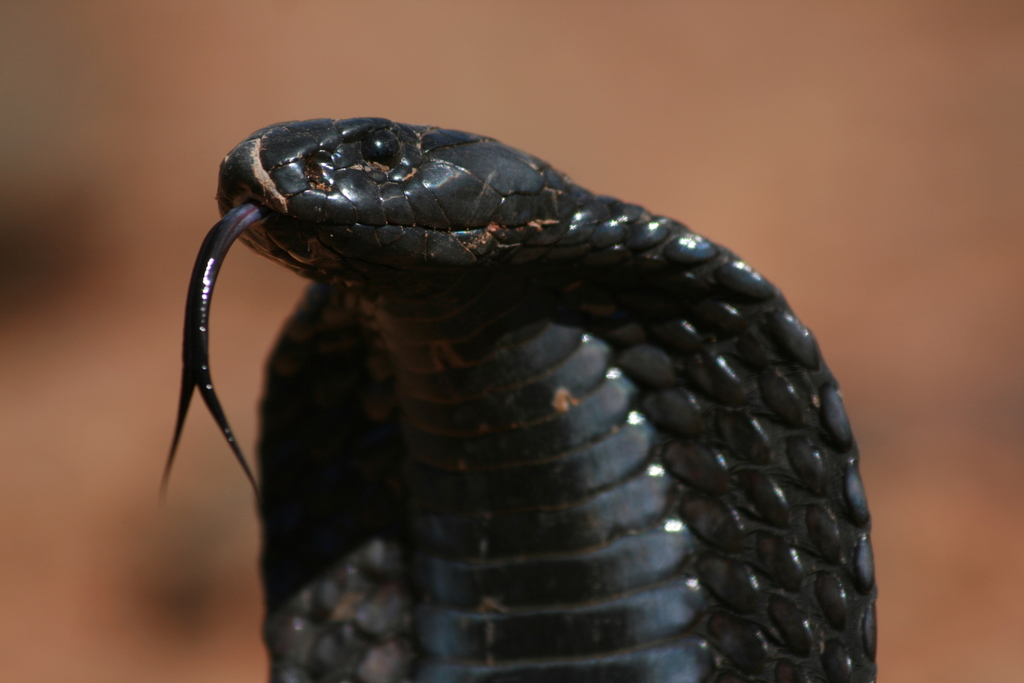
Egyptian Cobra
Naja haje
The Egyptian cobra (Naja haje) is an elapid venomous snake species in the genus Naja. It is one of the most venomous species of snakes inhabiting Northern Africa. The venom of the Egyptian cobra can be lethal to humans and consists mostly of neurotoxins and cytotoxins. Unlike most other cobras, the species does not spit venom. It averages roughly 1.4 metres (4.6 ft) in length; the longest specimen recorded so far measured 2.59 metres (8.5 ft). The species varies highly in color, ranging from shades of brown, copper-red, grey-brown to black. It mostly preys on toads but is also known to prey on small mammals, birds, lizards, and other snakes.
Naja haje was represented in Egyptian mythology by the goddess Meretseger. A stylised Egyptian cobra in the form of the uraeus representing the goddess Wadjet was the symbol of sovereignty for the Pharaohs, who incorporated it into their diadem. The snake was believed to be the cause of death of the Egyptian queen Cleopatra by ancient sources.
From the article Egyptian cobra on Wikipedia (CC BY-SA), quoted section by section
Description
The Egyptian cobra is a large species. The head is large and depressed and slightly distinct from the neck. The neck of this species has long cervical ribs capable of expanding to form a hood, like all other cobras. The snout of the Egyptian cobra is moderately broad and rounded. The eye is quite big with a round pupil. The body of the Egyptian cobra is cylindrical and stout, with a long tail. The length of the Egyptian cobra is largely dependent on subspecies, geographical locale, and population. The most recognizable characteristics of this species are its head and hood. The colour is highly variable, but most specimens are some shade of brown, and often a "tear-drop" mark below the eye. Some are more copper-red or grey-brown in colour. Specimens from northwestern Africa (Morocco) are almost entirely black. The ventral side is mostly a creamy white, yellow brown, greyish, blue grey, dark brown or black in colouration, often with dark spots. It averages roughly 1.4 metres (4.6 ft) in length; the longest specimen recorded so far measured 2.59 metres (8.5 ft).
Scalation. Naja haje has the following scalation pattern: the dorsal scales at midbody number 19–20. The ventral scales number 191–220. The anal plate is single. The subcaudal scales are paired and number 53-65. There is 1 preocular, 3 (or 2) postoculars, and 2 or 3 suboculars. …
Range & habitat
The Egyptian cobra ranges across most of North Africa north of the Sahara, across the savannas of West Africa to the south of the Sahara, south to the Congo Basin and east to Kenya and Tanzania. Older literature records from Southern Africa and the Arabian Peninsula refer to other species (as discussed in the taxonomy section).
Wikipedia: “Geographic range”
What it does
The Egyptian cobra is a terrestrial and crepuscular or nocturnal species. It can, however, be seen basking in the sun at times in the early morning. This species shows a preference for a permanent home base in abandoned animal burrows, termite mounds or rock outcrops. It is an active forager, sometimes entering human habitations, especially when hunting domestic fowl. Like other cobra species, it generally attempts to escape when approached, at least for a few metres, but if threatened it assumes the typical upright posture with the hood expanded, and strikes. This species prefers to eat toads, but it will prey on small mammals, birds, eggs, lizards, and other snakes. It is an intermediate host of the acanthocephalan parasite Pachysentis ehrenbergi.
Wikipedia: “Behaviour and ecology”
In human culture
Naja haje was first described in Europe by Swedish zoologist Carl Linnaeus in 1758. The generic name naja is a Latinisation of the Sanskrit word nāgá (नाग) meaning "cobra". The specific epithet haje is derived from the Arabic word ḥayya (حية) which means "snake". The snouted cobra (Naja annulifera) and Anchieta's cobra (Naja anchietae) were formerly regarded as subspecies of Naja haje, but have since been shown to be distinct species. The Arabian populations were long recognised as a separate subspecies, Naja haje arabica, and the black populations from Morocco sometimes as Naja haje legionis. A 2009 study found that the Arabian cobra constitutes a separate species, Naja arabica, whereas the subspecies legionis was synonymised with N. haje. The same study also identified the West African savanna populations as a separate species and described it as Naja senegalensis. The cladogram below illustrates the taxonomy and relationships among species of Naja following Van Wallach et al. (2009), with subgenus Uraeus resolved following Trape et al. (2009):
Wikipedia: “Etymology and Taxonomy”
Where it lives
Recorded sightings
—
geo-referenced records in GBIF, from museums, herbaria and field observers.
Drag the globe to turn it. Dots are where records exist, not a range map; darker means more records.
In the stacks
Searching the stacks…
Every page naming Naja haje in the Biodiversity Heritage Library →
This page is assembled live from iNaturalist, GBIF, Wikipedia, the Source Library and the Internet Archive. It is not yet part of the hand-edited codex. iNaturalist taxon 30479.