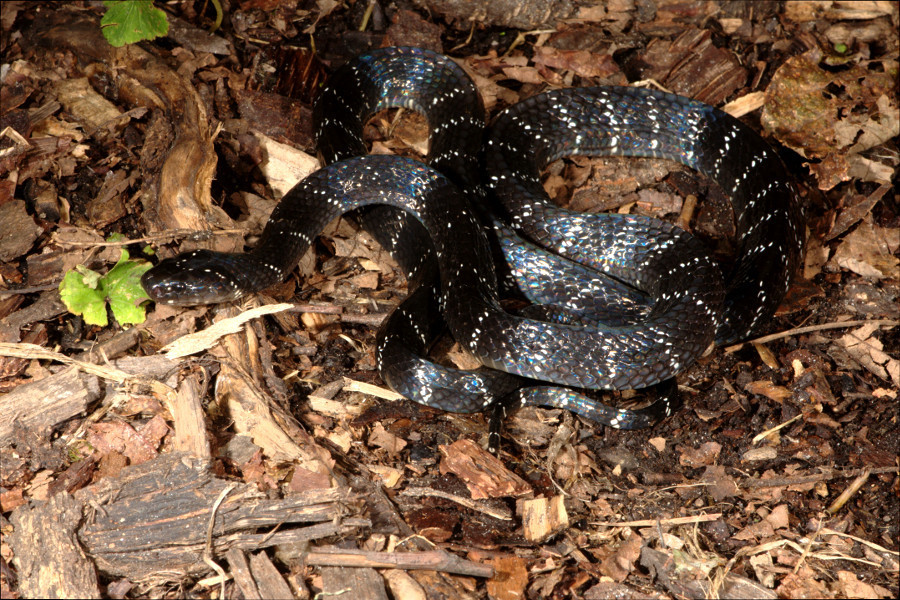
Northeastern Hill Krait
Bungarus bungaroides
Bungarus bungaroides, the northeastern hill krait, is a venomous species of elapid snake.
From the article Bungarus bungaroides on Wikipedia (CC BY-SA), quoted section by section
Description
This is a moderate- to large sized krait. Diagnostic characteristics include:
Dorsal scales in 15 longitudinal rows at midbody. Mid-dorsal scales are slightly enlarged anteriorly, but distinctly enlarged posteriorly. Subcaudal scutes ordinarily divided anteriorly, but occasionally some scutes may be single, but always divided near the tip Ventrals 220–237; subcaudals 44–51 Dorsum – smooth, black with a series of very narrow white to pale yellowish lines or crossbars; on the belly, the light crossbars widen to form distinct transverse bars head slightly distinct from the neck. Top of the head is flat. Snout is blunt. Total length of largest male 1400 mm (55 in); tail length 160 mm (6.3 in)
Range & habitat
This species is found in Myanmar, India (Assam, Manipur, Cachar, Sikkim), Nepal, and Vietnam at elevations around 2040 m as well as in Tibet. The type locality is given as: "Cherra Punjee, Khasi Hills, Meghalaya, India".
Wikipedia: “Distribution and habitat”
Where it lives
Recorded sightings
—
geo-referenced records in GBIF, from museums, herbaria and field observers.
Drag the globe to turn it. Dots are where records exist, not a range map; darker means more records.
In the stacks
Searching the stacks…
Every page naming Bungarus bungaroides in the Biodiversity Heritage Library →
This page is assembled live from iNaturalist, GBIF, Wikipedia, the Source Library and the Internet Archive. It is not yet part of the hand-edited codex. iNaturalist taxon 30452.