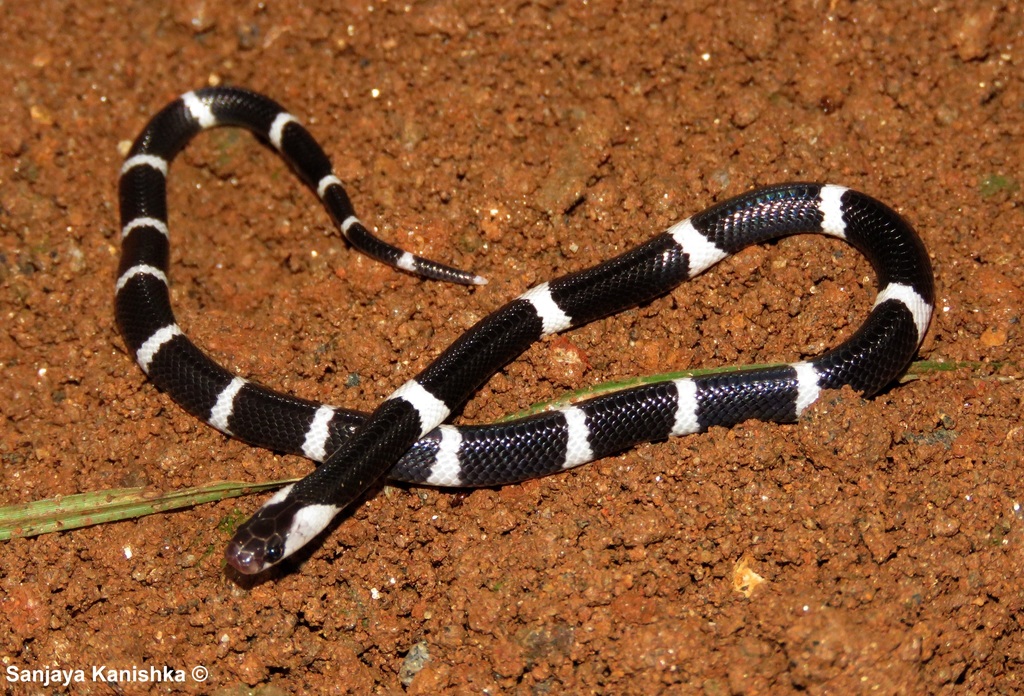
Ceylon Krait
Bungarus ceylonicus
Bungarus ceylonicus, the Ceylon krait or Sri Lankan krait, is a species of venomous elapid snake which is endemic to the island Sri Lanka, locally known as මුදු කරවලා (mudu karawalaa).
From the article Bungarus ceylonicus on Wikipedia (CC BY-SA), quoted section by section
Description
The Sri Lankan krait is small and slender. On hatching, the length of the snake is about 250 mm (9.8 in). The average adult length for this species is 75 cm (29+1⁄2 in) with 90 cm (35+1⁄2 in) being the upper limit. Its black skin is crossed with thin white transverse bands. It has an extraordinarily long lung which it inflates when angry.
Range & habitat
The species is principally present in the wet zone of Sri Lanka at elevations up to 1,700 m, with infrequent presence in the dry zone, and occurs in forest habitats as well as gardens and plantations.
Wikipedia: “Distribution and habitat”
What it does
The species is nocturnal, and sluggish by day. Its diet consists mainly of small mammals, frogs and other snakes. The krait is oviparous, laying cylindrical eggs with rounded ends that measure 30 mm x 17 mm.
== References ==
Wikipedia: “Ecology”
Where it lives
Recorded sightings
—
geo-referenced records in GBIF, from museums, herbaria and field observers.
Drag the globe to turn it. Dots are where records exist, not a range map; darker means more records.
In the stacks
Searching the stacks…
Every page naming Bungarus ceylonicus in the Biodiversity Heritage Library →
This page is assembled live from iNaturalist, GBIF, Wikipedia, the Source Library and the Internet Archive. It is not yet part of the hand-edited codex. iNaturalist taxon 30449.