 NL·0423
Herbarium of the Nature Library
- Name
- Dendroaspis polylepis
- Family
- Elapidae
- Native to
- Savannas and open woodland of eastern and southern Africa, with scattered populations in West Africa
- Habitat
- Savanna, Open woodland, Rocky hills
Black mamba
Dendroaspis polylepis
Also calledImamba (Zulu) · Mamba nyeusi (Swahili) · Swartmamba (Afrikaans)
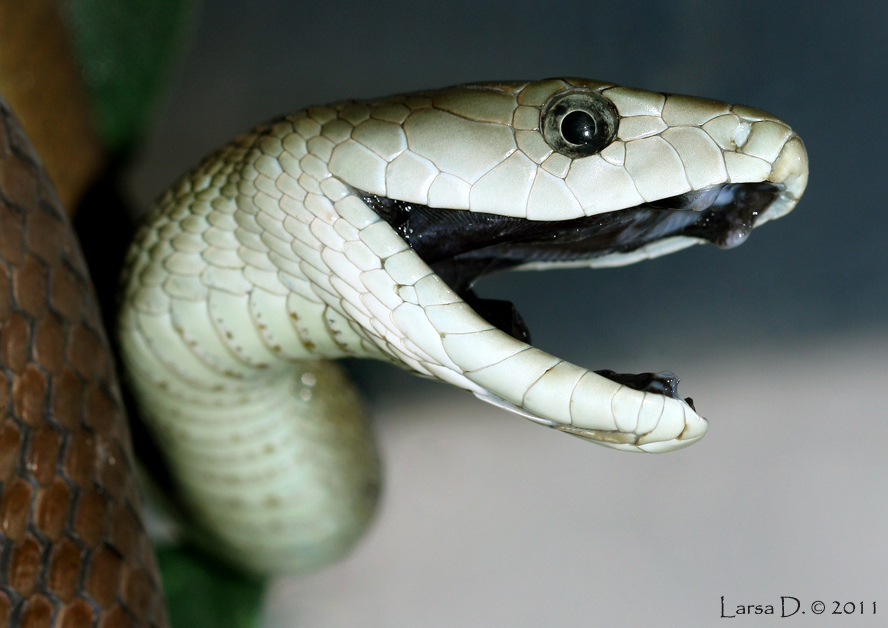
Africa's longest venomous snake, and despite its name grey to olive-brown. The name comes from the inky-black lining of its mouth, which it gapes in threat. Before antivenom, a serious bite was almost always fatal.
The black mamba is a species of highly venomous snake belonging to the family Elapidae. It is native to parts of sub-Saharan Africa. First formally described by Albert Günther in 1864, it is the second-longest venomous snake after the king cobra; mature specimens generally exceed 2 m and commonly grow to 3 m (9.8 ft). Specimens of 4.3 to 4.5 m have been reported. It varies in colour from grey to dark brown. Juvenile black mambas tend to be more pale in colour than adults, and darken with age. Despite the common name, the black mamba is not black; the colour name describes rather the inside of its mouth, which it displays when feeling threatened. Wikipedia
What it can do
- iOne of the fastest snakes on land, able to keep its head and front body off the ground while moving
- iiVenom contains dendrotoxins and other neurotoxins that can cause paralysis and breathing failure within hours
- iiiCan strike repeatedly from a raised position
- ivReturns to the same retreat, such as a termite mound or hollow tree, for years
In the field
Field marks
- aLong, slender body, grey to olive-brown with a paler belly; never truly black
- bLong 'coffin-shaped' head with a prominent brow
- cBlack inside of mouth, shown when gaping
- dSmooth scales; medium-sized round-pupilled eyes
- Not to be confused with
- Colour alone is not a reliable guide. The harmless mole snake (Pseudaspis cana) is stockier, with a small head and short tail. The boomslang has a short head and huge eyes. Green mambas are bright green and live in forest canopy. Cobras spread a wider hood. A large, long-headed grey snake moving fast with its head raised should be treated as a mamba.
- Where to see it
- Kruger National Park and KwaZulu-Natal in South Africa, Hluhluwe–iMfolozi, the Kenyan and Tanzanian savannas
- When
- Resident; active by day, often basking in the morning
Life & habits
- Diet
- Rodents, hyraxes, bushbabies, birds
- Habitat
- Dry savanna, rocky outcrops, open woodland; takes shelter in termite mounds and hollow trees
- Size
- Usually 2–2.5 m; exceptionally ~3 m or more
Shy, and usually escapes if it can. When cornered it rears up, spreads a narrow hood, gapes its black mouth and hisses. A bite needs urgent hospital care with antivenom and breathing support. As first aid, a firm pressure bandage on the bitten limb and a splint may slow the venom while the person is taken to hospital. Do not cut, suck or use tourniquets.
Where it lives
Recorded sightings
—
geo-referenced records in GBIF, from museums, herbaria and field observers.
Native range
Savannas and open woodland of eastern and southern Africa, with scattered populations in West Africa
Drag the globe to turn it. Dots are where records exist, not a range map; darker means more records.
In the stacks
Searching the stacks…
Every page naming Dendroaspis polylepis in the Biodiversity Heritage Library →
Marginalia
The name mamba comes from the Zulu imamba. The genus name Dendroaspis means 'tree asp', although the black mamba spends much of its time on the ground.
Curiosity
Mambalgins, peptides found in black mamba venom, relieved pain in mice about as strongly as morphine and with fewer side effects, which has made them a lead in painkiller research.
Kinship



Photographs: iNaturalist contributors under the licences shown. Records: GBIF.org. Historical plates: Source Library (CC BY-SA 4.0; originals public domain). Summary text: Nature Library editors and Wikipedia (CC BY-SA). Medicinal and edibility notes are historical and educational, not advice. iNaturalist taxon 30405.