- Animals
- ›Arthropods
- ›Hexapods
- ›Insects
- ›Winged and Once-winged Insects
- ›Butterflies and Moths
- ›Butterflies
- ›Brush-footed Butterflies
- ›Fritillaries and Longwings
- ›Fritillaries
- ›Argynnis
- ›Speyeria
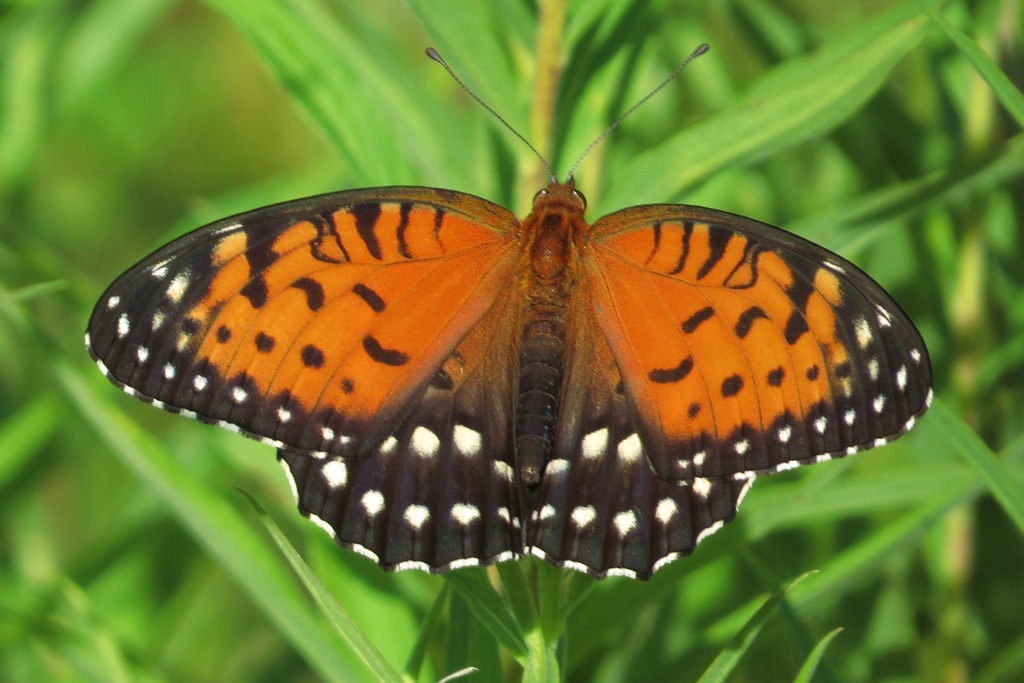
Regal Fritillary
Argynnis idalia
The regal fritillary (Speyeria idalia) is a striking nymphalid butterfly found in tallgrass and mixed-grass prairies in the east-central United States. This prairie-specialist butterfly is deep orange with distinctive dark hindwings with two bands of spots (Brock 2003). On the female, both bands of spots are white; on the male, the outer band of spots is orange. Females also tend to be slightly larger than males. The ventral surface of the hindwings is olive brown to black in color with bold silvery white spots (Selby 2007). The wingspan of S. idalia usually measures 68–105 millimetres (2.7–4.1 in) (Selby 2007). Flight is in the summertime from approximately June to September and adults tend to be swift in flight, coasting close to the ground (Brock 2003). It is listed as a species of special concern and believed extirpated in the US state of Connecticut.
Regal fritillary larvae are approximately 0.08 inches long after they hatch and reach a length of approximately 1.75 inches when fully developed (Edwards 1879). The mature larvae have a black body with yellowish-orange bands and stripes. There are yellowish middorsal and lateral stripes and a number of dorsal, subdorsal, and lateral fleshy spines extending from the body. The head of the mature larva is rounded and small, orangish-red on top and black underneath (Edwards 1879).
From the article Regal fritillary on Wikipedia (CC BY-SA), quoted section by section
What it does
The regal fritillary is univoltine, having a single generation per year (Selby 2007). Adult male butterflies emerge in early June along with the first milkweed plants. Adult females emerge shortly after and mating takes place in late June and early July. After mating, females enter a 6 to 8 week period of reproductive diapause, or a suspended period of development. The ovaries remain undeveloped during this time. Oogenesis does not initiate until late August when juvenile hormone sharply increases (Kopper et al. 2001). Once oogenesis takes place, the eggs are fertilized and soon after, oviposition occurs. The female lays over 1,000 eggs and possibly more than 2,000 (Vaughan and Shepherd, 2005). The small larvae hatch in late September and into October. Immediately after hatching, the tiny larvae seek protective covering in the leaf litter and overwinter there. At this stage the larvae delay development over the winter months and this is known as larval diapause (Kopper et al. 2001). Once spring arrives, the larvae emerge and begin feeding on violets. They grow and mature through six instar stages until late May when they pupate (Selby 2007). The life cycle of the regal fritillary is unique and is thought to be an adaptation to the phenology, or seasonal timing and nature, of their larval food plant, the violet (Kopper et al. 2001). …
Wikipedia: “Reproduction and life cycle”
Listen
Looking for field recordings…
Where it lives
Recorded sightings
—
geo-referenced records in GBIF, from museums, herbaria and field observers.
Drag the globe to turn it. Dots are where records exist, not a range map; darker means more records.
In the stacks
Searching the stacks…
Every page naming Argynnis idalia in the Biodiversity Heritage Library →
This page is assembled live from iNaturalist, GBIF, Wikipedia, the Source Library and the Internet Archive. It is not yet part of the hand-edited codex. iNaturalist taxon 1456600.