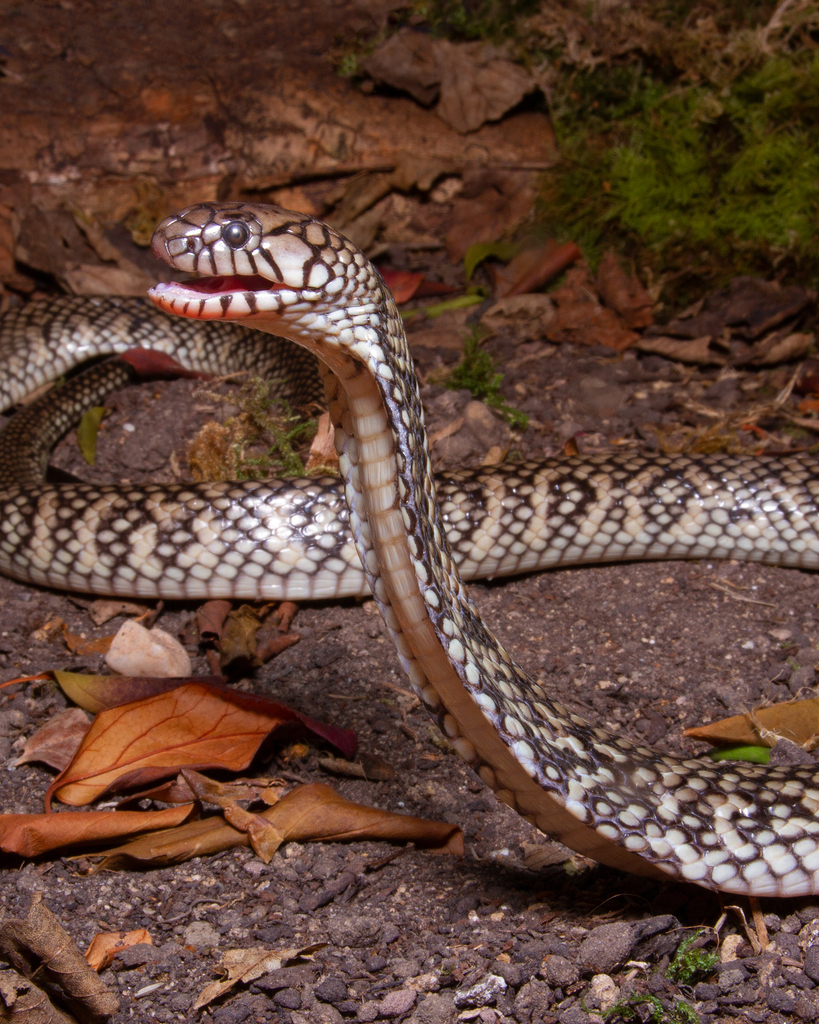
Dwarf Water Cobra
Naja nana
The dwarf water cobra (Naja nana) is a small, venomous species of aquatic cobra found in the Democratic Republic of Congo (Katanga). It was first described by Marcel Collet and Jean-Francois Trape in 2020, based on two specimens from Lake Mai-Ndombe.
From the article Dwarf water cobra on Wikipedia (CC BY-SA), quoted section by section
Description
The dwarf water cobra typically doesn't grow longer than 1 m (3.3 ft), unlike the two other semiaquatic African Naja species, Naja annulata and Naja christyi, both of which can attain lengths of up to about 2.5 m (8.2 ft). Distinguishing features of the species include its characteristic defensive posture, its aquatic lifestyle, the straight-row arrangement of its dorsal scales, and its distinctive coloration: black with small white or yellowish spots, a whitish abdomen, and a black underside of the tail. The eggs of the dwarf water cobra are large and elongated, and require 70 days of incubation to hatch.
What it does
Dwarf water cobras can swim and climb, but generally prefer a terrestrial habitat, although they will hunt and defecate in water when able. In the wild they are exclusively piscivorous, although in captivity they are often fed a rodent-based diet. One case of cannibalism of a conspecific snake is known.
== References ==
Wikipedia: “Behavior”
Where it lives
Recorded sightings
—
geo-referenced records in GBIF, from museums, herbaria and field observers.
Drag the globe to turn it. Dots are where records exist, not a range map; darker means more records.
In the stacks
Searching the stacks…
Every page naming Naja nana in the Biodiversity Heritage Library →
This page is assembled live from iNaturalist, GBIF, Wikipedia, the Source Library and the Internet Archive. It is not yet part of the hand-edited codex. iNaturalist taxon 1119912.