 NL·0635
Herbarium of the Nature Library
- Name
- Pleuronectes platessa
- Family
- Pleuronectidae
- Native to
- Northeast Atlantic from the Barents Sea to Morocco, North Sea, Baltic and western Mediterranean
- Habitat
- Continental shelf, Coastal waters, Sandy seabeds
European plaice
Pleuronectes platessa
Also calledRødspætte (Danish) · Schol (Dutch) · Plie (French) · Scholle (German) · Solla (Spanish)
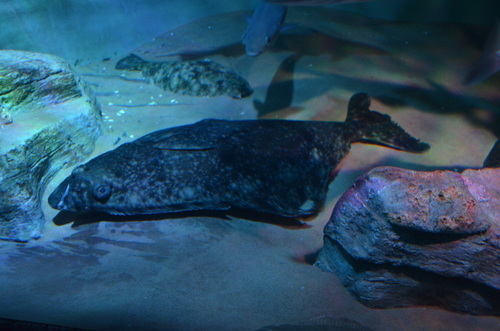
The classic orange-spotted flatfish of the North Sea. It lies buried in sand with only its eyes showing and can change its colour to match the seabed.
The European plaice, commonly referred to as simply plaice, or schol in Dutch, is a species of marine flatfish in the genus Pleuronectes of the family Pleuronectidae. Wikipedia
What it can do
- iAdjusts skin colour and pattern to match the background
- iiBuries itself with a flick of its fins
- iiiYoung migrate into shallow sandy nurseries like the Wadden Sea
- ivBites off siphons of buried clams
In the field
Field marks
- aOval flatfish with both eyes on the right side
- bBrown upper side with conspicuous bright orange-red spots
- cRow of 4–7 bony knobs on the head behind the eyes
- dSmooth skin and white underside
- Not to be confused with
- Flounder (Platichthys flesus) has rough prickles along the fin bases and dull spots; dab has a strongly curved lateral line over the pectoral fin and rough skin.
- Where to see it
- Sandy shallows of the North Sea, Danish and Dutch coasts, Irish Sea
- When
- Resident; inshore in summer, spawning Jan–Mar
Life & habits
- Diet
- Bivalves, polychaete worms, crustaceans
- Habitat
- Sandy and muddy bottoms from the shore to 200 m
- Size
- Usually 25–40 cm; up to ~1 m and 7 kg
- Lifespan
- Up to about 50 years
Feeds mainly at night and rests buried in sand by day; North Sea plaice migrate to spawning grounds in the Southern Bight in winter.
Where it lives
Recorded sightings
—
geo-referenced records in GBIF, from museums, herbaria and field observers.
Native range
Northeast Atlantic from the Barents Sea to Morocco, North Sea, Baltic and western Mediterranean
Drag the globe to turn it. Dots are where records exist, not a range map; darker means more records.
In the old herbals & bestiaries
Woodcuts and engravings matched from the Source Library’s scanned books by name. Plates marked “relative” show a close kin rather than this exact species. Click a plate to read the page it came from, with translation.

Jan Jonston — Naeukeurige beschryving van de natuur der viervoetige dieren (1660)
Jan Jonston · 1660 · p.151

History of Animals, Book II: On Oviparous Quadrupeds
Conrad Gessner · 1586 · p.466

History of Animals, Book I: On Viviparous Quadrupeds
Conrad Gessner · 1554 · p.770

History of Animals, Book I: On Viviparous Quadrupeds
Conrad Gessner · 1554 · p.804

Books on Marine Fishes
Guillaume Rondelet · 1554 · p.340

Books on Marine Fishes
Guillaume Rondelet · 1554 · p.340

Historiae Animalium Liber III: De Avium Natura
Conrad Gesner · 1555 · p.625

Historiae Animalium Liber III: De Avium Natura
Conrad Gesner · 1555 · p.666

Noah's Ark
Athanasius Kircher · 1675 · p.134

Louis Renard — Poissons, ecrevisses et crabes (1754)
Louis Renard · 1754 · p.99
In the stacks
Searching the stacks…
Every page naming Pleuronectes platessa in the Biodiversity Heritage Library →
Marginalia
Plaice studies by Walter Garstang and the North Sea 'plaice box' were foundational for fisheries science, and plaice catches dropped sharply then rebounded during and after both World Wars when fishing stopped.
Curiosity
North Sea plaice stocks reached record highs in the 2010s after fishing pressure was cut.
Kinship



Photographs: iNaturalist contributors under the licences shown. Records: GBIF.org. Historical plates: Source Library (CC BY-SA 4.0; originals public domain). Summary text: Nature Library editors and Wikipedia (CC BY-SA). Medicinal and edibility notes are historical and educational, not advice. iNaturalist taxon 47523.