 NL·0239
Herbarium of the Nature Library
- Name
- Schistocerca gregaria
- Family
- Acrididae
- Native to
- Deserts from West Africa through the Arabian Peninsula to India
- Habitat
- Desert, Semi-arid grassland
Desert locust
Schistocerca gregaria
Also calledJarād (Arabic) · Tiddi (Hindi/Urdu) · Malakh (Persian) · Nzige (Swahili) · Arbeh (Hebrew)
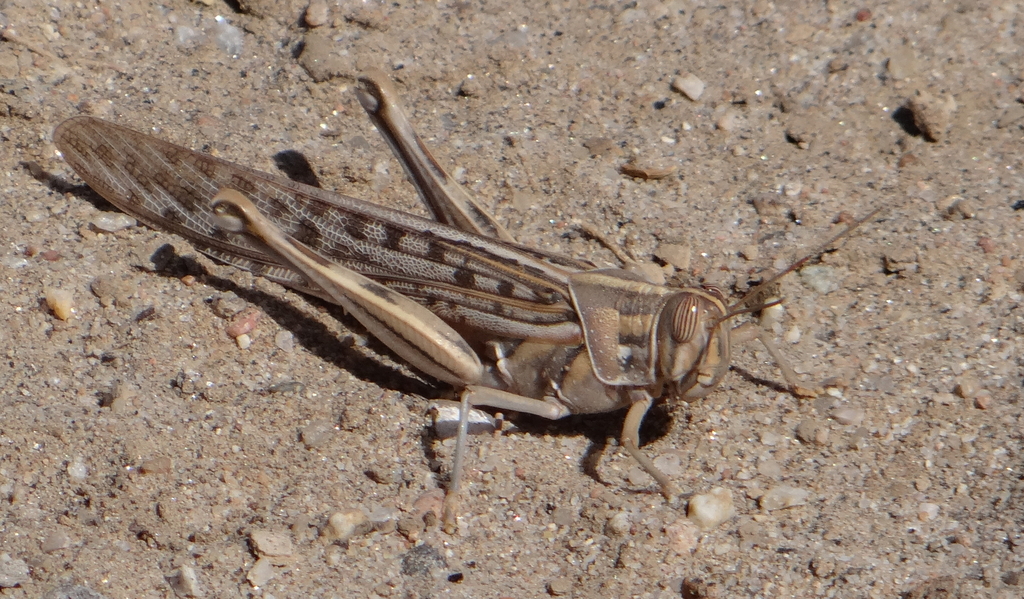
A grasshopper that transforms when crowded: it changes colour, behaviour and body shape, and forms swarms that can cover hundreds of square kilometres. A swarm can eat as much in a day as millions of people.
The desert locust is a species of locust in the grasshopper family, Acrididae. A periodically swarming, short-horned bird grasshopper, it is found primarily in the deserts and dry areas of northern and eastern Africa, Arabia, and southwest Asia. During population surge years, its range may extend north into parts of Southern Europe, Eastern Africa, and Northern India. The desert locust shows periodic changes in its body form and can change in response to environmental conditions over several generations. It begins life as a solitary, shorter-winged, highly fecund, non-migratory form, to a gregarious, long-winged, and migratory phase in which it may travel long distances into new areas. Due to this traveling, it may join groups, thus, forming locust plagues. This involves invading new areas where it may consume all vegetation including valuable crops. Although at other times, it may live unnoticed in small numbers in various areas. Wikipedia
What it can do
- iPhase change: crowding triggers serotonin release that switches it from solitary to gregarious form
- iiSwarms travel up to ~150 km a day on winds
- iiiCrossed the Atlantic from West Africa to the Caribbean in 1988
- ivA locust eats about its own weight in fresh food daily
In the field
Field marks
- aLarge grasshopper, 6–8 cm, with long wings reaching past the abdomen tip
- bSolitary phase sandy, grey or greenish
- cGregarious phase: immature adults pink, mature males bright yellow; hoppers yellow-and-black
- dForewings with large irregular dark spots
- When
- Breeds after rains; swarms are unpredictable and follow unusual rainfall
Listen
Looking for field recordings…
Life & habits
- Diet
- Almost any green vegetation, including crops
- Habitat
- Desert and semi-desert, swarming far beyond into farmland
- Size
- Adults 6–8 cm
- Lifespan
- About 3–5 months
Solitary green nymphs avoid each other; once crowded they turn yellow and black, march in bands and seek company.
Where it lives
Recorded sightings
—
geo-referenced records in GBIF, from museums, herbaria and field observers.
Native range
Deserts from West Africa through the Arabian Peninsula to India
Drag the globe to turn it. Dots are where records exist, not a range map; darker means more records.
In the old herbals & bestiaries
Woodcuts and engravings matched from the Source Library’s scanned books by name. Plates marked “relative” show a close kin rather than this exact species. Click a plate to read the page it came from, with translation.


In the stacks
Searching the stacks…
Every page naming Schistocerca gregaria in the Biodiversity Heritage Library →
Marginalia
The eighth plague of Egypt in Exodus is locusts, and John the Baptist ate 'locusts and wild honey'. Locusts are one of the few insects declared kosher in Leviticus, and are still eaten in parts of Yemen and Morocco.
Curiosity
Solitary and swarming forms looked so different that they were long classified as separate species, until Boris Uvarov showed in 1921 they were phases of one.
Kinship



Photographs: iNaturalist contributors under the licences shown. Records: GBIF.org. Historical plates: Source Library (CC BY-SA 4.0; originals public domain). Summary text: Nature Library editors and Wikipedia (CC BY-SA). Medicinal and edibility notes are historical and educational, not advice. iNaturalist taxon 198928.