 NL·0535
Herbarium of the Nature Library
- Name
- Merops apiaster
- Family
- Meropidae
- Native to
- Breeds in southern Europe, North Africa, Turkey, the Middle East and Central Asia; winters in sub-Saharan Africa, with a small resident population in southern Africa
- Habitat
- Mediterranean scrub, Farmland, Riparian, Steppe
On eBird ↗
European Bee-eater
Live sightings near you, the range map, bar charts of when it is seen, and Macaulay Library photos and recordings.
European bee-eater
Merops apiaster
Also calledWarwar (Arabic) · Zanbur-khar (Persian) · Arı kuşu (Turkish) · Bienenfresser (German) · Guêpier d'Europe (French) · Abejaruco (Spanish)
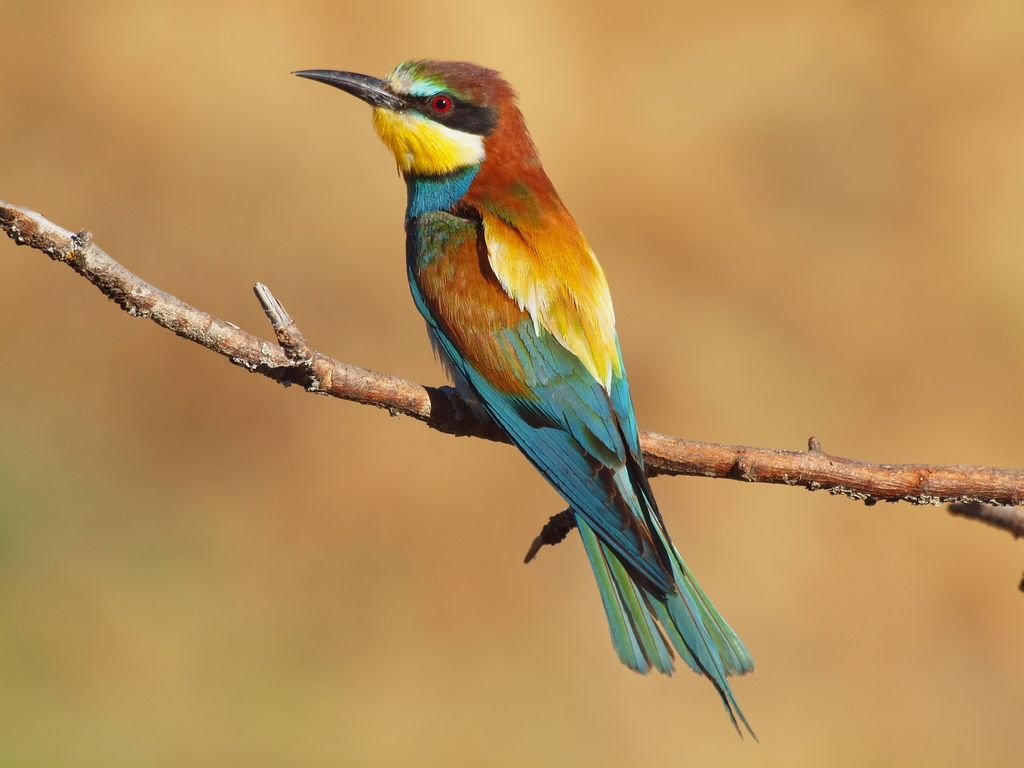
A gloriously coloured aerial hunter in chestnut, gold and turquoise that catches bees and wasps on the wing. It nests colonially in tunnels dug into sandy banks and winters in Africa.
The European bee-eater is a bird species in the bee-eater family, Meropidae. It has the largest range of any bee-eater species, breeding in southern and central Europe, northern and southern Africa, and western Asia. Except for the resident southern African population, the species is strongly migratory, wintering in tropical Africa. This species occurs as a spring overshoot north of its usual range, with occasional breeding in northern Europe. Wikipedia
What it can do
- iRemoves the sting of a bee by beating and rubbing it against a perch before swallowing
- iiDigs nest tunnels up to a metre or more long in sandbanks with its bill
- iiiHelpers, often previous offspring, assist some pairs in feeding chicks
- ivIts range is moving north with warmer summers, with recent breeding in Germany and Britain
In the field
Field marks
- aChestnut crown and back, golden-yellow shoulders and throat
- bBlack eye mask and black necklace
- cTurquoise-blue underparts
- dLong pointed central tail feathers and long, decurved black bill
- Voice
- A liquid, rolling 'prruip' or 'krruup', given constantly by flocks overhead and often the first sign of their presence.
- Not to be confused with
- Blue-cheeked bee-eater (North Africa, Middle East) is mostly green with a chestnut throat and longer streamers. European roller is stockier and blue with no long tail streamers.
- Where to see it
- Extremadura and the Ebro valley in Spain, the Camargue, Greek and Turkish river valleys; huge passage flocks over Eilat and the Bosphorus.
- When
- Summer visitor Apr/May–Sep; passage migrant across the Mediterranean and Middle East
Listen
Looking for field recordings…
Life & habits
- Diet
- Flying insects, chiefly bees, wasps and hornets, also dragonflies and beetles
- Habitat
- Open warm country with sandy or earthen banks, river cliffs, quarries
- Size
- 27–29 cm including tail streamers; 44–78 g
- Lifespan
- Typically a few years; the European ringing record is 7 years
Sallies from wires and dead branches to snap up insects, then returns to bash them on the perch.
Where it lives
Recorded sightings
—
geo-referenced records in GBIF, from museums, herbaria and field observers.
Native range
Breeds in southern Europe, North Africa, Turkey, the Middle East and Central Asia; winters in sub-Saharan Africa, with a small resident population in southern Africa
Drag the globe to turn it. Dots are where records exist, not a range map; darker means more records.
In the old herbals & bestiaries
Woodcuts and engravings matched from the Source Library’s scanned books by name. Plates marked “relative” show a close kin rather than this exact species. Click a plate to read the page it came from, with translation.

François Le Vaillant — Histoire naturelle des promerops et des guêpiers (1807)
François Le Vaillant · 1807 · p.305

François Le Vaillant — Histoire naturelle des promerops et des guêpiers (1807)
François Le Vaillant · 1807 · p.311

History of Animals, Book I: On Viviparous Quadrupeds
Conrad Gessner · 1554 · p.762

Ornithology
Ulisse Aldrovandi · 1599 · p.908

Historiae Animalium Liber III: De Avium Natura
Conrad Gesner · 1555 · p.617

History of Animals, Book I: On Viviparous Quadrupeds
Conrad Gessner · 1554 · p.764

Ornithologiae: de avibus historiae libri XII
Ulisse Aldrovandi · 1599 · p.891

Ornithology
Ulisse Aldrovandi · 1599 · p.907

Ten Books of Exotic Things
Carolus Clusius · 1605 · p.516
In the stacks
Searching the stacks…
Every page naming Merops apiaster in the Biodiversity Heritage Library →
Marginalia
Aristotle wrote that beekeepers regarded the 'merops' as an enemy of their hives, and its Arabic name 'warwar' imitates its rolling call.
Curiosity
In 2022 a small colony bred in a quarry at Trimingham, Norfolk, and drew thousands of visitors.
Kinship



Fact-checked: 2 corrections made to this sheet. Photographs: iNaturalist contributors under the licences shown. Records: GBIF.org. Historical plates: Source Library (CC BY-SA 4.0; originals public domain). Summary text: Nature Library editors and Wikipedia (CC BY-SA). Medicinal and edibility notes are historical and educational, not advice. iNaturalist taxon 2191.