 NL·0536
Herbarium of the Nature Library
- Name
- Merops nubicoides
- Family
- Meropidae
- Native to
- Southern Africa from Angola and southern DR Congo to northern South Africa; spreads more widely after breeding
- Habitat
- Riverine bank, Savanna, Floodplain
On eBird ↗
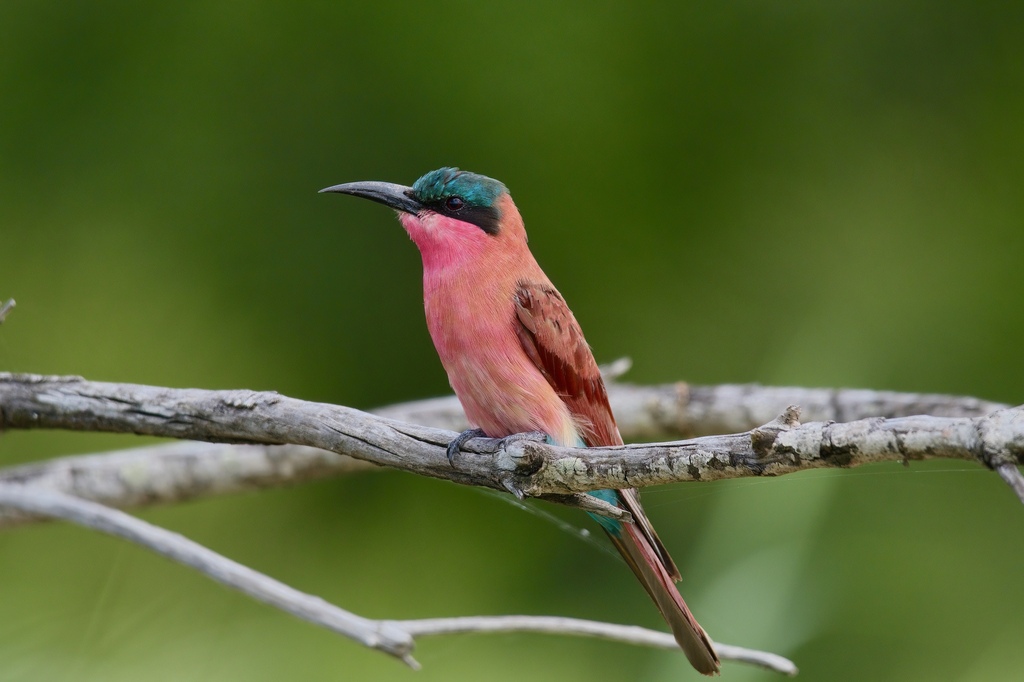
Southern Carmine Bee-eater
Live sightings near you, the range map, bar charts of when it is seen, and Macaulay Library photos and recordings.
Southern carmine bee-eater
Merops nubicoides
Also calledRooiborsbyvreter (Afrikaans) · Guêpier carmin (French)
A carmine-and-turquoise bee-eater that nests in colonies of hundreds to thousands of burrows dug into riverbanks. It famously hunts insects flushed by grazing animals, sometimes riding on the backs of kori bustards.
The southern carmine bee-eater is a species of bee-eater found across sub-equatorial Africa. It was formerly considered conspecific with the closely related northern carmine bee-eater, with the combined species then known as carmine bee-eater. Wikipedia
What it can do
- iExcavates burrows usually 1–2 m long, sometimes more, into vertical sand cliffs
- iiRides on kori bustards, ostriches and large mammals to snatch flushed insects
- iiiGathers at bush fires to catch fleeing insects
- ivRemoves the sting from bees and wasps by beating them on a perch
In the field
Field marks
- aCarmine pink-red body
- bTurquoise-blue crown and undertail
- cBlack mask through the eye
- dLong, pointed central tail streamers
- eSlender, down-curved black bill
- Voice
- Deep, throaty 'terk' or 'krik-krik' calls, given incessantly by flocks.
- Not to be confused with
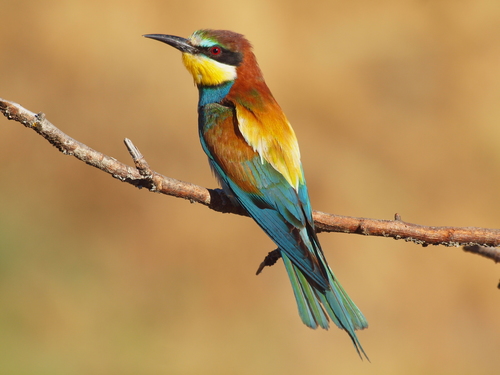
- Northern carmine bee-eater, north of the equator, has a blue-green throat rather than a carmine one. Other bee-eaters in its range are mostly green and none is carmine all over.
- Where to see it
- Luangwa Valley (Zambia), Zambezi and Chobe rivers, Okavango Delta, Mana Pools (Zimbabwe)
- When
- Intra-African migrant; breeds August to December in southern Africa, then disperses north and south
Listen
Looking for field recordings…
Life & habits
- Diet
- Flying insects: bees, wasps, locusts, grasshoppers, beetles, dragonflies
- Habitat
- River valleys, floodplains and savanna
- Size
- About 27–38 cm including tail streamers
Colonies of thousands of birds swirl above riverbanks, each pair digging its own tunnel side by side with neighbours.
Where it lives
Recorded sightings
—
geo-referenced records in GBIF, from museums, herbaria and field observers.
Native range
Southern Africa from Angola and southern DR Congo to northern South Africa; spreads more widely after breeding
Drag the globe to turn it. Dots are where records exist, not a range map; darker means more records.
In the old herbals & bestiaries
No plate in the Source Library names this exact species, so these show its closest relatives as the old naturalists drew them: same genus, or the same kind of animal. Click a plate to read the page it came from, with translation.

François Le Vaillant — Histoire naturelle des promerops et des guêpiers (1807)
Relative · François Le Vaillant · 1807 · p.351

François Le Vaillant — Histoire naturelle des promerops et des guêpiers (1807)
Relative · François Le Vaillant · 1807 · p.367

History of Animals, Book I: On Viviparous Quadrupeds
Relative · Conrad Gessner · 1554 · p.762

Ornithology
Relative · Ulisse Aldrovandi · 1599 · p.908

Historiae Animalium Liber III: De Avium Natura
Relative · Conrad Gesner · 1555 · p.617

Historiae Animalium Liber III: De Avium Natura
Relative · Conrad Gesner · 1555 · p.619

History of Animals, Book I: On Viviparous Quadrupeds
Relative · Conrad Gessner · 1554 · p.764

Ornithology: The History of Birds
Relative · Ulisse Aldrovandi · 1599 · p.908

Ornithologiae: de avibus historiae libri XII
Relative · Ulisse Aldrovandi · 1599 · p.891

Ornithology
Relative · Ulisse Aldrovandi · 1599 · p.907
In the stacks
Searching the stacks…
Every page naming Merops nubicoides in the Biodiversity Heritage Library →
Marginalia
Southern carmine bee-eater colonies on the Zambezi and Luangwa riverbanks are a celebrated attraction of the southern African dry season.
Curiosity
A breeding colony can number several thousand birds packed into a single sandbank.
Kinship

Fact-checked: 2 corrections made to this sheet. Photographs: iNaturalist contributors under the licences shown. Records: GBIF.org. Historical plates: Source Library (CC BY-SA 4.0; originals public domain). Summary text: Nature Library editors and Wikipedia (CC BY-SA). Medicinal and edibility notes are historical and educational, not advice. iNaturalist taxon 67434.