 NL·0736
Herbarium of the Nature Library
- Name
- Harpadon nehereus
- Family
- Synodontidae
- Native to
- Indo-Pacific: Arabian Sea and Bay of Bengal to the South China Sea and Indonesia
- Habitat
- Estuaries, Coastal waters, Muddy seabeds
Bombay duck
Harpadon nehereus
Also calledBombil / Bombila (Marathi) · Loitta (Bengali) · Bummalo · Long tou yu (Chinese)
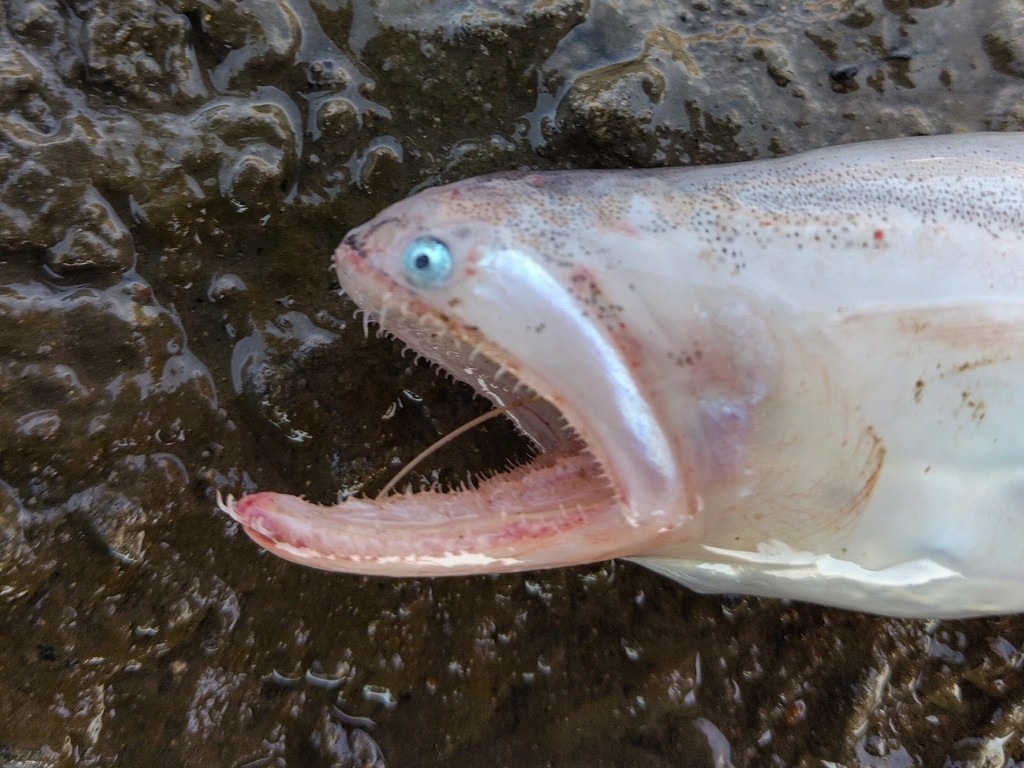
A soft, almost jelly-like lizardfish with needle teeth that is no duck at all. Sun-dried on bamboo racks along the Mumbai coast, its pungent fillets became a famous condiment of the British Raj.
Harpadon nehereus, commonly known as the Bombay duck or bummalo, is a species of lizardfish. Adults may reach a maximum length of 40 cm (16 in), but the usual size is around 25 cm (10 in). Wikipedia
What it can do
- iBody is about 90% water, making it gelatinous and translucent
- iiMouth bristles with backward-pointing, barbed teeth
- iiiGathers in huge numbers off river mouths during the monsoon
In the field
Field marks
- aSoft, semi-transparent pale body
- bLarge mouth with many fine, curved needle teeth
- cTail fin three-lobed, with a middle lobe extended by the lateral line
- dPectoral and pelvic fins long and dusky
- Not to be confused with
- Other lizardfishes (Saurida) are firmer, scaled and cylindrical; Harpadon translucens has a more transparent body.
- Where to see it
- Fish markets of Mumbai (Sassoon Dock), Karachi, Chittagong; drying racks along the Konkan coast
- When
- Year-round; largest catches after the monsoon
Life & habits
- Diet
- Small fish, prawns and crustaceans
- Habitat
- Turbid, muddy coastal waters near river mouths
- Size
- Usually 20–25 cm; up to about 40 cm
- Lifespan
- About 2–3 years
Feeds near the surface at night and moves inshore in large shoals with monsoon floodwater.
Where it lives
Recorded sightings
—
geo-referenced records in GBIF, from museums, herbaria and field observers.
Native range
Indo-Pacific: Arabian Sea and Bay of Bengal to the South China Sea and Indonesia
Drag the globe to turn it. Dots are where records exist, not a range map; darker means more records.
In the stacks
Searching the stacks…
Every page naming Harpadon nehereus in the Biodiversity Heritage Library →
Marginalia
One theory traces 'Bombay duck' to the mail trains of the Bombay Daak, whose carriages smelled of the dried fish; another to an English corruption of 'bombil'. An EU ban on imports in 1997 over processing rules prompted a 'Save the Bombay duck' campaign in Britain.
Curiosity
Its genus name Harpadon means 'hook-toothed'.
Kinship



Photographs: iNaturalist contributors under the licences shown. Records: GBIF.org. Historical plates: Source Library (CC BY-SA 4.0; originals public domain). Summary text: Nature Library editors and Wikipedia (CC BY-SA). Medicinal and edibility notes are historical and educational, not advice. iNaturalist taxon 512127.