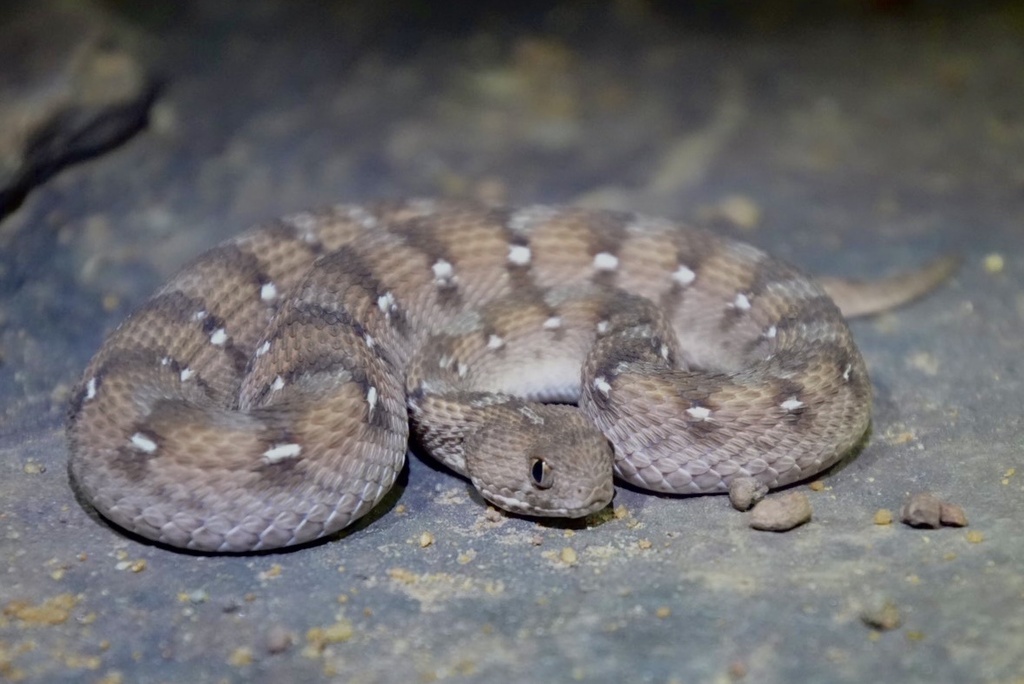
African Saw-scaled Viper
Echis ocellatus
Echis ocellatus, known by the common names West African carpet viper and ocellated carpet viper, is a highly venomous species of viper endemic to West Africa. No subspecies are currently recognized.
It is responsible for more human fatalities due to snakebite than all other African species combined. An antivenom called Echitab-plus-ICP is manufactured by the Costa Rican Instituto Clodomiro Picado and another called EchiTabG is manufactured by MicroPharm Ltd in the UK.
From the article Echis ocellatus on Wikipedia (CC BY-SA), quoted section by section
Description
The maximum total length (body + tail) is 65 cm (26 in), possibly more, while the average total length is 30–50 cm (12–20 in). They are characterized by their bulging eyes and short snout, typical of species of the genus Echis. E. ocellatus is terrestrial, nocturnal and crepuscular: it usually goes out to hunt its prey at the first hours of the night, prey like small vertebrates, like mammals, birds, lizards and amphibians, it has already been reported to hunt small invertebrates like centipedes and scorpions. It's a very aggressive viper; it forms its body like a ''S'' and rubs itself making an alert sound with its scales.
Wikipedia: “Description and behavior”
Range & habitat
It is found in West Africa in Mali, Ivory Coast, Burkina Faso, Ghana, Togo, Benin, southern Niger, and Nigeria. Older records from Senegal, Guinea Bissau and Guinea refer to Echis jogeri, and those from eastern Nigeria, Cameroon and southern Chad to Echis romani. The type locality is described as "Haute Volta, Garango, 048 N, 033 W" (Burkina Faso). There are also reports of single specimens found in the Bangui in the Central African Republic and in central Sudan. It is rarely found north of the 15th parallel, after which E. leucogaster becomes more common. The geographic range of E. ocellatus extends to the coast via the Dahomey Gap. They are mainly found in savanna and occasionally in wooded areas.
Wikipedia: “Range and habitat”
What it does
Sexually mature females lay between 6 and 20 eggs, usually at the end of the dry season in February to March. Hatchlings are 10–12 cm (3.9–4.7 in) in total length.
Wikipedia: “Reproduction”
Toxicity
The venom of the West African carpet viper is responsible for more fatalities than all other African snakes combined. Its venom is a compound of procoagulants, anticoagulants, hemorraghins, nephrotoxins and necrotoxins, and bite symptoms include local pain, swelling, bleeding necrosis and disfigurement which may result in amputation. Systemic symptoms include coagulopathy, hemorrhages, shock, renal failure and blindness. The envenoming rate is 80% and the lethality rate is 10-20%.
Wikipedia: “Venom”
Where it lives
Recorded sightings
—
geo-referenced records in GBIF, from museums, herbaria and field observers.
Drag the globe to turn it. Dots are where records exist, not a range map; darker means more records.
In the stacks
Searching the stacks…
Every page naming Echis ocellatus in the Biodiversity Heritage Library →
This page is assembled live from iNaturalist, GBIF, Wikipedia, the Source Library and the Internet Archive. It is not yet part of the hand-edited codex. iNaturalist taxon 99689.