- Animals
- ›Arthropods
- ›Hexapods
- ›Insects
- ›Winged and Once-winged Insects
- ›Flies
- ›Brachyceran Flies
- ›Cyclorrhaphan Flies
- ›Aschizan Flies
- ›Hover Flies
- ›Typical Hover Flies
- ›Syrphini
- ›Eupeodes
- ›Metasyrphus
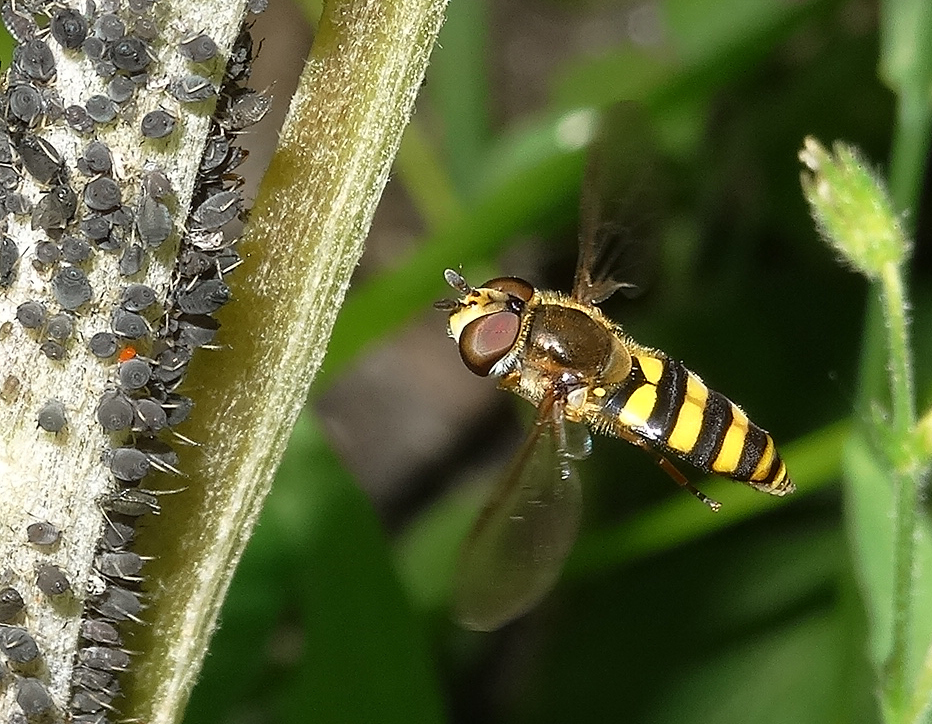
Long-tailed Aphideater Complex
Eupeodes americanus
Eupeodes americanus, the American hoverfly, is found throughout North America and inhabits meadows, and fields with flowers and foliage. Adults feed on nectar, whereas their larvae feed on aphids. The adult fly is black to metallic green, and has three yellow bands on its abdomen. Its face is a light yellow with large black compound eyes on either side, and its wings are clear; it is 9–12 mm in body length. The larvae are mature at around 11 mm, and they are yellow-white to salmon brown, with markings of black and white or yellow-white. The lighter markings consist of a transverse rectangular bars on segments 6 to 11, and a narrow line along each side of the larvae. Early instars have visible black setae. The larvae are active feeders. They are being considered as suitable biological control agents for aphids and scale insects. This species is considered highly migratory, moving from Canada to the southeastern United States during autumn
2 branches of this group, most-observed first
See this branch on the Wheel of Life →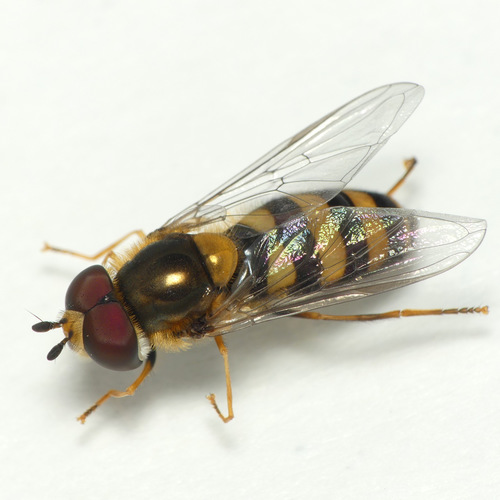

Where it lives
Recorded sightings
—
geo-referenced records in GBIF, from museums, herbaria and field observers.
Drag the globe to turn it. Dots are where records exist, not a range map; darker means more records.
In the stacks
Searching the stacks…
Every page naming Eupeodes americanus in the Biodiversity Heritage Library →
This page is assembled live from iNaturalist, GBIF, Wikipedia, the Source Library and the Internet Archive. It is not yet part of the hand-edited codex. iNaturalist taxon 963010.