- Animals
- ›Arthropods
- ›Hexapods
- ›Insects
- ›Winged and Once-winged Insects
- ›Flies
- ›Brachyceran Flies
- ›Cyclorrhaphan Flies
- ›Schizophoran Flies
- ›Calyptrate Flies
- ›Bot Flies, Blow Flies, and Allies
- ›Flesh Flies and Satellite Flies
- ›Typical Flesh Flies
- ›Raviniini
- ›Ravinia
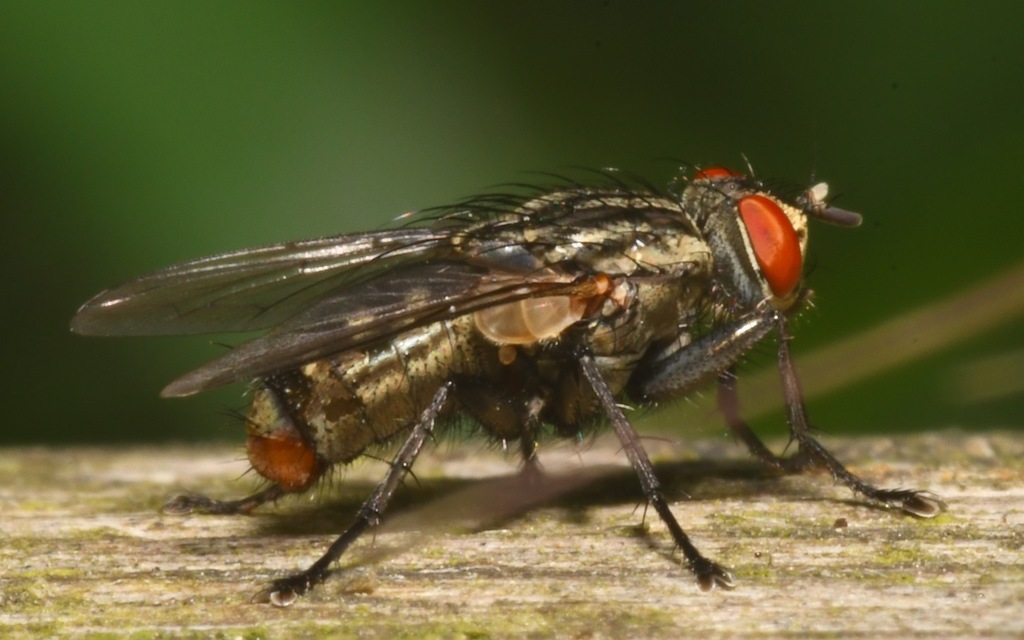
Ravinia pernix
Sarcophaga pernix, also known as the red-tailed flesh fly, is a fly in the Sarcophagidae family. This fly often breeds in carrion and feces, making it a possible vector for disease. The larvae of this species can cause myiasis, as well as accidental myiasis. It is potentially useful in forensic entomology.
From the article Sarcophaga pernix on Wikipedia (CC BY-SA), quoted section by section
Description
Sarcophagidae is the dipteran family commonly known as flesh flies, comprising approximately 2000 species. Many species of Sarcophagidae prefer to breed in carrion over other mediums, but there are several species that breed in dung. A large number of species are parasitoids or cleptoparasitoids and never breed in carrion. It is difficult to identify the S. pernix species unless genitalia can be observed. Only males can be identified and classified within the genus. Sarcophagids are rather large in size ranging from 4 to 23 mm, (adults of S. pernix vary in size from 7 to 14 mm). Distinguishing characteristics include a checkerboard like pattern on the abdomen, stripes on the thorax and red eyes. Flesh flies are attracted to anything rotting, including feces. Sarcophagidae are unimpeded by rain and fly in any weather. Because of this trait, Sarcophagidae will often be the first flies to colonize a corpse after an extended period of rain. Flesh flies appear to prefer sunlight over shaded conditions. Sarcophaga pernix (Bercaea cruentata) is one of the most common species of Sarcophagidae recovered from indoor crime scenes in the United States.
Range & habitat
Afghanistan, Albania, Algeria, Armenia, Austria, Azerbaijan, Azores, Belgium, Bulgaria, Belarus, Canary Islands, China, Cyprus, Czech Republic, Denmark, Egypt, Estonia, Finland, France, Germany, Greece, Gruzia, Hungary, Iran, Iraq, Ireland, Israel, Italy, Japan, Kazakhstan, Kyrgyzstan, Latvia, Lebanon, Libya, Lithuania, Malta, Moldova, Mongolia, Morocco, North Korea, Norway, Poland, Portugal, Romania, Russia, Saudi Arabia, Serbia, Slovakia, South Korea, Spain, Sweden, Switzerland, Syria, Tajikistan, Tunisia, Turkmenistan, Ukraine, United Kingdom, Uzbekistan, Chad, Yemen, Bangladesh, Bhutan, India, Nepal, Pakistan. Sarcophaga pernix is a common species of flesh fly that appear worldwide in distribution and is commonly found in the United States. It can be found throughout the year in the southern portion of the United States. The larvae are adaptable and can live in moist semi-aquatic habits that are unsuitable for most other fly species.
Overall, S. pernix is most likely to be found in climates with higher temperatures and will prefer high temperatures throughout its entire life cycle.
Wikipedia: “Distribution”
What it does
All members of the family Sarcophagidae are larviparous or ovoviviparous. Sarcophaga pernix (Bercaea cruentata) gives live birth to larvae with the female retaining the egg case in her abdomen. Flesh flies are strongly attracted to carrion or dry flesh. The female has a strong desire to lay larvae on the flesh and have even been noted to larviposit on the sleeve of a garment that has been previously soiled with blood. Oldroyd states that the larvae of Sarcophaga spp are voracious and will take anything of animal origin be it alive or dead. A larva is forced out of the larvipositor usually head first and soon disappears into the food material. Once larvae are deposited as 1st stage instars, rapid development follows with 3rd instars usually being achieved by three to four days. Larviposition to adulthood generally takes around two weeks. If the fly is forced to hibernate due to temperate climates, it will do so in the pupal stage.
Wikipedia: “Life cycle”
In medicine
Due to its attraction to feces and carrion, S. pernix has been accounted for as a dipteran species that may serve as a mechanical vector for disease, especially if it intrudes homes. The family Sarcophagidae is particularly attracted to human food and filth. Bacteria can be transferred physically from the fly's body, legs, or proboscis, to an animal, human food, or open sores. S. pernix has also been found to carry polio virus. During a 1914 polio epidemic, samples of the virus were collected from S. pernix, among other dipterans. The sample was used to infect a monkey with polio, showing that it was an active virus. However, there is still no conclusive evidence as to whether or not this species actually transmits diseases to humans or animals. The larvae of S. pernix may produce myiasis on necrotic or dead flesh. The first case of auricular myiasis (on the outer ear) on a human was reported in Iran in 1974. Other myiasis cases have been recorded around the world in both humans and animals. Examples range from aural myiasis caused by S. pernix in four children in Israel (from 1990 to 1993) that produced symptoms of ear discharge, otalgia and itching, to the infection of a schnauzer in Umbria, Italy in 1994 by S. pernix maggots. Accidental myiasis can also be caused by S. pernix larvae. …
Wikipedia: “Medical importance”
Listen
Looking for field recordings…
Where it lives
Recorded sightings
—
geo-referenced records in GBIF, from museums, herbaria and field observers.
Drag the globe to turn it. Dots are where records exist, not a range map; darker means more records.
In the stacks
Searching the stacks…
Every page naming Ravinia pernix in the Biodiversity Heritage Library →
This page is assembled live from iNaturalist, GBIF, Wikipedia, the Source Library and the Internet Archive. It is not yet part of the hand-edited codex. iNaturalist taxon 950225.