 NL·0263
Herbarium of the Nature Library
- Name
- Anguilla anguilla
- Family
- Anguillidae
- Native to
- Rivers, lakes and coasts of Europe and North Africa, from Iceland and Norway to the Mediterranean and Morocco; spawns in the Sargasso Sea
- Habitat
- Rivers and streams, Freshwater lakes, Estuaries, Open ocean
European eel
Anguilla anguilla
Also calledAnguila (Spanish) · Paling (Dutch) · Aal (German) · Ål (Swedish/Danish) · Ḥanklīs (Arabic) · Yılan balığı (Turkish) · Anguille (French)
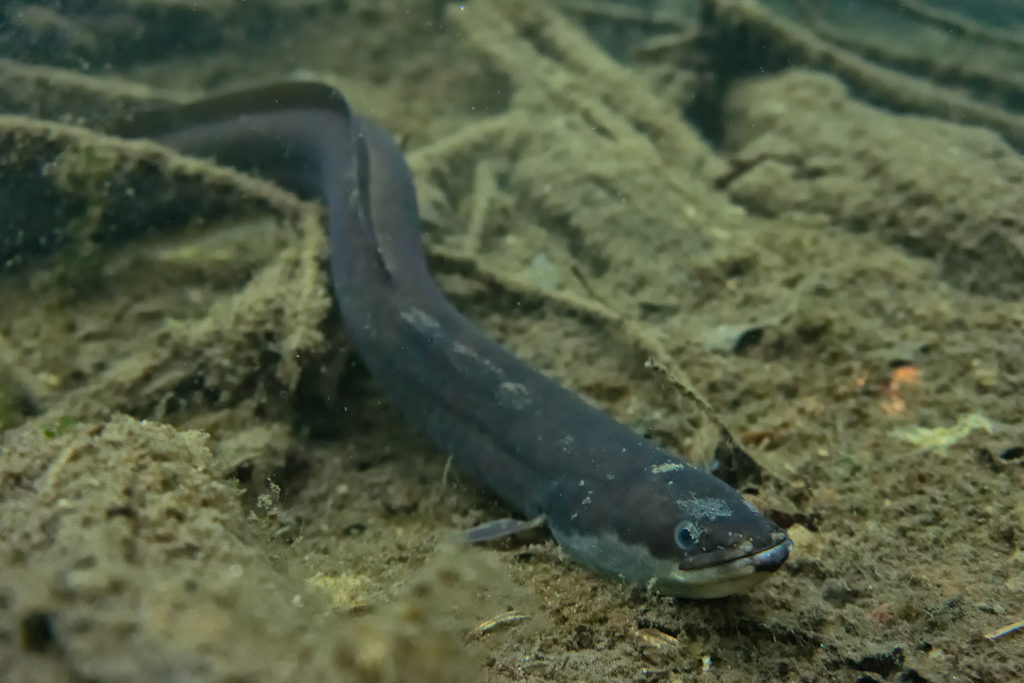
A snake-like fish that lives for decades in European rivers and lakes, then swims some 5,000 km to spawn in the Sargasso Sea and die. No one has yet seen European eels spawn in the wild.
The European eel is a species of eel. Their life history was a mystery for thousands of years, and mating in the wild has not yet been observed. The five stages of their development were originally thought to be different species. They are critically endangered due to hydroelectric dams, overfishing by fisheries on coasts for human consumption, and parasites. Wikipedia
What it can do
- iMigrates about 5,000–6,000 km across the Atlantic to spawn
- iiChanges form several times: leaf-like larva, transparent glass eel, elver, yellow eel and silver eel
- iiiBreathes partly through its skin and can wriggle across wet grass between waters
- ivAdjusts its eyes and body chemistry for the deep ocean before its final migration
In the field
Field marks
- aLong, snake-like body
- bDorsal fin starts well behind the pectoral fins
- cLower jaw slightly longer than the upper
- dYellow-brown, turning silver before migration
- Not to be confused with
- Conger eel is marine, with the dorsal fin starting just behind the pectoral fins and an upper jaw that projects. Lampreys have no jaws.
- Where to see it
- Elver runs on the River Severn (England)
- When
- Glass eels arrive Feb–May; silver eels leave in autumn on dark nights
Life & habits
- Diet
- Carnivore and scavenger: insect larvae, worms, crustaceans, fish, carrion
- Habitat
- Rivers, lakes, ponds, estuaries and coastal lagoons
- Size
- Females up to ~1.3 m; males usually under 50 cm
- Lifespan
- Usually 5–20 years in fresh water; can exceed 80 in captivity
Larvae drift on the Gulf Stream for about one to three years before arriving at European coasts as see-through glass eels.
Where it lives
Recorded sightings
—
geo-referenced records in GBIF, from museums, herbaria and field observers.
Native range
Rivers, lakes and coasts of Europe and North Africa, from Iceland and Norway to the Mediterranean and Morocco; spawns in the Sargasso Sea
Drag the globe to turn it. Dots are where records exist, not a range map; darker means more records.
In the old herbals & bestiaries
Woodcuts and engravings matched from the Source Library’s scanned books by name. Plates marked “relative” show a close kin rather than this exact species. Click a plate to read the page it came from, with translation.


In the stacks
Searching the stacks…
Every page naming Anguilla anguilla in the Biodiversity Heritage Library →
Marginalia
Aristotle concluded that eels arose spontaneously from mud, and a young Sigmund Freud dissected hundreds in Trieste in 1876 hunting for their testes. The Danish biologist Johannes Schmidt traced ever-smaller larvae to the Sargasso Sea between 1904 and 1922.
Curiosity
Glass eels arriving in Europe have fallen by over 90% since the 1980s, and illegal trafficking of them to Asia has been called one of the largest wildlife crimes in Europe.
Kinship






Photographs: iNaturalist contributors under the licences shown. Records: GBIF.org. Historical plates: Source Library (CC BY-SA 4.0; originals public domain). Summary text: Nature Library editors and Wikipedia (CC BY-SA). Medicinal and edibility notes are historical and educational, not advice. iNaturalist taxon 94105.