- Animals
- ›Chordates
- ›Vertebrates
- ›Reptiles
- ›Snakes and Lizards
- ›Snakes
- ›Colubrid Snakes
- ›Natricine Snakes
- ›Natrix
- ›Natrix natrix
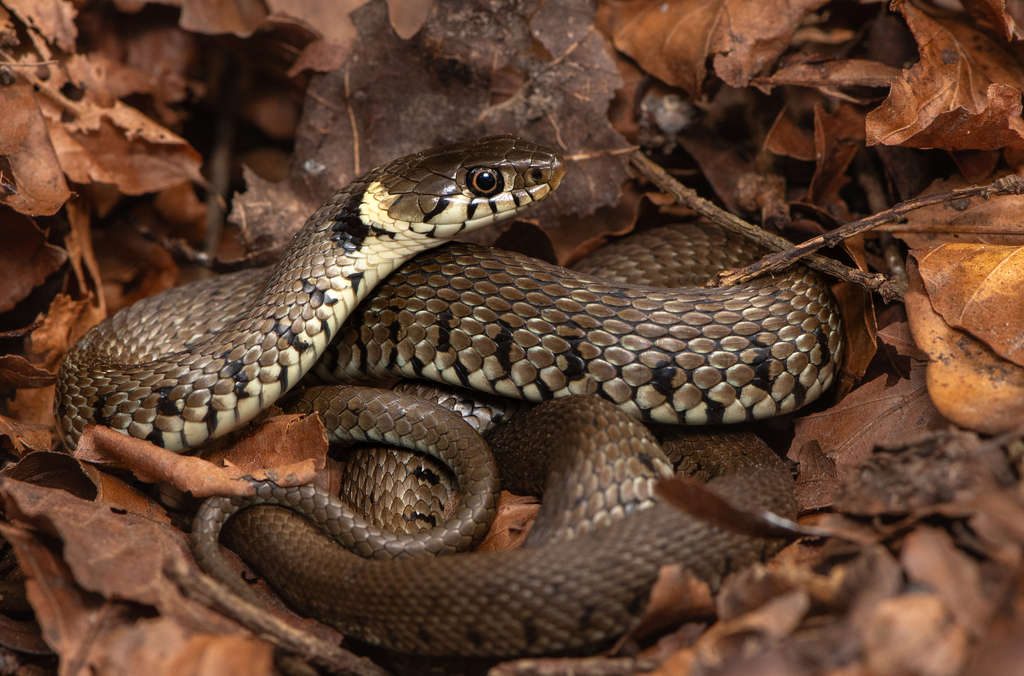
Barred Grass Snake
Natrix helvetica
The barred grass snake (Natrix helvetica) is a non-venomous colubrid snake from Western Europe, typically living in and close to water. It was included within the grass snake species, Natrix natrix, until August 2017, when genetic analysis led to its reclassification as a separate species.
From the article Barred grass snake on Wikipedia (CC BY-SA), quoted section by section
Description
The barred grass snake has a dark grey-green upper body with distinctive black markings in the form of bars running along its sides. Its underside is pale. Like the grass snake, it has a distinctive yellow and black collar around its neck. It can grow to over a metre in length.
Range & habitat
The species is found in Great Britain as far north as southern Scotland, and in the Netherlands, western Germany, Switzerland, Italy and France. The nominate subspecies N. h. helvetica has the widest distribution: from Britain to the Pyrenees and the Rhine region.
Wikipedia: “Distribution”
What it does
Barred grass snakes are semi-aquatic and prey mainly on amphibians, especially common toads and common frogs; they also eat fish, some small land mammals and nestling birds, and may occasionally take ants and their larvae. Captive snakes have been observed accepting earthworms offered by hand, but they never take dead prey items. The snake actively searches for prey, often on the edges of the water, using its Jacobson's organ to detect smells and sights. They consume live prey without using constriction.
Wikipedia: “Feeding”
Where it lives
Recorded sightings
—
geo-referenced records in GBIF, from museums, herbaria and field observers.
Drag the globe to turn it. Dots are where records exist, not a range map; darker means more records.
In the stacks
Searching the stacks…
Every page naming Natrix helvetica in the Biodiversity Heritage Library →
This page is assembled live from iNaturalist, GBIF, Wikipedia, the Source Library and the Internet Archive. It is not yet part of the hand-edited codex. iNaturalist taxon 851211.