- Animals
- ›Chordates
- ›Vertebrates
- ›Birds
- ›Swifts and Hummingbirds
- ›Hummingbirds
- ›Mango Hummingbirds and Allies
- ›Schistes
On eBird ↗
Geoffroy's Daggerbill
Live sightings near you, the range map, bar charts of when it is seen, and Macaulay Library photos and recordings.
Geoffroy's Daggerbill
Schistes geoffroyi
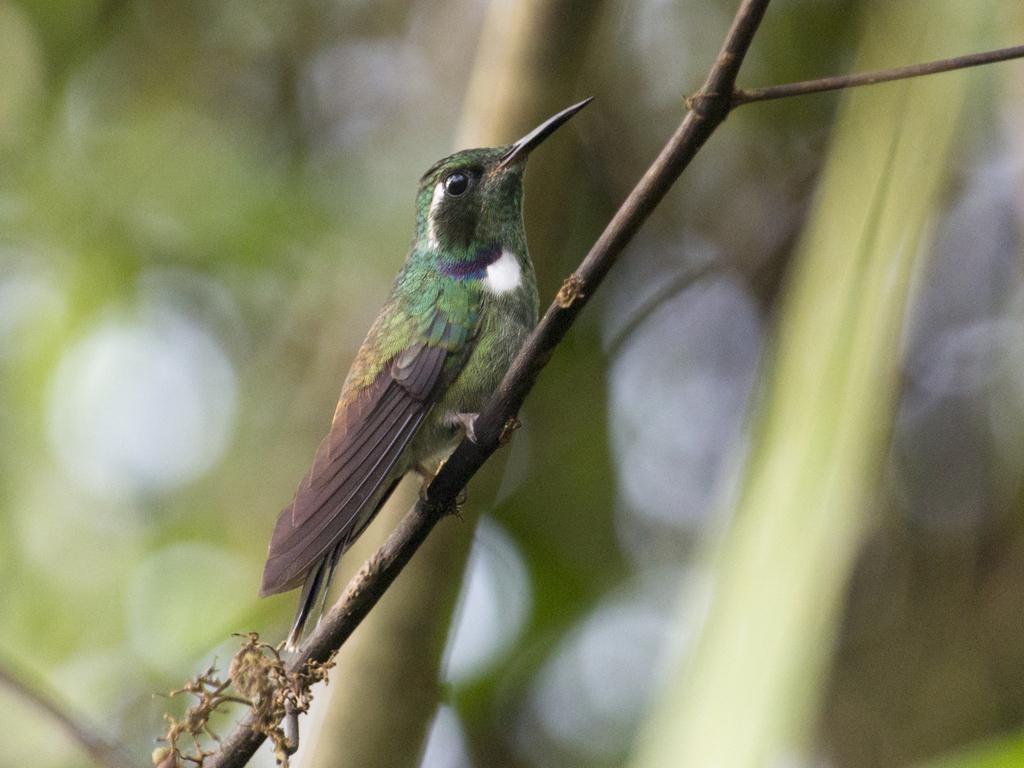
The Geoffroy's wedgebill or eastern wedge-billed hummingbird (Schistes geoffroyi) is a species of hummingbird in the family Trochilidae. It is sometimes merged with the visorbearers in Augastes. It has been split from the white-throated wedgebill by most taxonomic authorities. Some authorities, including the American Ornithological Society, continue to lump both species together, calling them the wedge-billed hummingbird.
From the article Geoffroy's daggerbill on Wikipedia (CC BY-SA), quoted section by section
Description
Geoffroy's daggerbill is 8.6 to 9.3 cm (3.4 to 3.7 in) long and weighs 3.5 to 4.1 g (0.12 to 0.14 oz). It gets its name from the tip of its bill, which is very narrow and sharply pointed, though this characteristic is not easily seen in the field. Males of the nominate subspecies have bronzy green upperparts with a coppery cast to the rump. They have glittery violet patches on the sides of the iridescent golden-green throat, white patches on either side of the upper chest, and an elongated white patch behind the eye. Their underpars are green. Females' throats are white with green speckles but they are otherwise like the male. S. g. chapmani is similar to the nominate but has no white patches on the throat.
Range & habitat
The nominate subspecies of Geoffroy's daggerbill is found from the Sierra de Perijá and Coastal Range of Venezuela south along the Andes through eastern Colombia and eastern Ecuador into Peru as far as Cuzco. S. g. chapmani is found from Cuzco into central Bolivia. The species inhabits the interior and edges of dense cloudforest. In elevation it usually ranges between 900 and 2,300 m (3,000 and 7,500 ft) and has been recorded as high as 2,500 m (8,200 ft) in Ecuador and 2,800 m (9,200 ft) in southeastern Peru.
Wikipedia: “Distribution and habitat”
What it does
Geoffroy's daggerbill forages in dense vegetation from near the ground to medium heights. It collects nectar from tubular flowers of a variety of shrubs, vines, and small trees. It also captures small insects on the wing or sometimes by gleaning from vegetation.
Wikipedia: “Feeding”
Listen
Looking for field recordings…
Where it lives
Recorded sightings
—
geo-referenced records in GBIF, from museums, herbaria and field observers.
Drag the globe to turn it. Dots are where records exist, not a range map; darker means more records.
In the stacks
Searching the stacks…
Every page naming Schistes geoffroyi in the Biodiversity Heritage Library →
This page is assembled live from iNaturalist, GBIF, Wikipedia, the Source Library and the Internet Archive. It is not yet part of the hand-edited codex. iNaturalist taxon 850877.