 NL·0111
Herbarium of the Nature Library
- Name
- Nelumbo nucifera
- Family
- Nelumbonaceae
- Native to
- South and East Asia to northern Australia; ancient introductions elsewhere
- Habitat
- Freshwater wetlands, Shallow ponds and lakes
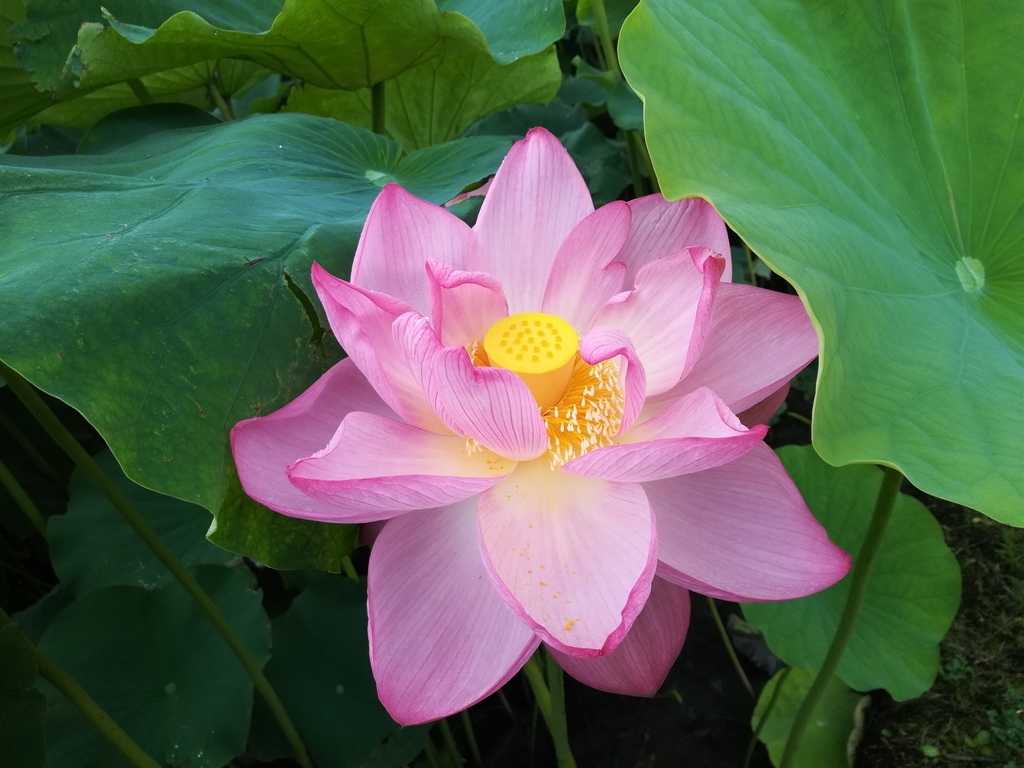
Sacred lotus
Nelumbo nucifera
Also calledKamal / Padma (Hindi/Sanskrit) · Lián 莲 / Ǒu 藕 (Chinese) · Hasu ハス / Renkon (Japanese) · Bua luang (Thai) · Sen (Vietnamese) · Thamarai (Tamil)
The flower that rises clean from the mud, central to Hinduism and Buddhism. Its leaves are so water-repellent that droplets roll off carrying dirt with them (the 'lotus effect'), its flowers warm themselves, and a seed about 1,300 years old has been sprouted.
Nelumbo nucifera, also known as Padma or Kamala, sacred lotus, pink lotus, Indian lotus, or simply lotus, is one of two extant species of aquatic plant in the family Nelumbonaceae. It is sometimes colloquially called water lily, though this more often refers to members of the family Nymphaeaceae. The lotus belongs in the order Proteales. Wikipedia
What it can do
- iIts leaf surface is covered in wax nano-bumps that make it superhydrophobic and self-cleaning
- iiWarms its flowers to around 30–35 °C for days, even on cool nights
- iiiProduces seeds that can stay alive for centuries; one from a dry lakebed in north-east China germinated after about 1,300 years
- ivPipes air down to its rhizomes through hollow channels in its stalks
At the table
Eatenrhizome (lotus root) · seeds · young leaves · stamens (tea) · leaves (for wrapping food)
All main parts are eaten. Cook the rhizome before eating, since raw aquatic plants can carry parasites such as Fasciolopsis; remove the bitter green embryo of seeds if desired.
In the medicine cabinet
| Tradition | Use |
|---|---|
| Traditional Chinese medicine | Seeds (lian zi) to calm the heart; leaves (he ye) for summer heat; the seed embryo (lian zi xin) as a cooling bitter |
| Ayurveda | Flowers and rhizome (kamala) for bleeding, diarrhoea and skin conditions |
Weight of evidence
Traditional. Long historical use; little or no modern clinical evidence.
Active compounds
nuciferine, neferine, liensinine, flavonoids
Fruit & seed


Fruit
Nutlets in an enlarged receptacle
Ripens: Late summer
A flat-topped, shower-head seed pod with each nut set in its own hole.
Seed
~1.5 cm
Hard, acorn-like nut
- Dispersal
- Water, after the pod tips over
- Germination
- File through the hard coat at the non-pointed end and soak in warm water; sprouts in days
Photographs from Wikimedia Commons under open licences; hover for the photographer, click for the file.
How to grow it
Hardiness (USDA zones)
USDA 4–11 (rhizome must not freeze). Survives winters down to about -34 °C.
- Light
- Full sun
- Water
- Aquatic: 10–60 cm of still water
- Soil
- Heavy loam or clay at the pond bottom
- Propagation
- Scarified seed or rhizome tubers
- To harvest
- Flowers in 1–2 years from seed; rhizomes after one season
- Climates
- Tropical, Subtropical, Temperate
- 1Nick the seed coat and soak in warm water, changing it daily
- 2Pot the sprouted seed into heavy loam in a wide, hole-free container
- 3Submerge in still, sunny water and raise depth as leaves grow
- 4Give at least 6 hours of sun and warm water to flower
Can it grow where you are?
Where it lives
Recorded sightings
—
geo-referenced records in GBIF, from museums, herbaria and field observers.
Native range
South and East Asia to northern Australia; ancient introductions elsewhere
Drag the globe to turn it. Dots are where records exist, not a range map; darker means more records.
In the old herbals & bestiaries
Woodcuts and engravings matched from the Source Library’s scanned books by name. Plates marked “relative” show a close kin rather than this exact species. Click a plate to read the page it came from, with translation.

Complete Treatise on Agricultural Administration
Xu Guangqi · 1909 · p.825

The History of the Heavens
[Pluche, Antoine] · 1764 · p.143

The Ambonese Herbal, Vol. 4
Georg Eberhard Rumphius · 1743 · p.246

Garden of Health
1507 · p.144

Commentaries on the Six Books of Dioscorides
Pietro Andrea Mattioli · 1560 · p.380

Commentaries on the Six Books of Dioscorides on Medical Matter
Pietro Andrea Mattioli · 1563 · p.365

Commentaries on the Six Books of Pedanius Dioscorides on Medical Matter
Pietro Andrea Mattioli · 1565 · p.593

History of Rare Plants of Pannonia
Carolus Clusius · 1576 · p.819

History of Rare Plants of Pannonia
Carolus Clusius · 1576 · p.818

Compendium of Materia Medica
李時珍 · 1596 · p.91
In the stacks
Searching the stacks…
Every page naming Nelumbo nucifera in the Biodiversity Heritage Library →
Marginalia
In Hindu iconography Lakshmi and Brahma sit on lotuses, and Buddhist art shows the Buddha on a lotus throne; 'Om mani padme hum' means 'the jewel in the lotus'. Zhou Dunyi's 11th-century essay 'On the Love of the Lotus' praised it for rising unstained from mud.
Curiosity
Self-cleaning paints and fabrics are modelled on the lotus leaf's microstructure; 'lotus effect' is a registered trademark.
Kinship

Photographs: iNaturalist contributors under the licences shown. Records: GBIF.org. Historical plates: Source Library (CC BY-SA 4.0; originals public domain). Summary text: Nature Library editors and Wikipedia (CC BY-SA). Medicinal and edibility notes are historical and educational, not advice. iNaturalist taxon 82814.