- Plants
- ›Vascular Plants
- ›flowering plants
- ›Dicots
- ›Nances, Willows, and Allies
- ›Spurge Family
- ›Euphorbioideae
- ›Euphorbieae
- ›Euphorbiinae
- ›Euphorbia
- ›Chamaesyce
- ›Alectoroctonum
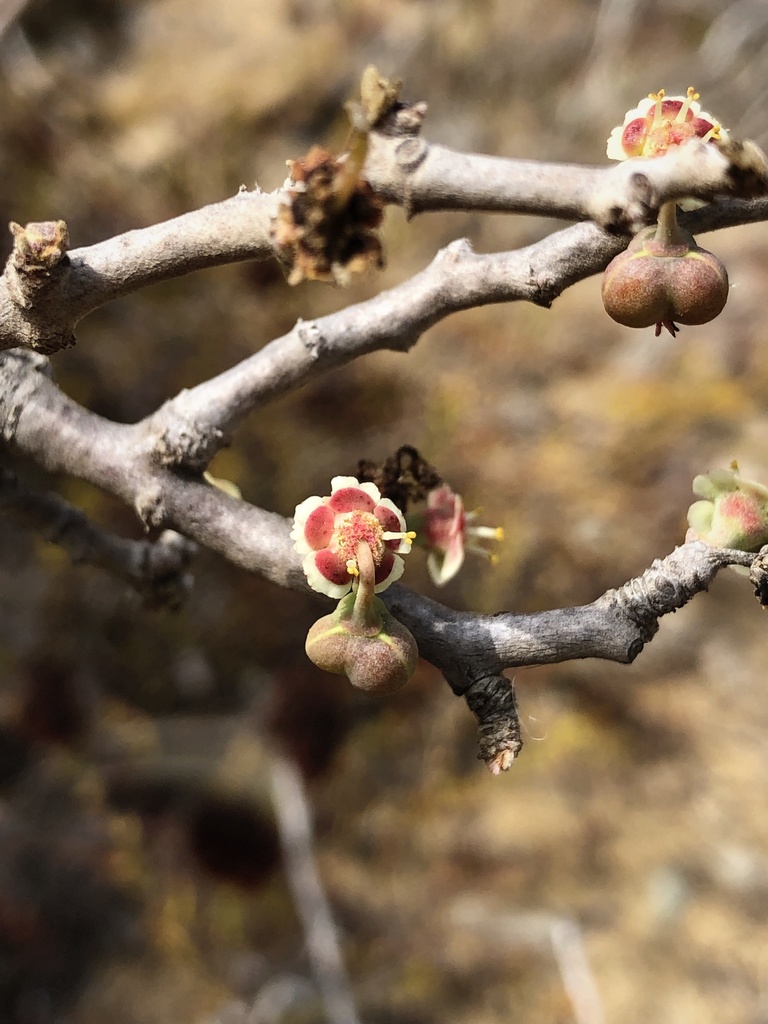
cliff spurge
Euphorbia misera
Euphorbia misera is a semi-succulent shrub in the genus Euphorbia commonly known as the cliff spurge or coast spurge. A drought-deciduous shrub, it is typically found as a gnarled, straggly plant occupying seashore bluffs, hills and deserts. Like other members of its genus, it has a milky sap, which can be found exuding out of the light gray bark when damaged. The alternately-arranged leaves are round and folded in the middle, with small hairs on them. The "flowers" (actually an inflorescence called a cyathium) can be found blooming year-round, and are colored maroon or yellow in the center with 5 white to light-yellow petal-like appendages attached outside. This species is native to the Baja California peninsula and Sonora in Mexico, and the coast of Southern California in the United States, where it is a rare species. It is threatened in some localities by the development of its coastal habitat, which tends to be prime locations for high-end residential and commercial developments.
From the article Euphorbia misera on Wikipedia (CC BY-SA), quoted section by section
Description
Euphorbia misera is a drought-deciduous shrub standing erect or mounding. An acrid, milky sap is exuded when the leaves or branches are ruptured or cut. It has small, rounded, hairy leaves and inflorescences at the tips of the branches. The distinctive flower has a central nectar disc with a bright red appendage with scalloped edges and a light yellow fringe. The fruit is a spherical capsule with lobes containing round, wrinkled gray seeds.
Morphology. The majority of the plant is covered in very fine hairs, except for the stems. The stems are soft and rubbery, covered in a light gray bark, stout, and often gnarled. The stems may reach 5–10 decimetres (1.6–3.3 ft) in length. The branches are semi-succulent and flexible. The pubescent leaves are petioled, on short, lateral spurs placed in a lateral arrangement. The leaf is 0.4–1.5 centimetres (0.16–0.59 in) long, shaped ovate to round, and more or less folded, with entire margins. The base of the leaf is obtuse to rounded, and the tip is rounded. The stipules are thread-like and fringed. The inflorescence is a cyathium, (a structure that looks similar to a traditional flower) with usually a single cyathia at a branch tip or sometimes in the distal axils. The involucre is 2–3 millimetres (0.079–0.118 in) long and bell shaped. There are 5 glands on the cyathium, colored a maroon to yellow. …
Range & habitat
This species is distributed across the Baja California peninsula (the states of Baja California, Baja California Sur) and parts of Sonora in Mexico, and the coast of Southern California in the United States. On the Baja California peninsula, this species is a common and widespread shrub found from the vicinity of Tijuana in northwest Baja California south to the southern Sierra de la Giganta in Baja California Sur, along with adjacent Pacific and Gulf of California islands. Plants found on the San Benito Islands have sometimes been regarded as their own species, Euphorbia benedicta, based on their larger gland appendages and seeds. In Sonora, this species is found on the Gulf coast. In California, this species can be found on coastal bluffs and mesas from Corona Del Mar in Orange County to the international border in San Diego County, along with Santa Cruz, Santa Catalina, and San Clemente islands. A disjunct population is found in the Coachella Valley of Riverside County. This species is found growing on rocky slopes and soils, vertical cliff faces, and coastal bluffs. It is an abundant resident of coastal succulent scrub habitat present in coastal California and Baja California. Habitats vary from bluff margins and coastal mesas to outright desert.
Wikipedia: “Distribution and habitat”
Where it lives
Recorded sightings
—
geo-referenced records in GBIF, from museums, herbaria and field observers.
Drag the globe to turn it. Dots are where records exist, not a range map; darker means more records.
In the stacks
Searching the stacks…
Every page naming Euphorbia misera in the Biodiversity Heritage Library →
This page is assembled live from iNaturalist, GBIF, Wikipedia, the Source Library and the Internet Archive. It is not yet part of the hand-edited codex. iNaturalist taxon 77116.