 NL·0584
Herbarium of the Nature Library
- Name
- Otis tarda
- Family
- Otididae
- Native to
- Iberia, central Europe (Hungary, Austria, Germany), Morocco, Turkey, Russia, Kazakhstan, Central Asia and Mongolia to China; reintroduced to England
- Habitat
- Steppe, Temperate grassland, Farmland
On eBird ↗
Great Bustard
Live sightings near you, the range map, bar charts of when it is seen, and Macaulay Library photos and recordings.
Great bustard
Otis tarda
Also calledToy (Turkish) · Mish-morgh (Persian) · Avutarda (Spanish) · Großtrappe (German) · Outarde barbue (French) · Túzok (Hungarian) · Drofa (Russian)
One of the heaviest flying birds on Earth. Males transform themselves in spring into billowing white 'foam baths' of feathers to impress females on open steppe and farmland. Most of the world population now lives in Spain.
The great bustard is a bird in the bustard family, and the only living member of the genus Otis. It breeds in open grasslands and farmland from northern Morocco, South and Central Europe to temperate Central and East Asia. European populations are mainly resident, but Asian populations migrate farther south in winter. Endangered as of 2023, it had been listed as a Vulnerable species on the IUCN Red List since 1996. Wikipedia
What it can do
- iMales weigh up to about 16 kg, contesting the title of heaviest flying animal
- iiDisplaying males turn wings and tail inside out to become a mass of white plumes
- iiiMales grow long white whisker feathers in the breeding season
- ivLek-like display grounds are used for generations
In the field
Field marks
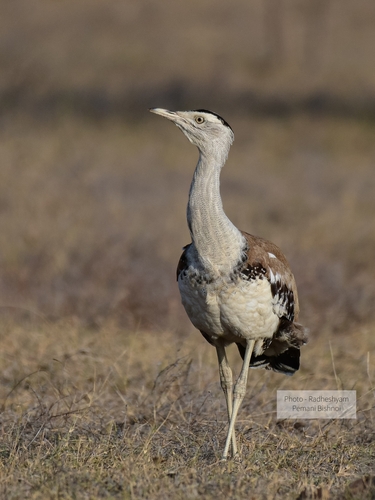
- aVery large, stately, goose-sized ground bird with long neck and legs
- bUpperparts golden-buff barred with black
- cGrey head and neck; males with chestnut breast band and white whiskers
- dHuge white wing panels in flight
- Voice
- Generally silent; a low barking or grunting at close quarters.
- Not to be confused with
- Little bustard is much smaller (pheasant-sized) with a black-and-white neck in males. Asian houbara is sandy with a black neck plume. Female great bustard is far smaller than the male and can be mistaken for a goose at distance.
- Where to see it
- Villafáfila and Extremadura in Spain, Castro Verde in Portugal, Hungary's Dévaványa, Salisbury Plain in England (reintroduced).
- When
- Resident in Iberia; partially migratory in Russia and Central Asia; display Mar–Apr
Listen
Looking for field recordings…
Life & habits
- Diet
- Plant shoots, leaves, seeds, legumes; insects such as beetles and grasshoppers, especially for chicks
- Habitat
- Open steppe, extensive cereal farmland and pasture
- Size
- Males 90–105 cm, 5.8–16 kg; females 75–85 cm, 3.3–5.3 kg; wingspan 1.9–2.6 m
- Lifespan
- Typically about 10 years; some exceed 15, with a maximum recorded age of 28
Males gather on traditional display grounds in spring, where females visit to choose a mate.
Where it lives
Recorded sightings
—
geo-referenced records in GBIF, from museums, herbaria and field observers.
Native range
Iberia, central Europe (Hungary, Austria, Germany), Morocco, Turkey, Russia, Kazakhstan, Central Asia and Mongolia to China; reintroduced to England
Drag the globe to turn it. Dots are where records exist, not a range map; darker means more records.
In the old herbals & bestiaries
Woodcuts and engravings matched from the Source Library’s scanned books by name. Plates marked “relative” show a close kin rather than this exact species. Click a plate to read the page it came from, with translation.


In the stacks
Searching the stacks…
Every page naming Otis tarda in the Biodiversity Heritage Library →
Marginalia
Bustards were exterminated in Britain by the 1830s; the bird still appears on Wiltshire's county emblem, and a reintroduction using chicks from Russia and Spain began on Salisbury Plain in 2004.
Curiosity
Its Latin name 'tarda' means 'slow', but despite its weight it is a strong flier.
Kinship



Fact-checked: 1 correction made to this sheet. Photographs: iNaturalist contributors under the licences shown. Records: GBIF.org. Historical plates: Source Library (CC BY-SA 4.0; originals public domain). Summary text: Nature Library editors and Wikipedia (CC BY-SA). Medicinal and edibility notes are historical and educational, not advice. iNaturalist taxon 77.