- Animals
- ›Chordates
- ›Vertebrates
- ›Reptiles
- ›Snakes and Lizards
- ›Snakes
- ›Colubrid Snakes
- ›Colubrine Snakes
- ›Zamenis
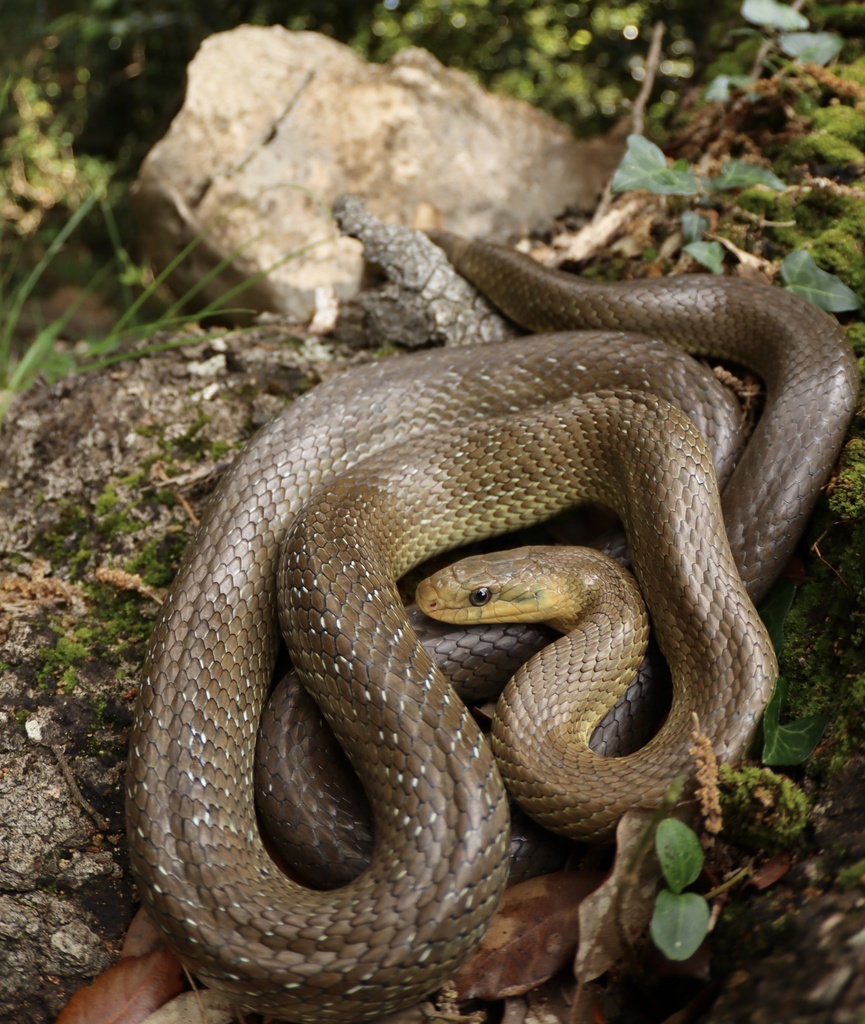
Aesculapian Snake
Zamenis longissimus
The Aesculapian snake (Zamenis longissimus, previously Elaphe longissima) is a species of non-venomous constrictor snake native to Europe, a member of the subfamily Colubrinae of the family Colubridae. Growing up to 2 metres (6.6 ft) in length, it is among the largest European snakes, similar in size to the four-lined snake (Elaphe quatuorlineata) and the Montpellier snake (Malpolon monspessulanus). The Aesculapian snake has been of cultural and historical significance for its role in ancient Greek, Roman, and Illyrian mythology and derived symbolism.
From the article Aesculapian snake on Wikipedia (CC BY-SA), quoted section by section
Description
Zamenis longissimus hatches at around 30 cm (11.8 in). Adults are usually from 110 cm (43.3 in) to 160 cm (63 in) in total length (tail included), but can grow to 200 cm (79 in), with the record size being 225 cm (7.38 ft). Expected body mass in adult Aesculapian snakes is from 350 to 890 g (0.77 to 1.96 lb). It is dark, long, slender, and typically bronzy in colour, with smooth scales that give it a metallic sheen. Juveniles can easily be confused with juvenile grass snakes (Natrix natrix) and barred grass snakes (Natrix helvetica), because juvenile Aesculapians also have a yellow collar on the neck that may persist for some time in younger adults. Juvenile Z. longissimus are light green or brownish-green with various darker patterns along the flanks and on the back. Two darker patches appear in the form of lines running on the top of the flanks. The head in juveniles also features several distinctive dark spots, one hoof-like on the back of the head in-between the yellow neck stripes, and two paired ones, with one horizontal stripe running from the eye and connecting to the neck marks, and one short vertical stripe connecting the eye with the fourth to fifth upper labial scales.
Adults are much more uniform, sometimes being olive-yellow, brownish-green, sometimes almost black. …
Range & habitat
The contiguous area of the previous nominotypical subspecies, Zamenis longissimus longissimus, which is now the only recognized monotypic form, covers most of France except in the north (up to about the latitude of Paris), the Spanish Pyrenees and the eastern side of the Spanish northern coast, Italy (except the south and Sicily), all of the Balkan peninsula down to Greece and Asia Minor and parts of Central and Eastern Europe up until about the 49th parallel in the eastern part of the range (Switzerland, Austria, South Moravia (Podyjí/Thayatal in Austria) in the Czech Republic, Hungary, Slovakia, south Poland (mainly Bieszczady/Bukovec Mountains in Slovakia), Romania, south-west Ukraine). Further isolated populations have been identified in western Germany (Schlangenbad, Odenwald, lower Salzach, plus one - near Passau - connected to the contiguous distribution area) and the northwest of the Czech Republic (near Karlovy Vary, the northernmost known current natural presence of the species). Also found in a separate enclave south of Greater Caucasus along the Russian, Georgian and Turkish northeastern and eastern shores of the Black Sea. Two further enclaves include the first around Lake Urmia in northern Iran, and on the northern slopes of Mount Ararat in east Turkey, roughly halfway between the former and the Black Sea habitats. V.L. …
Wikipedia: “Geographic range”
What it does
The main food source of Zamenis longissimus is small mammals such as shrews, moles, and rodents up to the size of rats. A 130 cm (51 in) adult specimen has been reported to have overpowered a 200 g (7.1 oz) rat. It also eats birds as well as bird eggs and nestlings. It suffocates its prey by constriction, though harmless smaller mouthfuls may be eaten alive without constriction, or simply crushed on eating by jaws. Juveniles mainly eat lizards and arthropods, later small rodents. Other snakes and lizards are taken, but adults are rarely taken. Predators include badgers and other mustelids, foxes, wild boar (mainly by digging up and eating egg clutches and hatchlings), hedgehogs, and various birds of prey (though there are reports of adults successfully standing their ground). Juveniles may be eaten by smooth snakes and other reptilivorous snakes. Domestic animals such as cats, dogs, and chickens are a threat mainly to juveniles and hatchlings; rats may be dangerous to inactive adults in hibernation. In areas of concurrent distribution, the snake is also preyed upon by introduced North American raccoons and east Asian raccoon dogs.
Wikipedia: “Diet and predators”
In human culture
The Aesculapian snake was first described by Josephus Nicolaus Laurenti in 1768 as Natrix longissima, later it was also known as Coluber longissimus and for the most part of its history as Elaphe longissima. The current scientific name of the species based on revisions of the large genus Elaphe is Zamenis longissimus. Zamenis is from Greek ζαμενής "angry", "irritable", "fierce", longissimus comes from Latin and means "longest"; the snake is one of the longest over its range. The common name of the species, Aesculape in French and its equivalent in other languages, refers to the classical god of healing (Greek Asclepius and later Roman Aesculapius) whose temples the snake was encouraged around. It is surmised that the typical depiction of the god with his snake-entwined staff features the species. Later from these, modern symbols developed of the medical professions as used in a number of variations today. The species, along with four-lined snakes, is carried in an annual religious procession in Cocullo in central Italy, which is of separate origin and was later made part of the Catholic calendar.
Wikipedia: “History”
Where it lives
Recorded sightings
—
geo-referenced records in GBIF, from museums, herbaria and field observers.
Drag the globe to turn it. Dots are where records exist, not a range map; darker means more records.
In the old herbals & bestiaries

Jan Jonston — Naeukeurige beschryving van de natuur der viervoetige dieren (1660)
Jan Jonston · 1660 · p.559

Ulyssis Aldrovandi ... serpentum et draconum historiae libri duo
Ambrosini, Bartolommeo · 1640 · p.281

Serpentum et Draconum Historiae
Ulisse Aldrovandi · 1640 · p.288

History of Serpents and Dragons
Ulisse Aldrovandi · 1640 · p.280

History of Serpents and Dragons
Ulisse Aldrovandi · 1640 · p.283

Serpentum et Draconum Historiae
Ulisse Aldrovandi · 1640 · p.291
In the stacks
Searching the stacks…
Every page naming Zamenis longissimus in the Biodiversity Heritage Library →
This page is assembled live from iNaturalist, GBIF, Wikipedia, the Source Library and the Internet Archive. It is not yet part of the hand-edited codex. iNaturalist taxon 74009.