- Animals
- ›Chordates
- ›Vertebrates
- ›Reptiles
- ›Snakes and Lizards
- ›Snakes
- ›Colubrid Snakes
- ›Colubrine Snakes
- ›Zamenis
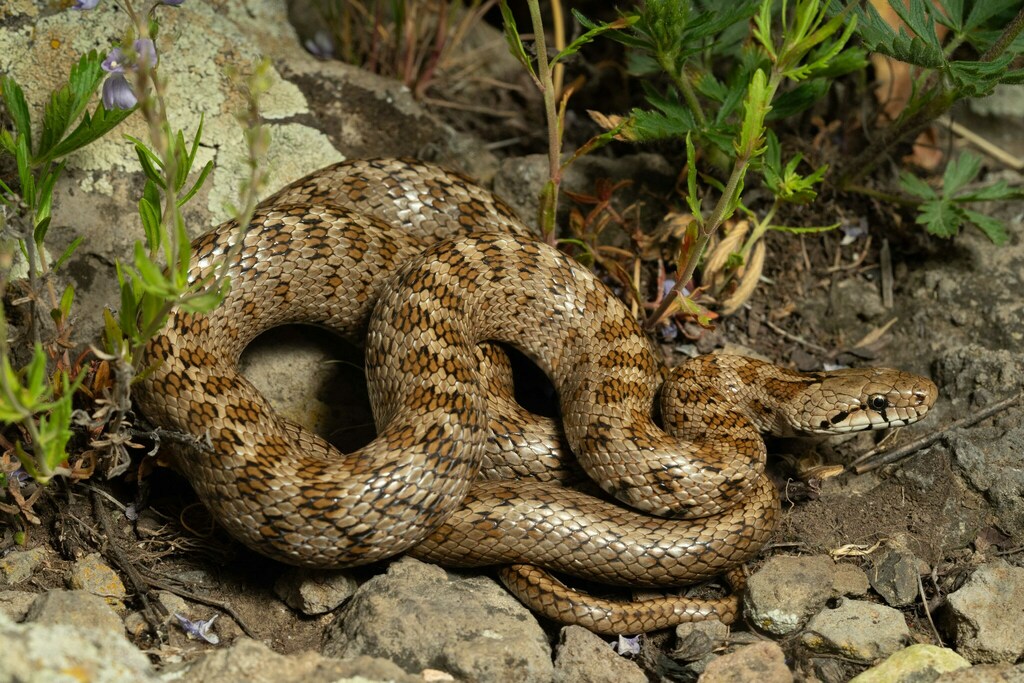
Caucasian Ratsnake
Zamenis hohenackeri
The Transcaucasian ratsnake (Zamenis hohenackeri), also commonly known as the Gavand snake, is a species of nonvenomous ratsnake in the subfamily Colubrinae of the family Colubridae. The species is native to Western Asia and the Middle East. There are three recognized subspecies.
From the article Transcaucasian ratsnake on Wikipedia (CC BY-SA), quoted section by section
Description
Zamenis hohenackeri may attain a total length of 65 cm (26 in), which includes a tail 11 cm (4.3 in) long. Dorsally, it is gray with four alternating series of dark brown spots. Ventrally, it is reddish or yellowish, marbled or spotted with gray. On the head, there is a diagonal black streak from the eye to the corner of the mouth, and a vertical black line below the eye.
Range & habitat
Zamenis hohenackeri is found in Armenia, Azerbaijan, Georgia, Iran, Iraq, Israel, Lebanon, southwestern Russia, Syria, and Turkey.
Wikipedia: “Geographic range”
In human culture
The specific name, hohenackeri, is in honor of Rudolph Friedrich Hohenacker, who was a Swiss missionary, physician, and naturalist.
Wikipedia: “Etymology”
Where it lives
Recorded sightings
—
geo-referenced records in GBIF, from museums, herbaria and field observers.
Drag the globe to turn it. Dots are where records exist, not a range map; darker means more records.
In the stacks
Searching the stacks…
Every page naming Zamenis hohenackeri in the Biodiversity Heritage Library →
This page is assembled live from iNaturalist, GBIF, Wikipedia, the Source Library and the Internet Archive. It is not yet part of the hand-edited codex. iNaturalist taxon 74007.