- Animals
- ›Arthropods
- ›Hexapods
- ›Insects
- ›Winged and Once-winged Insects
- ›True Bugs, Hoppers, Aphids, and allies
- ›True Hoppers
- ›Planthoppers
- ›Fulgoroidea
- ›Lanternflies
- ›Aphaeninae
- ›Aphaenini
- ›Lycorma
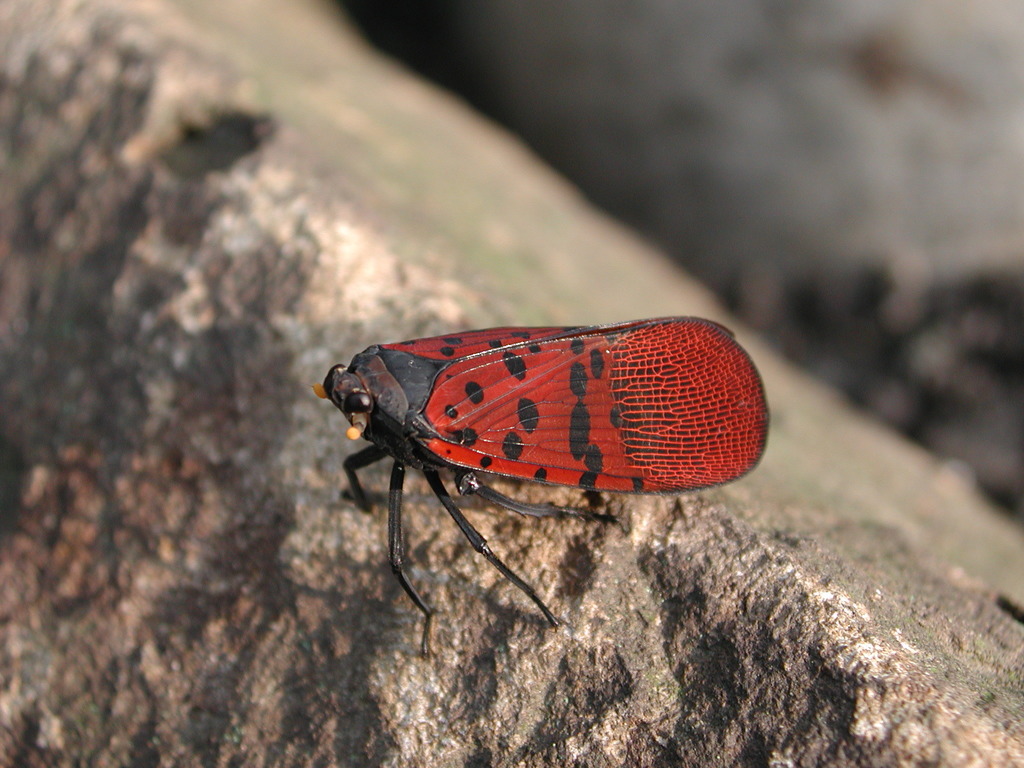
Lycorma meliae
Lycorma meliae is a planthopper species endemic to Taiwan, with multiple, dramatically different color morphs depending on the life stage. The species was described by Masayo Kato in Taiwan in 1929, and is the only member of its genus confirmed to be native to the island. In 1929, a specimen of L. meliae was originally described as a separate species, L. olivacea, also by Kato. These two taxon names were declared synonymous in 2023. L. meliae undergoes four instar stages before achieving adulthood and generally only survive until the winter.
From the article Lycorma meliae on Wikipedia (CC BY-SA), quoted section by section
Description
Males have a body length that ranges from 22.2 millimetres (0.87 in) to 28.5 millimetres (1.12 in). Females are larger, with a body length ranging from 26.5 millimetres (1.04 in) and 32.2 millimetres (1.27 in). Male forewing (tegmen) length ranges from 18.9 millimetres (0.74 in) to 25 millimetres (0.98 in); female forewing length ranges from 23.2 millimetres (0.91 in) to 27.8 millimetres (1.09 in). The head is short, broad, and angled upward; it ranges from a brown to black. The back of the head is marked with two dark brown projections, both of which have a ridge running down the back. There are two longitudinal ridges also running down each side of these. The clypeus is broad and the labium (a part of the mouth) is long but does not reach the abdomen. The antennae are both a marigold orange-yellow. The prothorax and mesonotum are both black, as is the abdomen. The margins of the abdominal tergites are sometimes a marigold orange-yellow. The basal 3/5ths of the forewings range from a bright red to blue. These sections are covered in black and brown spots that vary in size, and sometimes have a white powdery appearance. The rest is covered in a reticulate pattern of veins. The hindwings vary from pink to light blue, often featuring brown spots. The basal third of the hindwings are brown. The legs are generally dark brown to black. …
Range & habitat
Lycorma meliae is endemic to the island of Taiwan. The following cladogram shows the phylogenetic position of L. meliae among select members of the tribe Aphaenini, based upon comparison of mitochondrial DNA:
Wikipedia: “Distribution and evolution”
What it does
L. meliae is hemimetabolous, meaning that it has nymphal stages before becoming an adult, rather than larval and pupal stages. L. meliae lays its egg clusters, coated in a waxy layer, during the late fall to early winter seasons. The eggs develop until late spring when L. meliae nymphs emerge. In total, L. meliae nymphs pass through four instar stages before achieving adulthood. The chinaberry tree Melia azedarach is a known host for L. meliae. Lycorma meliae, along with the rest of the genus Lycorma, are parasitized by the eupelmid wasp Anastatus orientalis and by Dryinus sinicus, a dryinid wasp.
Wikipedia: “Life cycle and ecology”
Listen
Looking for field recordings…
Where it lives
Recorded sightings
—
geo-referenced records in GBIF, from museums, herbaria and field observers.
Drag the globe to turn it. Dots are where records exist, not a range map; darker means more records.
In the stacks
Searching the stacks…
Every page naming Lycorma meliae in the Biodiversity Heritage Library →
This page is assembled live from iNaturalist, GBIF, Wikipedia, the Source Library and the Internet Archive. It is not yet part of the hand-edited codex. iNaturalist taxon 737740.