- Animals
- ›Chordates
- ›Vertebrates
- ›Birds
- ›Swifts and Hummingbirds
- ›Hummingbirds
- ›Brilliants, Coquettes, and Allies
- ›Brilliants and Allies
- ›Urosticte
On eBird ↗
Rufous-vented Whitetip
Live sightings near you, the range map, bar charts of when it is seen, and Macaulay Library photos and recordings.
Rufous-vented Whitetip
Urosticte ruficrissa
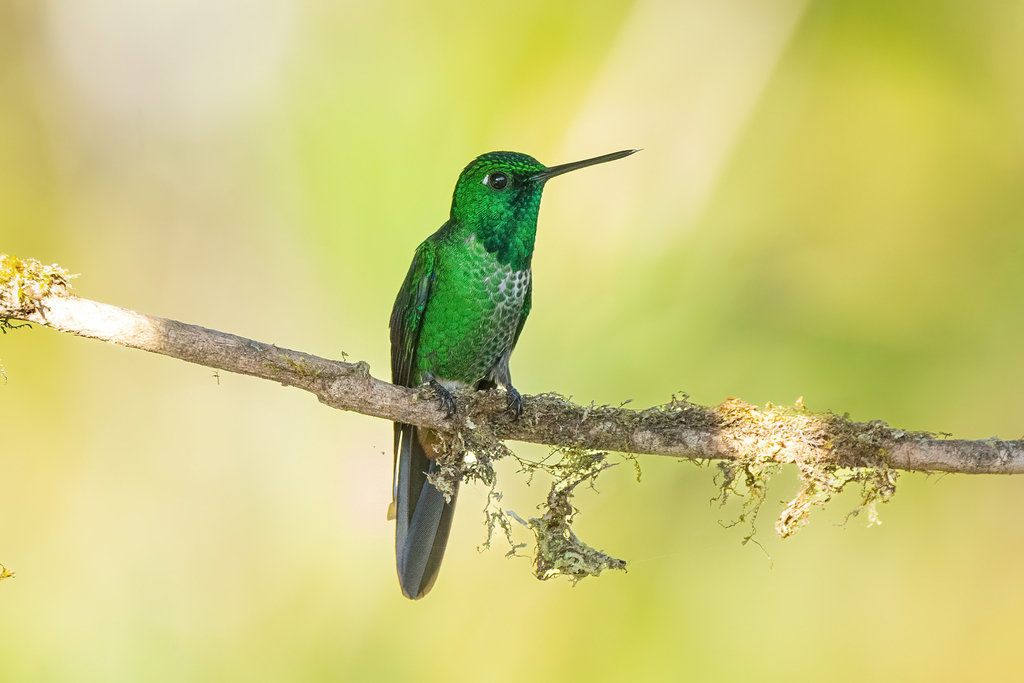
The rufous-vented whitetip (Urosticte ruficrissa) is a species of hummingbird in the Trochilidae family. It is found in Colombia and Ecuador. Its natural habitat is subtropical or tropical moist montane forests.
From the article Rufous-vented whitetip on Wikipedia (CC BY-SA), quoted section by section
Description
The rufous-vented whitetip is 9 to 10 cm (3.5 to 3.9 in) long and weighs 4 to 4.2 g (0.14 to 0.15 oz). Both sexes have a medium-length straight black bill and a prominent white stripe behind the eye. Both have shining green upperparts and a forked tail, though the female's is not as deeply indented as the male's. Males have shining green underparts with buffy undertail coverts. The tail is dusky bronze; the central feathers have wide white tips. Females have white underparts spotted with green. The tail is dusky bronze with white tips on the outermost feathers. Juveniles are similar to females with the addition of brown edges on the head feathers.
Range & habitat
The rufous-vented whitetip is found on the eastern slope of the Andes from Colombia's Huila and Nariño departments south through eastern Ecuador into Peru's Department of San Martín. It inhabits the interior and edges of partly open montane forest and cloudforest between elevations of 1,600 and 2,400 m (5,200 and 7,900 ft).
Wikipedia: “Distribution and habitat”
What it does
The rufous-vented whitetip mostly forages from near the ground to the forest's mid level. It collects nectar from a variety of flowering plants including bromeliads and members of genera Clusia and Palicourea. In addition to feeding on nectar it captures insects by hawking from a perch and sometimes by gleaning from vegetation.
Wikipedia: “Feeding”
Listen
Looking for field recordings…
Where it lives
Recorded sightings
—
geo-referenced records in GBIF, from museums, herbaria and field observers.
Drag the globe to turn it. Dots are where records exist, not a range map; darker means more records.
In the stacks
Searching the stacks…
Every page naming Urosticte ruficrissa in the Biodiversity Heritage Library →
This page is assembled live from iNaturalist, GBIF, Wikipedia, the Source Library and the Internet Archive. It is not yet part of the hand-edited codex. iNaturalist taxon 73550.